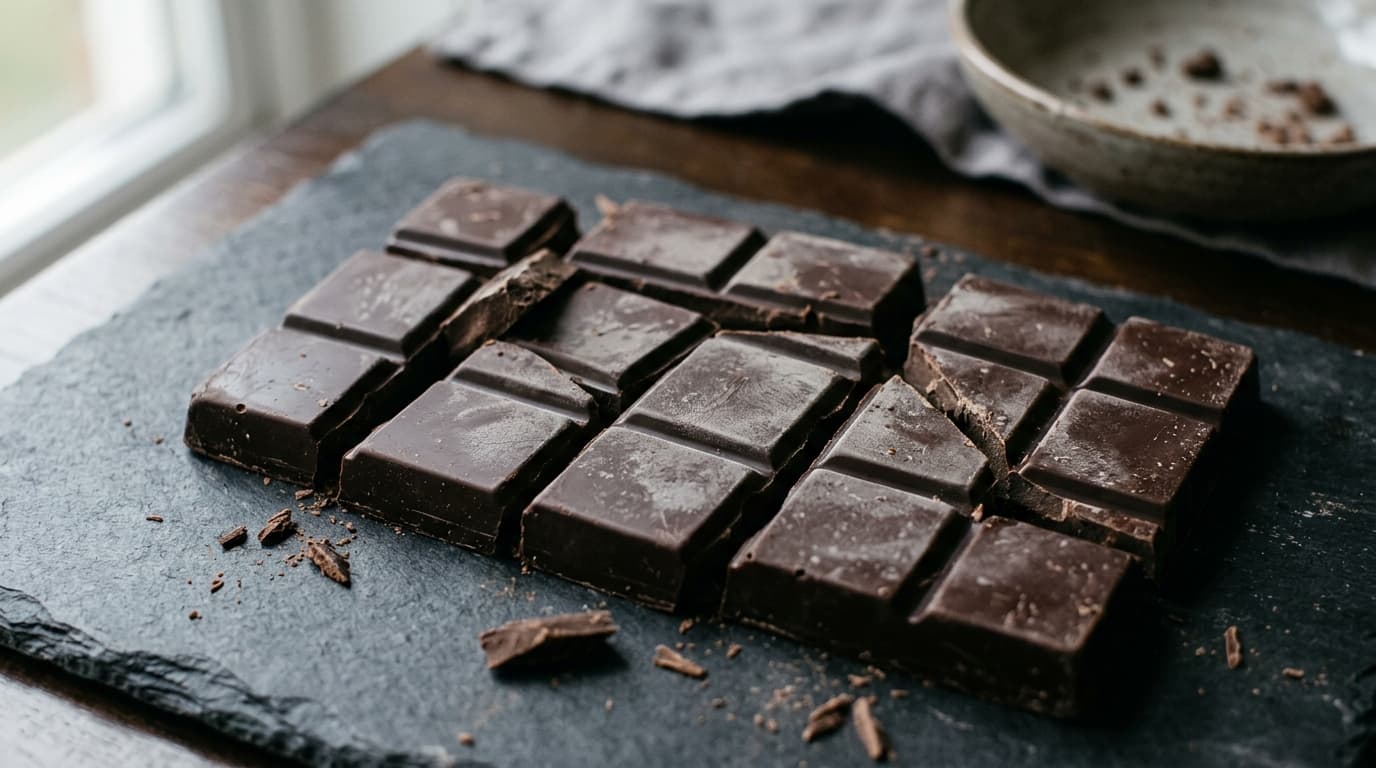
No, the grey film that dulls a bar is not a manufacturing flaw or the start of mould: it is cocoa butter completing, weeks after purchase, a crystal transformation that began the moment it was poured. Two distinct mechanisms are at play, and one of them reaches even perfectly tempered chocolate.
Cocoa butter exists in six crystal forms
Cocoa butter is not a simple fat. Depending on the speed and temperature of cooling, its molecules settle into six different crystal networks, numbered I to VI by the chemists who first described them back in the 1960s. Each has its own melting point, its own hardness, its own feel in the mouth.
A chocolatier who tempers is doing nothing more than forcing that choice. The target is form V, the only one that delivers a clean snap, real gloss, and enough contraction on cooling to release a praline from its mould without a fight. Our guide to tempering chocolate covers how to get there at home, by seeding or over a bain-marie. The other five forms are real enough, but none of them gives that result: forms I to III stay soft and dull, form IV is decent but no more, and form VI, which we come back to below, is the most stable of all and the least pleasant to eat.
| Form | Name given by chemists | Approximate melting point | Result when unmoulding |
|---|---|---|---|
| I | gamma | 16 to 18°C | soft, crumbly, no snap |
| II | alpha | around 23°C | soft, crumbly |
| III | unstable beta prime | around 25°C | firm but dull |
| IV | beta prime | around 27°C | firm, decent snap |
| V | beta | around 34°C | glossy, clean snap: the form tempering aims for |
| VI | stable beta | around 36°C | dull and powdery: this is fat bloom |
A couverture maker like Callebaut or Belcolade sells nothing more than a product calibrated to crystallise cleanly into form V. That's exactly what the fluidity spec sheet attached to every professional bag is for.
Why isn't the glossiest form also the most stable?
Because gloss and stability don't measure the same thing. Chemists call form V a metastable state: it needs the least energy to form under normal tempering conditions, but it is not the lowest-energy state cocoa butter molecules can reach. Form VI is. Rather like diamond and graphite, two possible arrangements of the same carbon, where one shines and the other doesn't, yet it's the second that represents the truly stable state over the long run.
Give any crystalline material enough time and a bit of warmth, and it slides toward the most stable state it can reach. For a bar, that slide takes weeks, sometimes months, and it speeds up with every swing in temperature: an afternoon of sun through a window, a radiator too close by, a trip to the fridge followed by a return to the counter. Each cycle melts and then recrystallises a thin surface layer, and with every pass, a little more matter joins form VI rather than form V.
It isn't automatic: a shift toward form VI doesn't always produce a visible film. But it is the cause most widely blamed for fat bloom, and it explains a fact few people accept easily: even perfectly tempered chocolate will eventually bloom. Just far more slowly than chocolate that was poorly crystallised from the start.
Perfectly tempered chocolate doesn't escape bloom. It only buys itself more time.
Touch tells apart what the eye confuses
To the eye, the two blooms look alike: a grey or whitish film, dull, spread evenly across the surface. Under a finger, they tell two opposite stories.
- Fat bloom: a smooth, slightly greasy surface that melts under the warmth of a finger within seconds. A drop of water sits on it as a bead, without spreading.
- Sugar bloom: a rough, almost sandy surface that does not melt under a finger. A drop of water vanishes into it at once, soaked up by the sugar crystals.
- Neither one forms raised, isolated spots. A scatter of fuzzy dots, green, grey and cottony, or black, is no longer bloom: it's mould, and that case, rare on properly stored chocolate, is covered separately in our article on expired chocolate.
The test takes ten seconds and it settles the question better than a glance, especially on milk or white chocolate, where the film shows up less clearly than against a dark background.
Can you retemper chocolate that has bloomed?
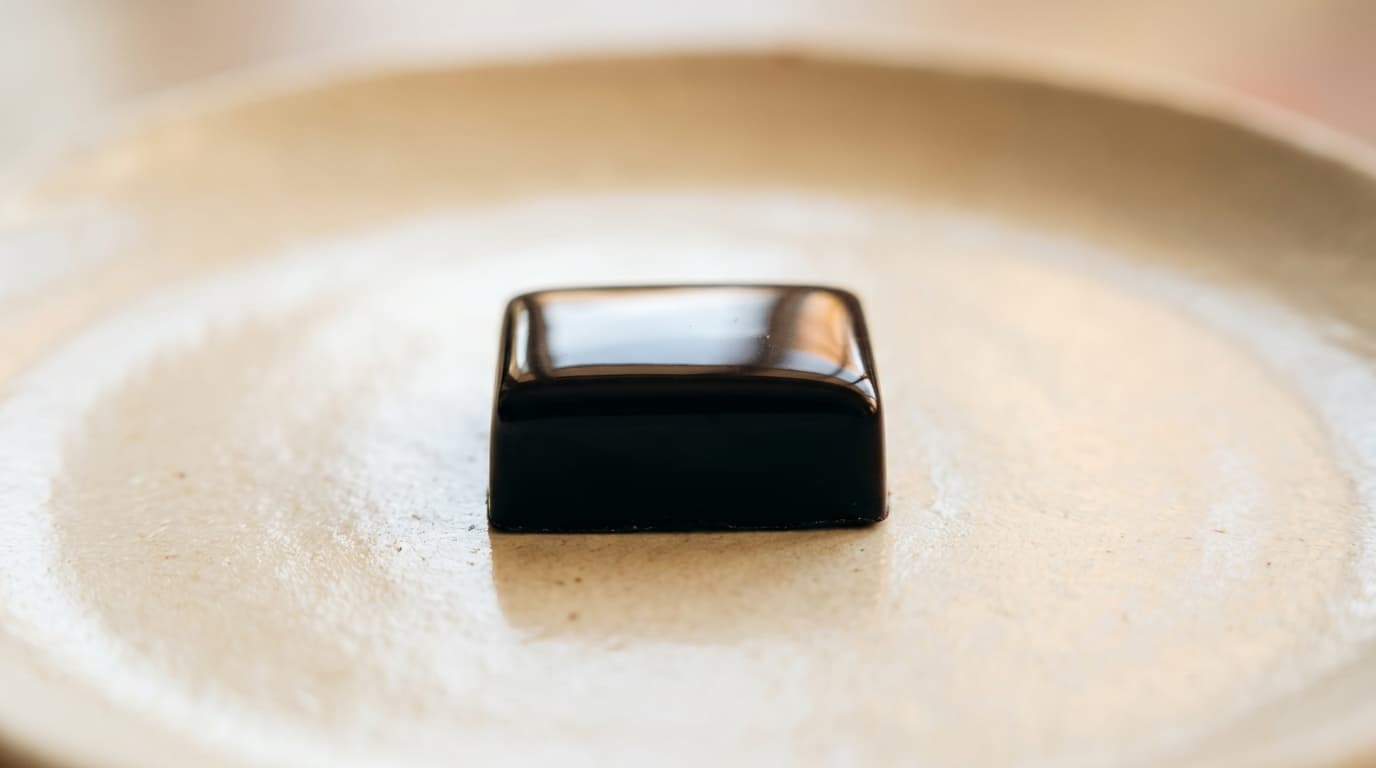
Yes, if it's fat, never if it's sugar. The fat regains its form V if you melt it down completely and run the crystallisation curve again from the start, the method covered in our tempering guide. The water behind sugar bloom never leaves on reheating: melting it back down gives a paste that seizes instead of flowing, fine for a ganache, ruined for enrobing. For an already-filled praline the question barely comes up. You cannot melt down a shell without losing everything: bloom there is a signal, not a problem to fix.
How long before it actually blooms?
Four days, under the harshest conditions I could recreate without a lab. The test, run from 20 to 27 September 2026: two squares cut side by side from the same bar of Côte d'Or dark tasting chocolate at 70%, bought the same day at a Brussels Delhaize, to rule out any difference in batch or recipe.
The first square stayed in a kitchen drawer, stable around 17-18°C for the full seven days of the test. The second went through a daily round trip: two hours in the fridge at 4°C, then the rest of the day on the counter, wrapper simply folded back, never sealed.
The cycled square showed its first streaks after just the fourth pass, on 23 September: a dull, smooth film that melted under a finger with no grain at all, the exact signature of fat bloom rather than sugar bloom. The square left stable still showed nothing on the seventh day, 27 September. Both pieces tasted identical at the tasting that same day; only the gloss and the snap had gone from the first.
This is not a lab measurement, and another chocolate would likely react a little differently depending on its cocoa butter content. But four two-hour cycles are enough to show the mechanism sped up: it's the repetition of the thermal shock that counts, not its total duration.
Two blooms, one real precaution
Prevention comes down to one line, already covered in our guide to storing Belgian chocolate: a stable temperature between 15 and 18°C, away from moisture. What changes here is the reason why. It isn't heat itself that pushes chocolate toward form VI, it's the gap between two temperatures, repeated. Chocolate kept at 20°C year-round blooms more slowly than chocolate cycled between 4°C in the fridge and 24°C on the table, even though its average is higher.
A detail few people know: milk chocolate generally blooms more slowly than dark, and white chocolate more slowly still. It isn't a matter of more careful manufacturing. The milk fat both of them contain disrupts the regular stacking of cocoa butter crystals and slows the drift toward form VI. Dark chocolate, richer in pure cocoa butter, has nothing to hold the movement back, which is why it shows its veil first, and shows it most clearly, against its dark background.
One last point to close on. Bloom has never made chocolate unsafe, and it says nothing about its best-before date, a subject covered on its own in our article on expired chocolate. It only says that at some point, somewhere between the factory and the cupboard, the cocoa butter got one more chance to move closer to its most stable state. On that one point, physics doesn't negotiate.
Praline, praliné and gianduja sorts out the vocabulary if the glossary side of chocolate interests you, and our ranking remains the best starting point for comparing Belgian houses on other criteria.
Pralines & spécialités comparator
Compare all pralines & spécialités side by side.
Compare now →
Frequently asked questions
Bruxelloise pur sucre, Margaux arpente les chocolateries belges depuis plus de dix ans. Ancienne pâtissière reconvertie dans le journalisme gourmand, elle goûte, compare et raconte le chocolat belge sans complaisance — des grandes maisons aux ateliers de quartier.