
A ballotin bought on rue au Beurre, forgotten two days on a windowsill, and that's twenty euros of pralines turned waxy. Belgian chocolate keeps between 15 and 18 °C, dry, away from light and smells. Here is the full guide, from the cupboard to your hand luggage.
What temperature should Belgian chocolate be stored at?
Between 15 and 18 °C, somewhere dry, dark and free of strong smells. That's the range Belgian chocolatiers recommend themselves, and it applies to a ballotin of pralines just as much as to an opened bar.
Cocoa butter is an unstable fat: properly tempered, it forms fine crystals that give chocolate its snap and its clean melt at 34 °C, just below body temperature. Heat it too much and the structure breaks; cool it too fast and it breaks too. Callebaut's storage documentation — the Belgian manufacturer supplying couverture to a large share of the country's chocolatiers — gives a range of 12 to 20 °C and a maximum relative humidity of 70 %. The 15-18 °C window is the comfortable middle of that band.
In practice, the right spot at home is rarely the kitchen: too warm, too humid, too smelly. A hallway cupboard, a dry cellar or a north-facing bedroom all do better. At tasting, the difference is obvious between a praline kept at 17 °C and the same praline taken from a 26 °C living room — the second one sticks to the palate instead of melting.
15-18 °C
Ideal range
70 %
Maximum humidity
34 °C
Melting point
Should pralines be kept in the fridge?
No, unless the heat leaves you no choice. The fridge stacks up the three enemies of chocolate: cold (5 °C instead of 16), damp, and the smells of everything else inside it.
Cold causes sugar bloom. When you take the box out, condensation settles on the pralines, dissolves the surface sugar, then evaporates and leaves white crystals and a sandy texture. As for smells, cocoa butter soaks them up like a sponge: an open ballotin sitting next to a ripe cheese is beyond saving.
If your flat goes above 25 °C, the fridge still becomes the lesser evil. The protocol: box closed, slipped into an airtight bag or container, placed in the vegetable drawer (the least cold and most stable zone), then taken out 30 minutes before eating, without opening the container until it's back to room temperature. That's exactly what Leonidas advises on its own blog for getting through summer.
How long do Belgian pralines keep?
It all depends on the filling. A ganache contains cream, therefore water: it lives a few weeks. A praliné, fatty and dry, holds several months. A dark bar, one to two years.
Leonidas, which makes its fresh pralines in Belgium and restocks its shops weekly, states an average shelf life of 8 to 12 weeks — while recommending you eat them within the month. At Neuhaus, a classic ballotin works the same way. At Pierre Marcolini, where batches are shorter and the ganaches more worked, the window is tighter still: we tasted a plain ganache three days after buying, then again three weeks later, and the second had lost half its length on the palate.
| Type of chocolate | Best window | Reasonable limit |
|---|---|---|
| Fresh ganache praline | 2 to 4 weeks | 8 to 12 weeks |
| Fresh truffle | 1 to 2 weeks | 1 month |
| Praliné or gianduja praline | 2 to 3 months | 6 months |
| Dark bar (Callebaut, Galler, Côte d'Or) | 12 months | 24 months |
| Milk or white bar | 8 to 10 months | 12 months |
| Marzipan, coated fruit paste | 1 month | 3 months |
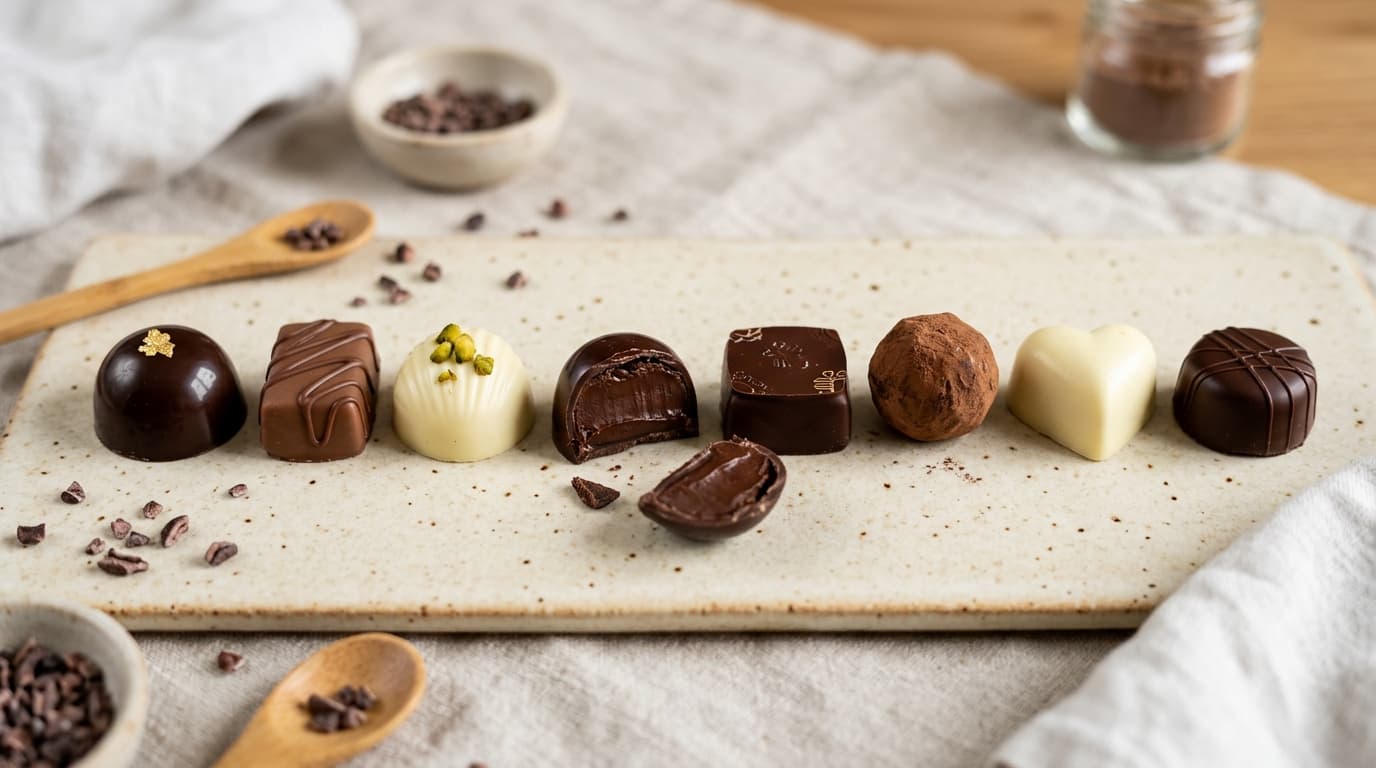
Why does chocolate turn white, and can you still eat it?
Yes, bloomed chocolate is perfectly safe. The grey film is neither mould nor contamination: it's cocoa butter or sugar risen to the surface. The self-check guide for the Belgian chocolate sector published by AFSCA, the federal food safety agency, classes chocolate among the lowest microbiological risk foods — its water activity is far too low for anything to grow in it.
There are two kinds of bloom, and they tell different stories. Fat bloom comes from a heat shock: the fat melts, migrates to the surface and recrystallises as a dull grey film. Sugar bloom comes from moisture: water condenses on the chocolate, dissolves the sugar, evaporates and leaves rough crystals behind. Touch tells you which is which — fat bloom is greasy and smooth, sugar bloom scratches under the finger.
What changes is the pleasure. Bloomed chocolate has lost its snap and some of its volatile aromas. For a bar, there is a fix: melt it down and re-temper it, or use it for baking where looks no longer matter. For a fresh praline, there's nothing to rescue — blooming there almost always means the texture went through a bad time too.
Chocolate that blooms isn't telling you it has gone off. It's telling you it got too hot, or too cold, and that somebody stored it badly.
How do you store pralines properly, step by step?
Five minutes of work when you get back from the shop, no expensive gear, and a ballotin that lasts three times longer.
Kit: an airtight box (€5 to €15 in any supermarket), cling film or a zip bag, a pencil. Time: 5 minutes. Cost: the price of the box, once.
- Take the ballotin out of the paper bag as soon as you get home. The bag protects nothing and traps moisture if it caught the rain.
- Write the purchase date in pencil under the box. It's the only reliable marker for pralines sold by weight.
- Close the ballotin without packing it tight. Pralines shouldn't touch or slide around: a cracked shell oxidises faster.
- Slide the whole thing into an airtight box. That barrier, more than the location, is what keeps out smells and moisture.
- Pick the coolest, most stable spot in the home — hallway cupboard, dry cellar, north-facing bedroom. Avoid the top of the fridge, the window and the kitchen.
- Once the box is open, put the lid back after every serving and finish it within the week.
How do you transport Belgian chocolate in summer or on a plane?
In a cool bag, with an ice pack wrapped in a cloth and never touching the box. The aim isn't to chill the chocolate, but to stop it going above 22 °C.
Planes are less risky than people think: solid chocolate counts as a solid food and goes into hand luggage with no restriction, in a cabin held around 22 °C. The real trap is the car. A boot in full sun goes well past 50 °C: fifteen minutes are enough to turn a ballotin into a puddle. If you're bringing pralines back from Brussels or Bruges, keep them inside the car, in the shade, never in the boot.
For a postal shipment in July, better to wait. Belgian chocolatiers often suspend fresh praline deliveries during heatwaves, or switch to refrigerated parcels. If your recipient is far away, a bar travels infinitely better than a ganache — our detailed advice is in our guide to the Belgian chocolate worth bringing home.
The five most common mistakes
They come up for everyone, myself included in my first year.
- The fridge by reflex, with no airtight box and no return to room temperature. It's the number one cause of sugar bloom at home.
- The ballotin left open on the coffee table all evening. A fresh praline dries out quickly in contact with air.
- Storing in the kitchen, above the fridge or next to the oven: the warmest and most unstable zone in the house.
- Repeated fridge-to-room round trips, multiplying thermal shocks. One clean cycle beats five sloppy ones.
- Trusting the best-before date on a fresh praline. It tells you what the product remains, not what it's worth: a ganache that's legal at three months has little left to say.
Curious why a fresh truffle is even more fragile than a classic praline? We broke it down in our comparison of Belgian truffles, and each house's style is dissected in our guide to Belgian chocolatiers.
Not sure yet what kind of chocolate lover you are? Test yourself with our chocolate quiz before your next shop visit.
Pralines & spécialités comparator
Compare all pralines & spécialités side by side.
Compare now →
Frequently asked questions
Bruxelloise pur sucre, Margaux arpente les chocolateries belges depuis plus de dix ans. Ancienne pâtissière reconvertie dans le journalisme gourmand, elle goûte, compare et raconte le chocolat belge sans complaisance — des grandes maisons aux ateliers de quartier.