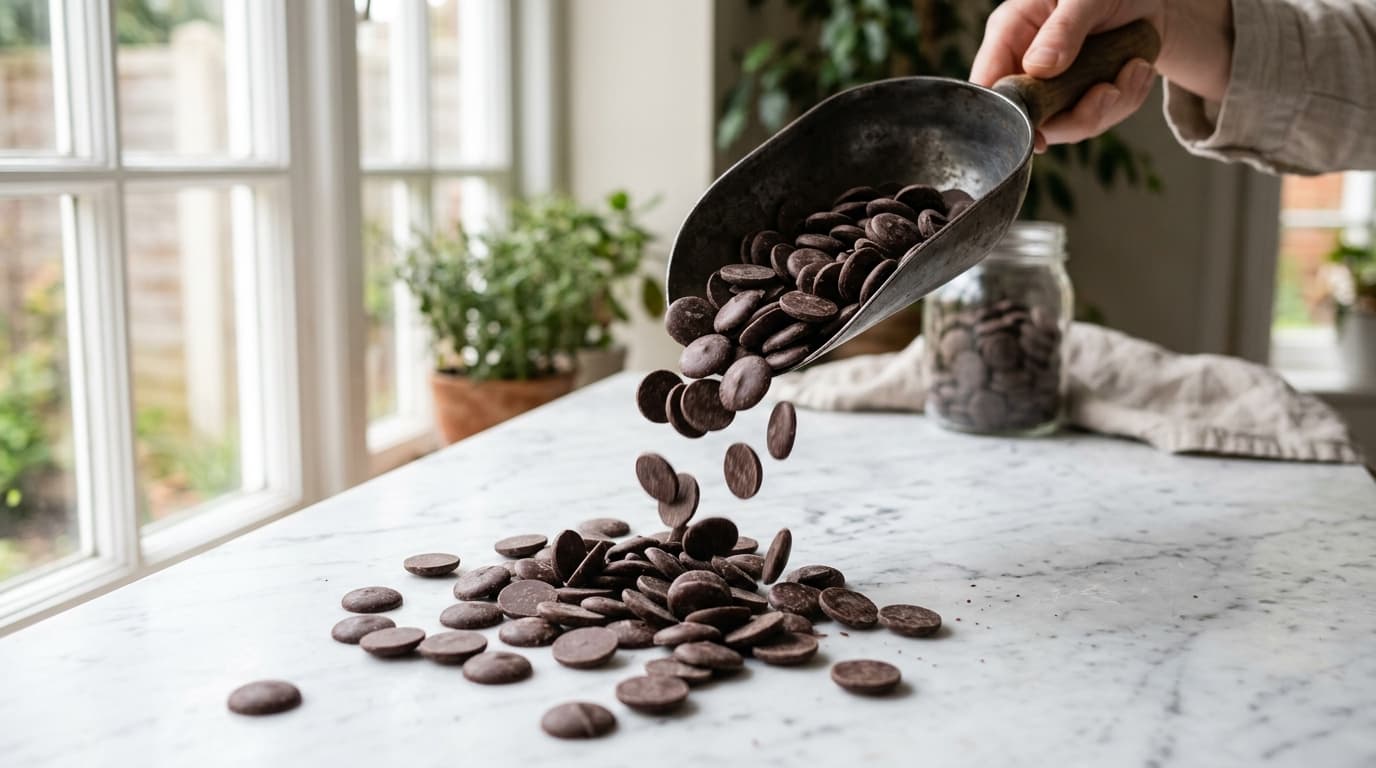
A pistole is a disc of couverture chocolate, calibrated so you can dose it by the piece and melt it fast. Callebaut says "callets", Cacao Barry "pistols", Valrhona "fèves". Three names, one shape, and yet 3.8 g on one side against about 2 g on the other, according to resellers. The label matters more than the word.
Three houses, three names for the same disc
I found no legal text that defines the pistole. It is a shape, not a category: the couverture inside it remains subject to directive 2000/36/EC, which requires at least 31 % cocoa butter.
Survey of 19 October 2026 on the makers' own pages, completed for Valrhona with a reseller's page.
| Callebaut | Cacao Barry | Valrhona | |
|---|---|---|---|
| Name of the shape | callets | pistols | fèves |
| Reference read | recipe 811, dark 54.5 % | Mexique, dark 66 % | Guanaja, dark 70 % |
| Weight of one piece | not published | not published | 3.8 g |
| Bags seen | 400 g, 1 kg, 2.5 kg, 10 kg | 1 kg, 2.5 kg | 500 g, 1 kg, 3 kg |
| Fluidity shown | 3 drops out of 5 | "medium", rated 3 | not stated |
| Tempering curve | not provided | not provided | melt 55 to 58 °C, crystallise 28 to 29 °C, work 31 to 32 °C |
| Storage | 12 to 20 °C, dry, a Belgian reseller's technical sheet | 24 months, no storage instruction | sealed bag, dry, 16 to 18 °C |
Valrhona is the only one of the three to write down a weight. Its definition page speaks of "small discs of couverture chocolate weighing a few grams", then gives a figure: 3.8 g for its fèves. Resellers round off, about 3 g at Valrhona, about 2 g at Barry and at Callebaut. I keep the maker's figure, and I have not weighed a single fève myself.
Why a disc rather than a bar to chop?
Because you stop breaking, stop chopping, and start dosing.
Valrhona says as much on its page on pistoles: pieces "all of the same size", which melt faster and more evenly than a chunk of bar, with no breaking or crushing. The arithmetic takes two lines. At 3.8 g a fève, 100 g makes 26 pieces and a kilo holds 263; at 2 g, the same kilo holds 500. A ganache built on 150 g of chocolate is therefore about forty Valrhona fèves: nothing for a hand that counts, a chore for a knife.
3.8 g
One Valrhona fève
263
Fèves in 1 kg
17 %
Cheaper Callebaut kilo in a 2.5 kg bag
One reservation all the same: the disc has no advantage in flavour. It has an advantage in gesture.
How much does a kilo cost, depending on the bag?
The same chocolate does not cost the same per kilo depending on bag size, and the gap can be measured. On 19 October 2026 I noted the displayed prices, VAT included, and brought each bag back to the kilo.
| Product | Bag | Price noted | Price per kilo |
|---|---|---|---|
| Callebaut 811, callets, maker's shop | 400 g | 7.62 € | 19.05 € |
| Callebaut C811, callets, reseller based in the Netherlands | 2.5 kg | 39.39 € | 15.76 € |
| Valrhona Guanaja 70 %, fèves, Meilleur du Chef | 1 kg | 32.50 € | 32.50 € |
| Valrhona Guanaja 70 %, fèves, Meilleur du Chef | 3 kg | 89.50 € | 29.83 € |
Going from a 400 g bag to a 2.5 kg bag brings the Callebaut kilo from 19.05 to 15.76 €, 17 % less, provided you accept comparing two different sellers, one official and Belgian, the other based in the Netherlands, whose postage and delivery times do not enter this calculation. At Valrhona, a single seller, three kilos instead of one earn 8 %. No more. The struck-through prices shown by the reseller are not used: only the price paid counts. Cacao Barry shows no price on its page, which points to a list of stockists.
Do not compare Callebaut and Valrhona on this table. At 54.5 % and 70 % cocoa, they are not equivalent products.
The same number, two percentages
Callebaut's recipe 811 is shown at 54.5 % cocoa on the maker's shop. A Belgian reseller's technical sheet and a Dutch reseller's page write 53.1 % for the same code. I found no published explanation.
Read the percentage printed on the bag you receive.
What do the sheets say about fluidity and tempering?
Very little, and seldom the same thing. Callebaut shows 3 drops out of 5 for its 811, Cacao Barry a "medium fluidity" rated 3 for its Mexique 66 %, Valrhona nothing on the page read. Two sheets out of three give no tempering curve at all: only the Guanaja 70 % publishes one, repeated by the reseller, with melting at 55 to 58 °C, crystallisation at 28 to 29 °C and working at 31 to 32 °C.
Tempering nevertheless needs that curve, and since it changes with the cocoa percentage, with the presence of milk and with the recipe, copying it from one brand to another means tempering at random and ending up with a dull chocolate, a poor snap, and a bloom that arrives fast. If it is missing from the page, look for it on the bag or ask the seller for the technical sheet. Our guide to tempering chocolate explains how to use it.
Five lines to read before paying
The name of the shape says nothing about the recipe. Here is what matters, in the order I check it:
- The recipe code and the printed percentage, not just the word "callets" or "pistoles".
- The weight of the bag and the price per kilo, which you have to work out yourself when the page shows a bag price.
- The tempering curve, essential for moulding and missing from two pages out of three.
- The keeping time: 24 months stated by Cacao Barry on its Mexique sheet, and a range of 12 to 20 °C on the Belgian technical sheet for the Callebaut.
- The allergens of the exact reference: soya in the Callebaut 811, "may contain milk and traces of nuts" on Valrhona's Guanaja.
Do you really need a 5 kg bag?
No, unless you mould every week.
The saving is real but thin: three euros a kilo at Callebaut, under three at Valrhona. A badly kept bag wipes out that saving in a single summer. Valrhona asks for the bag to be kept sealed, dry, between 16 and 18 °C. In a flat that climbs to 24 °C in July, an opened bag blooms before it is finished, and why chocolate turns white details the mechanism.
Work it out with your own use. At 200 g a month, two desserts and a batch of pralines, a one-kilo bag lasts five months and stays well within the 24 months Cacao Barry states on its sheet. For three kilos, count fifteen months, and the cellar must stay dry. The storage guide gives the temperature and humidity benchmarks.
Pastilles, galets, pépites: false friends
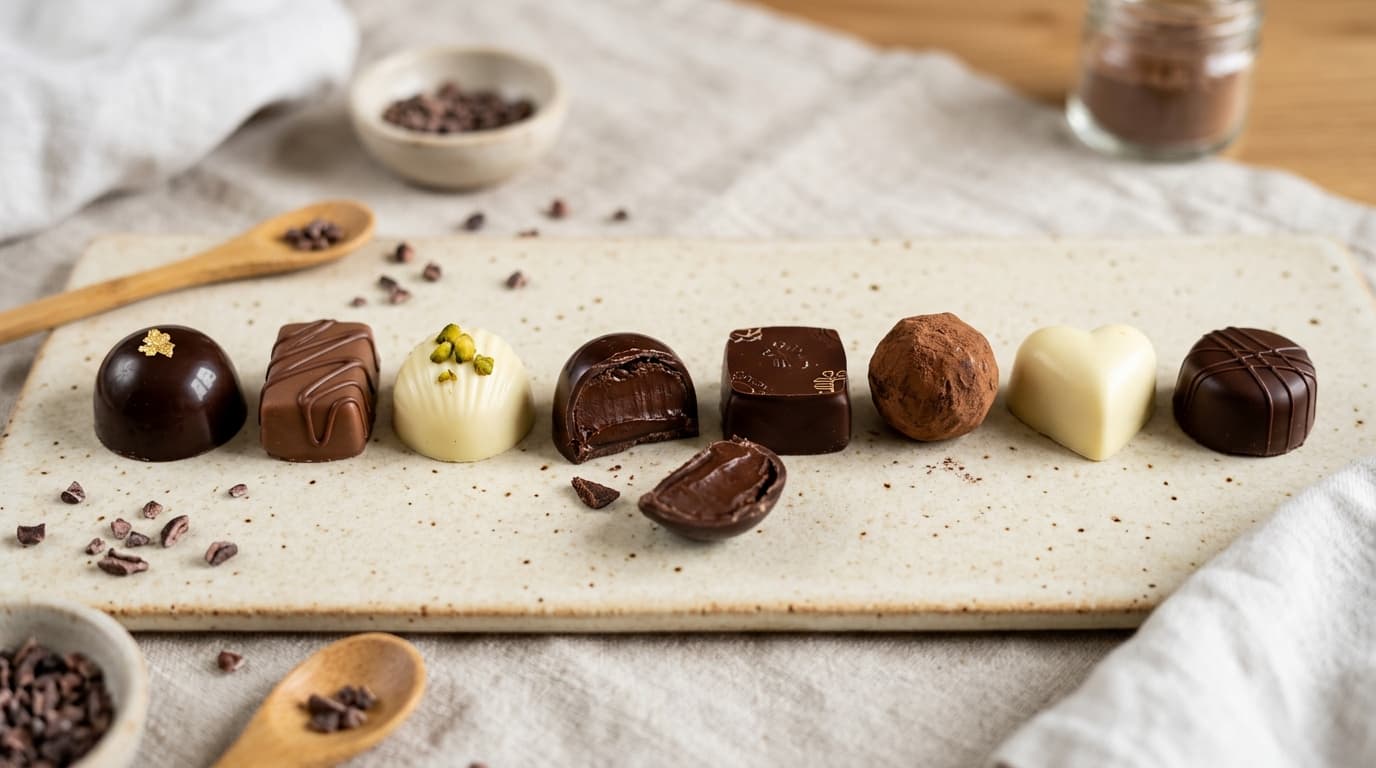
Resellers mix the words. Pistoles, pastilles, galets, fèves: a French online shop files all of them in a single category. Watch out for pépites: one reseller's blog lists them as a synonym, whereas baking chips are a different product, designed to hold up to oven heat. They are not tempered, do not replace a couverture and serve to decorate a bake.
As for the word itself, the pistole was also a coin: Wikipedia states that in France the word was used for the Spanish écu. The disc shape probably explains the image. I found no source that establishes it.
The verdict by profile
No single winner: it depends on what you do with chocolate.
- A dessert now and then: the 400 g Callebaut bag at 7.62 € is enough, and it will not age in the cupboard.
- Regular pastry work: a one-kilo bag, used up in under six months.
- Moulding: the tempering curve first, fluidity second, price last. Our article on the polycarbonate mould shows what comes next.
- A particular diet: the label of the exact reference, never that of the range.
To understand the material before the shape, couverture chocolate sets out its rules, and the ranking compares the Belgian houses on the shop-window side. The reference sheets are those of Cacao Barry and Valrhona.
Pralines & spécialités comparator
Compare all pralines & spécialités side by side.
Compare now →
Frequently asked questions
Bruxelloise pur sucre, Margaux arpente les chocolateries belges depuis plus de dix ans. Ancienne pâtissière reconvertie dans le journalisme gourmand, elle goûte, compare et raconte le chocolat belge sans complaisance — des grandes maisons aux ateliers de quartier.