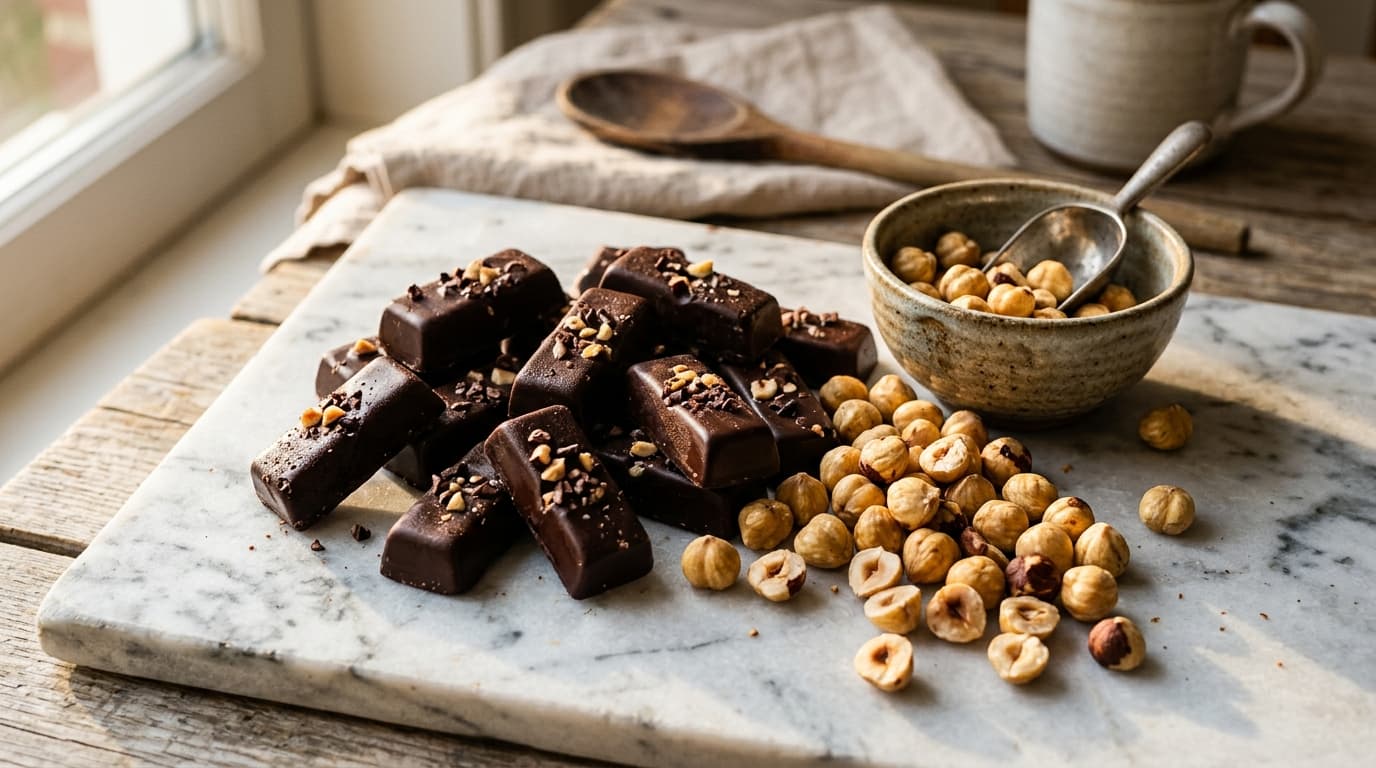
Gianduja is chocolate with finely ground hazelnuts added: 20 to 40 g per 100 g in the dark version, 15 to 40 g in the milk version, under the European directive of 2000. Born in Turin, it has nothing of a praliné. And it sits even further from a chocolate spread.
Chocolate that contains hazelnuts, not the other way round
First there is a chocolate, then hazelnuts ground so fine you no longer feel them under the tooth. The result is softer than a bar, because hazelnut oil stays liquid at room temperature, as the encyclopaedia entry on gianduja sums it up.
Where does gianduja come from, and why is it named after a puppet?
From Turin, in the early nineteenth century, and from a shortage.
In 1806, the Continental Blockade decreed by Napoleon cut Europe off from British goods, and cocoa became scarce and dear. Turin's chocolatiers mixed in what they had to hand: the hazelnuts of Piedmont, the Tonda Gentile of the Langhe, according to the Italian government portal. A wartime economy became a speciality.
The name comes from Gianduja, a puppet of the Piedmontese carnival who embodies the typical Piedmontese.
That leaves the gianduiotto, the ingot associated with Caffarel, and here the sources contradict each other. One dates its invention to 1852, the other its presentation at the Turin carnival to 1865. I am not picking: none of the pages consulted on 13 October 2026 shows its evidence, and a round number repeated everywhere is not proof.
How many hazelnuts must a gianduja contain?
The law answers, which is rare in the world of pralines. Directive 2000/36/EC sets the limits, and the Belgian royal decree of 19 March 2004, which transposes it, repeats them.
| Version | Base chocolate required | Finely ground hazelnuts per 100 g | Other nuts |
|---|---|---|---|
| Gianduja (chocolate) | at least 32 % dry cocoa solids, of which 8 % non-fat cocoa | 20 to 40 g | whole or chopped, total with the ground hazelnuts limited to 60 % |
| Milk gianduja | milk chocolate with at least 10 % dry milk solids | 15 to 40 g | same 60 % limit |
Milk or dry milk solids may also be added to dark gianduja, up to 5 % of the finished product. Whole or chopped nuts count towards the 60 % limit, which leaves an enormous margin: a gianduja packed with shards of hazelnut and almond is still a gianduja, as long as the ground hazelnuts respect their floor.
A calculation to fix ideas, dated 13 October 2026. In a 250 g box of dark gianduja, the law therefore requires 50 to 100 g of ground hazelnuts. In the same box in the milk version, 37.5 to 100 g. For the dark one, the gap between floor and ceiling is a factor of two, which explains why very different gianduja turn up under the same name: a recipe at the legal minimum and a generous one do not taste alike, even if the label carries the same word.
Gianduja, praliné, hazelnut paste, chocolate spread: where is the line?
Four products look alike on the shelf and share almost nothing in the recipe. The table relies on the directive, on the French trade code for praliné, and on the Open Food Facts listing of a famous chocolate spread, consulted on 13 October 2026.
| Product | Hazelnuts | Cocoa | Legal framework |
|---|---|---|---|
| Dark gianduja | 20 to 40 g per 100 g, ground | base chocolate, at least 32 % dry cocoa solids | directive 2000/36/EC |
| Praliné | at least 50 % caramelised nuts | none | French usage, no European text |
| Hazelnut paste | 100 %, nothing else | none | none |
| Chocolate spread (listing consulted) | 13 % | 7.4 % reduced-fat cocoa powder | no gianduja threshold |
Thirteen grams of hazelnuts per hundred: two grams under the floor for milk gianduja, seven under the floor for dark. On the same listing, palm oil weighs around 18 % and sugar over 50 %, according to the database's estimate. The spread does descend from gianduja, and was first sold as Pasta Gianduja, but the kinship stops at the genealogy.
For praliné and its cousins, the detail is in our article on praliné and praline.
How do you recognise a good gianduja?
By the ingredient list first, because it is the part that does not lie.
- The hazelnuts appear high in the list, and the house gives their percentage when it is proud of its recipe.
- Cocoa butter is among the fats cited; a mention of "contains vegetable fats in addition to cocoa butter" signals a less noble recipe.
- The texture melts in one piece, without waxing the palate or leaving grit.
- The hazelnut smell is clear, never rancid fat: ground hazelnut ages badly.
The survey of 13 October 2026 on the listing for the Leonidas Gianduja praline gives, in order: sugar, hazelnuts, cocoa butter, whole milk powder, cocoa mass, soy lecithin, natural vanilla. No palm oil appears. The listing does not publish the hazelnut percentage, and that is the limit of this survey: you read the order, not the dosage.
Can you make gianduja at home?
Yes, with patience and a food processor that does not stall.
- Roast hazelnuts in the oven until the skin comes away, then rub them in a tea towel.
- Grind them for a long time: the powder tips into paste when the oil comes out, as with a praliné.
- Melt the chocolate, dark or milk, and stir the paste in: 30 g of paste to 70 g of chocolate stays within the legal limits.
- Temper the mixture if you want a glossy bar, or use it as it is for a filling.
What is it for, and which one should you pick?
| Your project | Pick | Why |
|---|---|---|
| Filling bonbons or choux | gianduja as paste or block | firm when cold, melts in the mouth |
| Crunch on a dessert | pralin, not gianduja | dry shards, no chocolate and no paste |
| Morning spread | a chocolate spread, reading the label | pure gianduja is firmer and does not spread cold |
| A bar to bite into | milk or dark gianduja, tempered | glossy and snappy when cold |
| A tree-nut allergy | nothing from this family | the hazelnut is in the definition |
To compare the spreads sold in shops, our selection goes further. Home bakers will also want couverture chocolate, and the ranking gives the order of the Belgian houses.
Pralines & spécialités comparator
Compare all pralines & spécialités side by side.
Compare now →
Frequently asked questions
Bruxelloise pur sucre, Margaux arpente les chocolateries belges depuis plus de dix ans. Ancienne pâtissière reconvertie dans le journalisme gourmand, elle goûte, compare et raconte le chocolat belge sans complaisance — des grandes maisons aux ateliers de quartier.