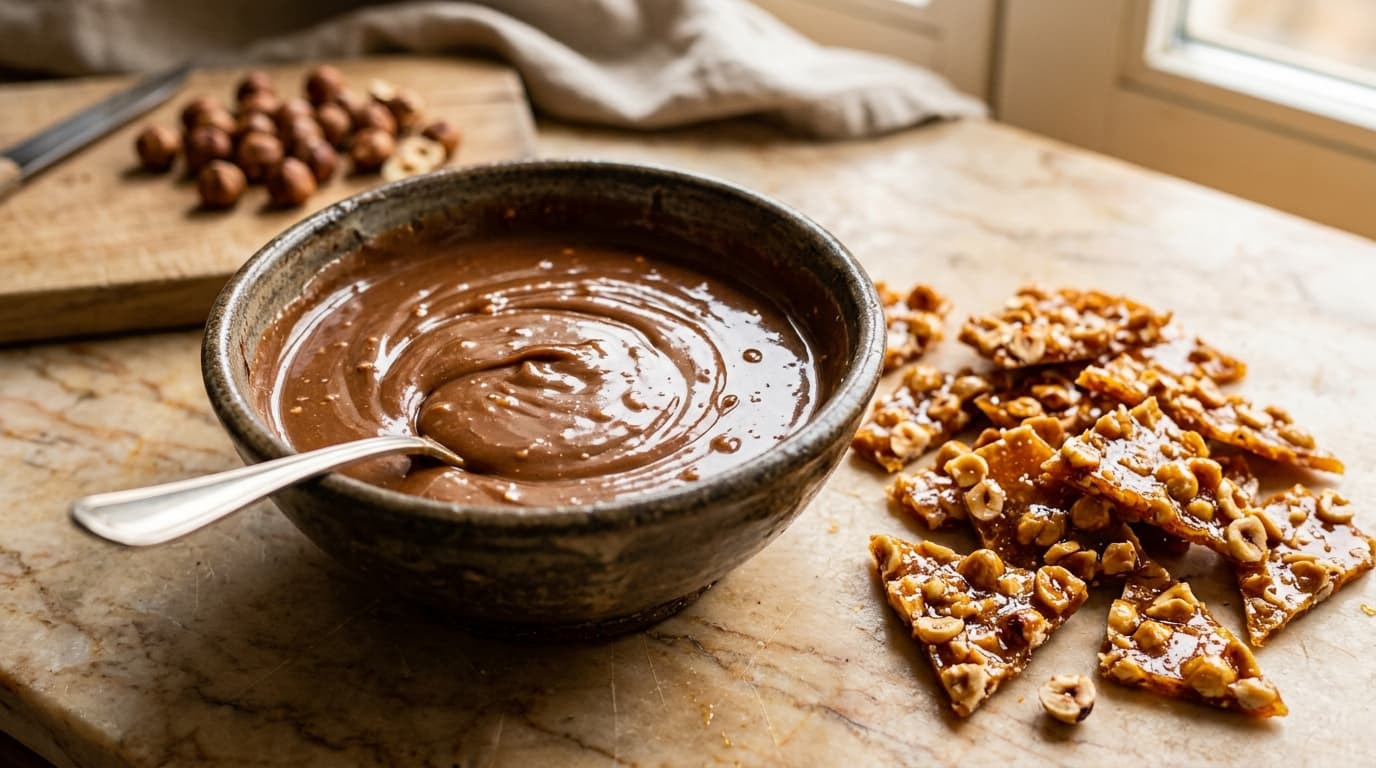
Praliné is a paste: caramelised nuts, ground until they release their own oil. Pralin is the same preparation stopped earlier, in crunchy shards. As for praline, it does not point at the same object depending on which side of the border you order it.
Praliné is a paste, pralin stops short of it
Both start in the same place. Toasted hazelnuts or almonds, sugar cooked to caramel, the two mixed and then cooled into a slab. At that stage nobody can yet say which of the two products will come out of the bowl.
Crush the slab and you have pralin. Irregular shards, sandy under the tooth, scattered over a Paris-Brest, over ice cream or over an entremets to give it some relief. Keep grinding, for a long time, and the nuts heat up under the blades, release their own oil, and the powder tips all at once into a smooth paste. You have praliné.
Nothing else changes.
Not the ingredients, not the proportions: only the grinding time. The École Valrhona chocolate glossary describes exactly that tipping point, and the sound of the machine confirms it when you do it at home: the dry scraping turns into a fatty purr, and you have to stop before the paste turns to oil.
On proportions, French usage is codified. The Code des usages de la confiserie, the French confectionery trade code, reserves the word praliné for preparations containing at least 50 % nuts, hence the famous 50/50 of pastry chefs, half almonds or hazelnuts, half sugar. A praliné pushed to 60 % nuts will be runnier and more bitter; taken down to 40 %, sweeter and firmer.
What is a praline in Belgium?
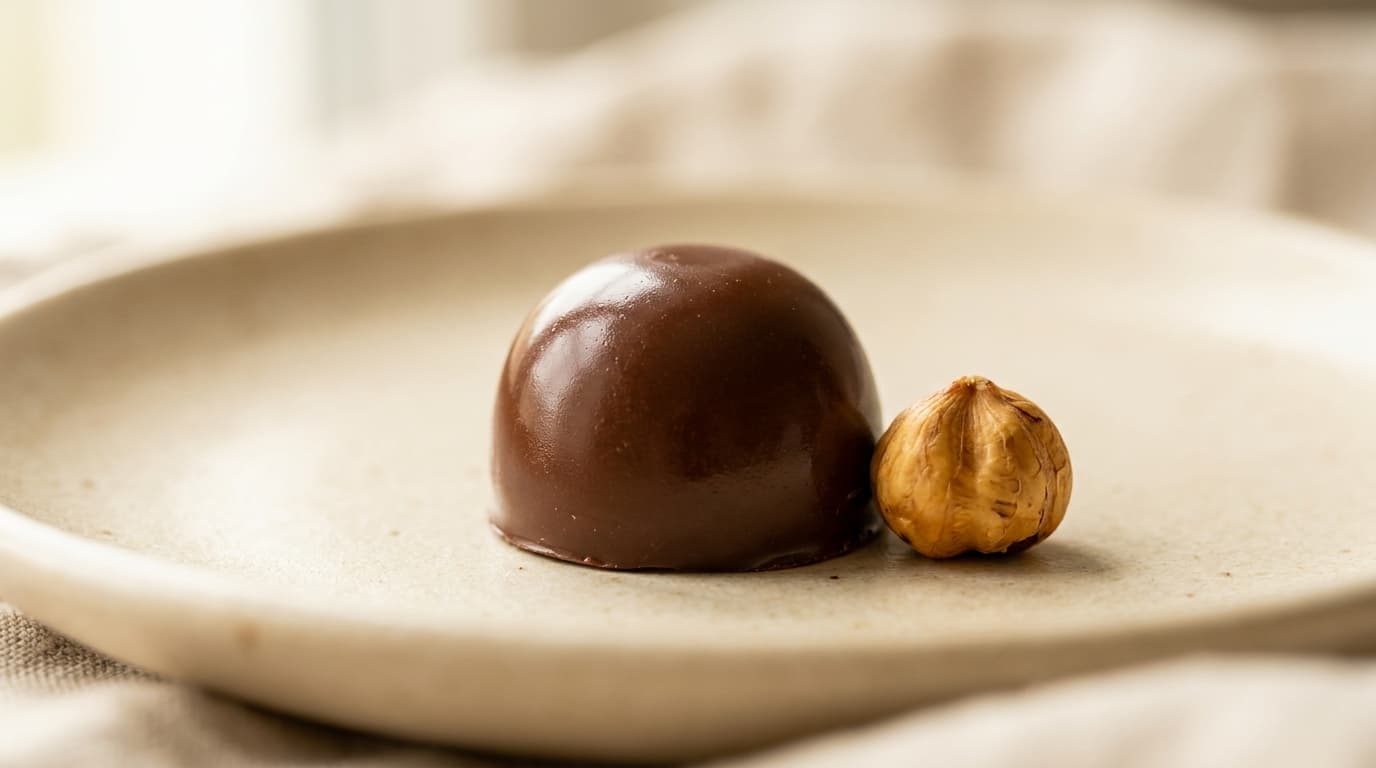
A bite-sized chocolate. The filling plays no part in the definition, and that is where the whole misunderstanding starts.
The Royal Decree of 19 March 2004 on cocoa and chocolate products, which transposes the European directive of 2000, files "praline" and "chocolate bonbon" under the same entry: a product of a single mouthful size, consisting either of filled chocolate or of chocolate juxtaposed or mixed with other edible matter, provided the chocolate accounts for no less than 25 % of the total weight of the finished product. Not a word about hazelnuts. Not a word about almonds.
The text is available online, and it is worth one read: it is the only enforceable definition of the word in this country.
On 9 September 2026 I went through the praline catalogue of Leonidas Belgium, which sorts its range by filling recipe. Thirteen families are listed: confectioner's cream, ganache, caramel, coffee, liqueur, manon, marzipan, praliné, buttercream, solid chocolate, truffle, vanilla, fruit. Praliné takes one slot out of thirteen.
Twelve families out of thirteen therefore contain not a gram of ground nut, and all of them are still called pralines. The word describes the shape and the coating, never the centre.
And in France, why is a praline an almond?
Because there the word stayed attached to its original object, which dates back to the 1630s.
The most widely repeated account credits the find to Clément Jaluzot, kitchen officer to Maréchal César de Choiseul, Count of Plessis-Praslin. A roasted almond, cooked sugar, a caramel coating that hardens into an irregular crust. The sweet took the count's name, was first spelled "prasline", lost its s around 1680, and settled in Montargis when the cook opened a shop there. The encyclopaedia entry on the praline traces that lineage.
Tinted pink, the same almond becomes the praline of Lyon, the one in the brioches and in the tart you see in every window in the city.
Belgium, for its part, borrowed the word for something else. When Jean Neuhaus junior launched his filled chocolate bonbon in the Galerie de la Reine in 1912, he called it a praline, and usage won out over etymology. Two countries, one word, two objects whose only shared feature is the principle of one ingredient coated by another.
Order "a praline" in Lyon and then in Brussels, and you walk out with two things that look nothing alike.
Five words, two countries, one table
The table below settles the question for good: for each word, the texture in the mouth, the composition, the text that defines it where one exists, and where you come across it.
| Word | Texture | Composition | Text that defines it | Where you meet it |
|---|---|---|---|---|
| Praline (Belgium) | moulded or dipped mouthful | chocolate ≥ 25 % of total weight, filling unrestricted | Royal Decree of 19 March 2004 | shop windows and ballotins, all over Belgium |
| Praline (France) | whole almond, crunchy, irregular | almond and caramelised sugar, sometimes coloured | none, usage only | Montargis, Lyon, praline tart |
| Pralin | crunchy, sandy shards | crushed caramelised nuts | none, usage only | Paris-Brest, decoration on ice cream and entremets |
| Praliné | runny to slightly grainy paste | at least 50 % nuts, the rest sugar | Code des usages de la confiserie, in France | praline filling, entremets, spreads |
| Gianduja | firm paste, spreadable and mouldable | chocolate and finely ground hazelnuts | Royal Decree of 19 March 2004 | bars, gianduja pralines, Turin |
One column deserves a comment. Three of these five words are defined by no text at all: pralin and the French praline belong to usage rather than to law, so nobody can sell you a bad pralin in any legal sense of the term.
Can a praline contain no chocolate at all?
Yes, and it is written in black and white.
Article 5 of the same royal decree provides a derogation: the name "praline" may also be used for products of praline size even when they contain none of the chocolates defined by the text, on condition that they are presented together with genuine pralines. Translated to the shop window: plain marzipan, fruit jellies or nougatine slipped into an assorted ballotin are legally pralines.
Nobody is being dishonest here. The derogation does explain why a 500 gram ballotin can hold pieces without an ounce of chocolate in them, with no obligation on the packaging to flag it other than through the ingredient list.
Gianduja is the only word in the family that the law weighs
A short chapter, and worth the detour. The royal decree sets numerical limits: to carry the gianduja label, 100 grams of product must contain between 20 and 40 grams of finely ground hazelnuts in the dark chocolate version, between 15 and 40 grams in the milk chocolate one. Below the floor, the word is banned. Above the ceiling too.
How do you recognise a real praliné at the counter?
By tasting first, and the test takes three seconds: a good praliné melts without sticking to the palate, and the toasted hazelnut comes up after the sugar, never before. The rest you check by eye and by asking.
- The colour of the centre, between pale beige and caramel brown: a very pale praliné was ground without a proper roast, or stretched with uncaramelised nut paste.
- The grain under the tooth, noticeable without grating; a perfectly smooth praliné is often an industrial one with added fat.
- The share of nuts when the house states it, 50 % being the floor rather than a selling point.
- The nut used, hazelnut or almond, which any chocolatier names without hesitating; hesitation means a bought-in filling.
- The production date, because praliné goes rancid, and faster than a ganache, since it is fatty.
On 9 September 2026 I tasted the Leonidas gianduja and a Brussels artisan's own praliné side by side. The first is round, frankly sweet, and it fades in about ten seconds. The second holds a bitterness of hazelnut roasted far, and it stays in the mouth considerably longer. Neither is a failure. They simply are not aiming at the same mouth, and the gap in price per kilo says the same thing.
If the word manon stopped you in the list of thirteen recipes, the manon has its own article, and so does the Belgian truffle. As for the box that carries them, the ballotin tells another story about a misunderstood word. And our ranking gives the order of preference among the houses.
Pralines & spécialités comparator
Compare all pralines & spécialités side by side.
Compare now →
Frequently asked questions
Bruxelloise pur sucre, Margaux arpente les chocolateries belges depuis plus de dix ans. Ancienne pâtissière reconvertie dans le journalisme gourmand, elle goûte, compare et raconte le chocolat belge sans complaisance — des grandes maisons aux ateliers de quartier.