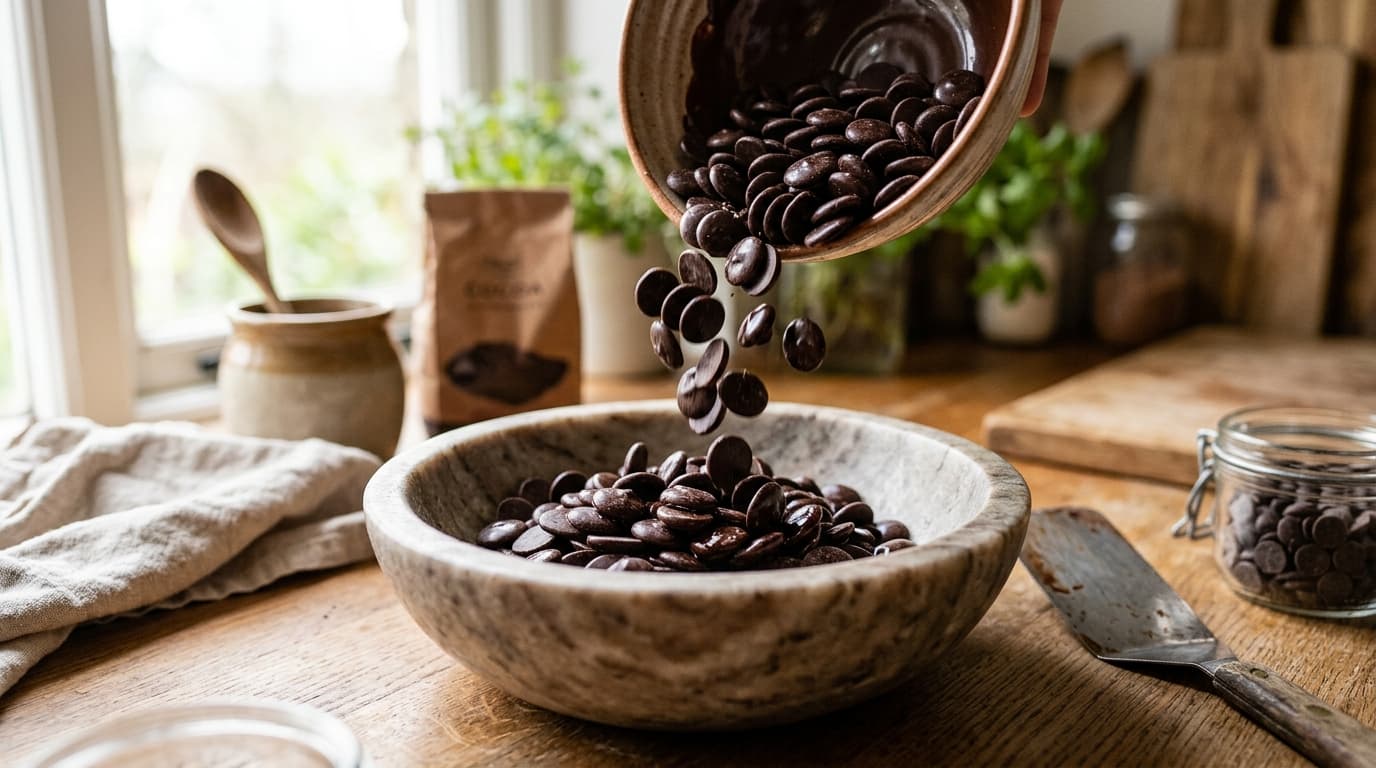
Couverture chocolate is chocolate that contains at least 31% cocoa butter, against 26 to 31% for ordinary baking chocolate. Those few points of fat do not make it taste better. They make it more fluid, and therefore able to do things another chocolate simply cannot.
European law sets the threshold, not the chocolatiers
“Couverture” is not a marketing word. It is a regulated designation.
European directive 2000/36/EC reserves the term for chocolate containing a minimum of 35% total dry cocoa solids, of which at least 31% cocoa butter and 2.5% fat-free dry cocoa solids. A manufacturer who falls below those figures may not print “couverture” on the bag, however good the beans are.
| Designation | Legal framework | Total dry cocoa solids | Cocoa butter | Fat-free cocoa solids |
|---|---|---|---|---|
| Chocolate | Directive 2000/36/EC | 35% minimum | 18% minimum | 14% minimum |
| Couverture chocolate | Directive 2000/36/EC | 35% minimum | 31% minimum | 2.5% minimum |
| “Baking”, “dessert” chocolate | No definition of its own | Varies by brand | Often 26 to 31% | Varies |
| Compound coating, “cake covering” | Outside the definition of chocolate | Varies | Partly replaced by vegetable fats | Varies |
Two things stand out in that table. Couverture demands almost twice the cocoa butter of ordinary chocolate, and in exchange it gives up most of the fat-free cocoa solids, the part that carries colour and bitterness. As for the phrase “baking chocolate”, which covers half the dessert aisle of a Belgian supermarket, it corresponds to nothing in law: it is a promise of use, not a composition.
What separates it from supermarket baking chocolate?
Five to ten points of cocoa butter. Nothing else, and that is already a lot.
Cocoa butter is the only fat in compliant chocolate, and it is what decides viscosity once the chocolate is melted. A three-drop couverture spreads into a two-millimetre shell that snaps cleanly under the tooth, contracts as it cools and leaves the mould on its own; the same mould filled with a melted supermarket bar gives a thick, soft shell that has to be twisted out of the silicone and keeps every fingerprint.
It is a technical service. The taste itself does not move.
I repeat it because the confusion is constant and it costs people money: couverture is not formulated to be eaten as it is. Callebaut 811, the absolute reference in Belgian workshops, is a round, balanced, deliberately neutral chocolate, designed to sit alongside a ganache, a praliné or a fruit without crushing anyone. Eaten on its own, it is frankly less interesting than a good single-origin bar. You buy couverture for what it lets you build.
Callebaut counts in drops, on a scale of 1 to 5
The system is Belgian, it is public, and it tells you more than any percentage printed on the wrapper.
Callebaut indicates the fluidity of each recipe with drop-shaped symbols, from one to five. One detail few people know, and it settles a lot of arguments: according to the manufacturer's own technical page, every chocolate carrying the same recipe number tastes exactly the same, even when they do not contain the same amount of cocoa butter. So the drop does not measure quality. It measures destination.
One drop is for flavouring an ice cream or a buttercream. Two drops, for moulding a large hollow figure, because a thick layer laid in a single pass saves enormous time on an Easter rabbit. Three drops cover almost everything: that is the fluidity of 811 dark, 54.5% cocoa and 36.6% cocoa butter according to its product sheet. Four drops, for moulded bonbons with thin shells and moulds with sharp edges. Five, for laying a thin veil over a large biscuit surface.
The other common Belgian couverture comes out of the Puratos plant in Erembodegem: Belcolade Selection Noir at 55% cocoa, Cacao-Trace sourcing, 100% cocoa butter and natural vanilla. Valrhona and Cacao Barry, on the French side, work on the same principle but state fluidity differently, which makes comparing brands more tedious than it ought to be.
Do you need couverture for a mousse or a cake?
No. In most cases, it is money thrown away.
The extra cocoa butter earns its keep when the chocolate has to stand alone, thin and glossy. As soon as it is drowned in another medium, it plays no part at all, and it costs more per kilo. Here are the preparations I never buy it for.
- A mousse: the chocolate is diluted in eggs and cream, and the fluidity disappears in the process.
- A fondant or a molten cake: the chocolate is baked, and cocoa butter contributes no structure.
- A tart ganache: the cream dictates the texture, and a good 60% bar does the job.
- Shavings, a marble cake, a rustic glaze: no tempering, therefore no need for couverture.
- Hot chocolate: the fat rises as a film on the surface of the cup, and it is genuinely unpleasant.
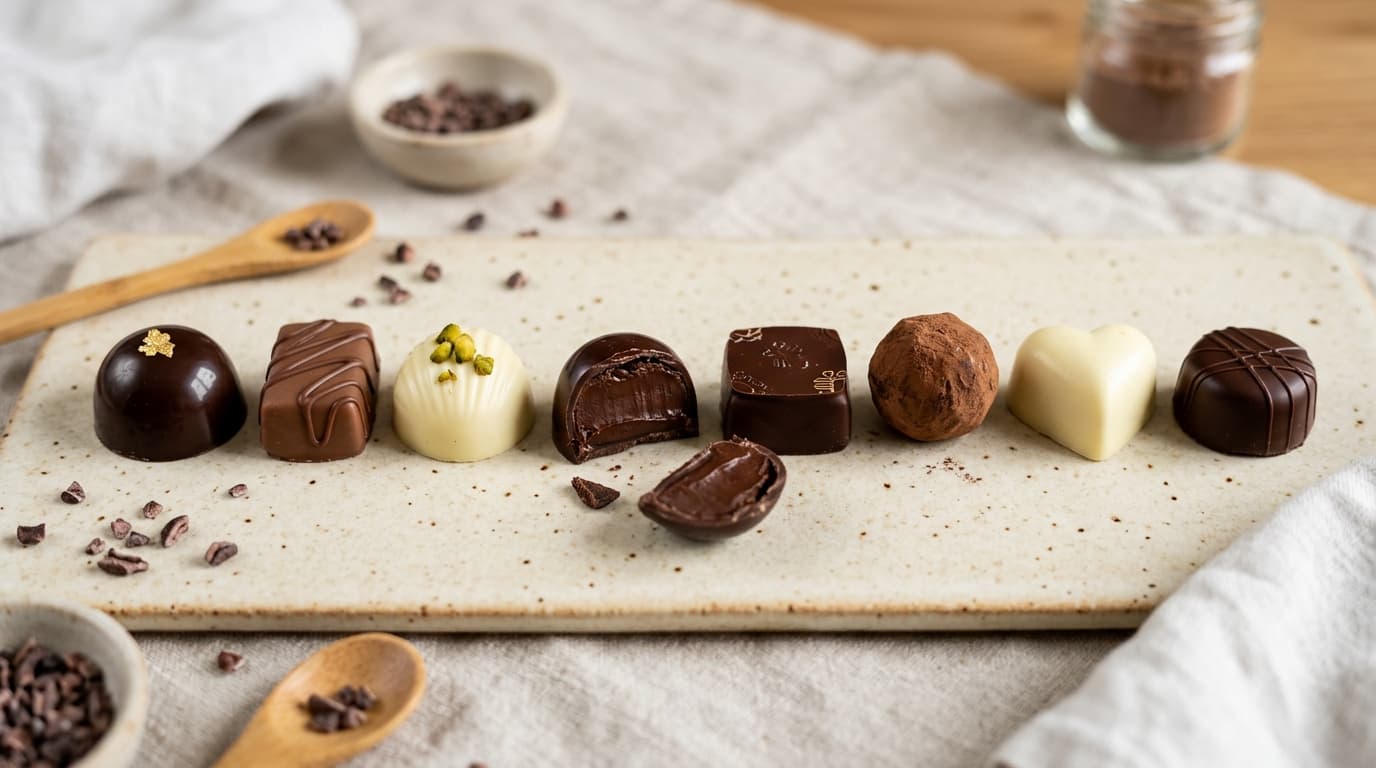
That leaves four situations where couverture changes everything: the moulded praline shell, enrobing a truffle or a mendiant, tempered decoration, and homemade bars. All four have one thing in common. The chocolate is bare, visible, and it has to shine.
What does Belgian couverture cost, and where do you buy it?
Less than people imagine, provided you give up on the 100 g bar.
Checked on 29 August 2026 at Cook & Bake, a Belgian retailer selling to private customers without a trade account:
| Reference | Pack | Price checked 29/08/2026 | Price per kilo |
|---|---|---|---|
| Callebaut 811, dark 54.5%, 3 drops | 2.5 kg bag | €35.79 | €14.32 |
| Callebaut 811, dark 54.5%, 3 drops | 10 kg bag | €116.40 | €11.64 |
| Callebaut 823, milk | 10 kg bag | €123.90 | €12.39 |
The arithmetic is instructive. At €14.32 per kilo, Belgian couverture works out at €1.43 per 100 g, the price of a decent supermarket bar, and the 10 kg bag falls to €1.16 per 100 g. Couverture is not a luxury product. It is a wholesale product, and the only real obstacle is the pack size: 2.5 kg is roughly two hundred praline shells, which is a lot for a Sunday afternoon.
One mistake I made myself, and see repeated at every workshop. My first 2.5 kg bag ended up at the back of a cupboard, open, badly resealed, next to a jar of cumin; six months later it smelled of spice and the callets had turned grey. Chocolate picks up odours, and a large opened bag oxidises. Decant it straight away into airtight jars, between 15 and 18 °C, away from light, as set out in our guide to storing Belgian chocolate.
One local advantage deserves a mention, because it is rare. Callebaut produces at Wieze, Belcolade at Erembodegem: in most European countries a genuine couverture means a special order or a wholesaler's account, whereas here it sits in provincial baking supply shops and with several Belgian online retailers, in one or two kilo bags.
Compound coating is not chocolate
A classic aisle trap, made worse by a misleading name: “cake covering chocolate”.
Compound coating replaces some or all of the cocoa butter with vegetable fats, which takes it outside the legal definition of chocolate. It needs no tempering, it shines on its own and it never blooms. In the mouth, it melts at the wrong temperature and leaves a waxy sensation that nothing can fix. For a throwaway decoration, fine. For a box you are giving to someone, never.
Without tempering, couverture gives a worse result
A caveat that spoils the party slightly, and it is better heard before the card comes out.
The more cocoa butter a chocolate contains, the more sensitive it is to crystallisation. A supermarket bar melted carelessly and poured into a mould gives a dull but acceptable result; a four-drop couverture treated the same way gives grey, soft chocolate streaked with pale marbling, sticking to the mould and melting between your fingers. That extra cocoa butter forgives nothing: it has to be brought into the right crystal form, the beta form, along a precise temperature curve.
Buying couverture without knowing how to temper therefore means paying more to get less. The full method is in our guide to tempering chocolate, and a €20 thermometer is plenty to follow it. So is a salvaged slab of marble.
To pick the chocolate that belongs in your cakes rather than in your moulds, our comparison of Belgian baking chocolate sorts it brand by brand. And if the price stopped you at the checkout, it goes back to the source: we set out the mechanism in our analysis of the price of cocoa. To see which Belgian houses actually make their own couverture, start with our ranking of Belgian chocolatiers.
Pralines & spécialités comparator
Compare all pralines & spécialités side by side.
Compare now →
Frequently asked questions
Bruxelloise pur sucre, Margaux arpente les chocolateries belges depuis plus de dix ans. Ancienne pâtissière reconvertie dans le journalisme gourmand, elle goûte, compare et raconte le chocolat belge sans complaisance — des grandes maisons aux ateliers de quartier.