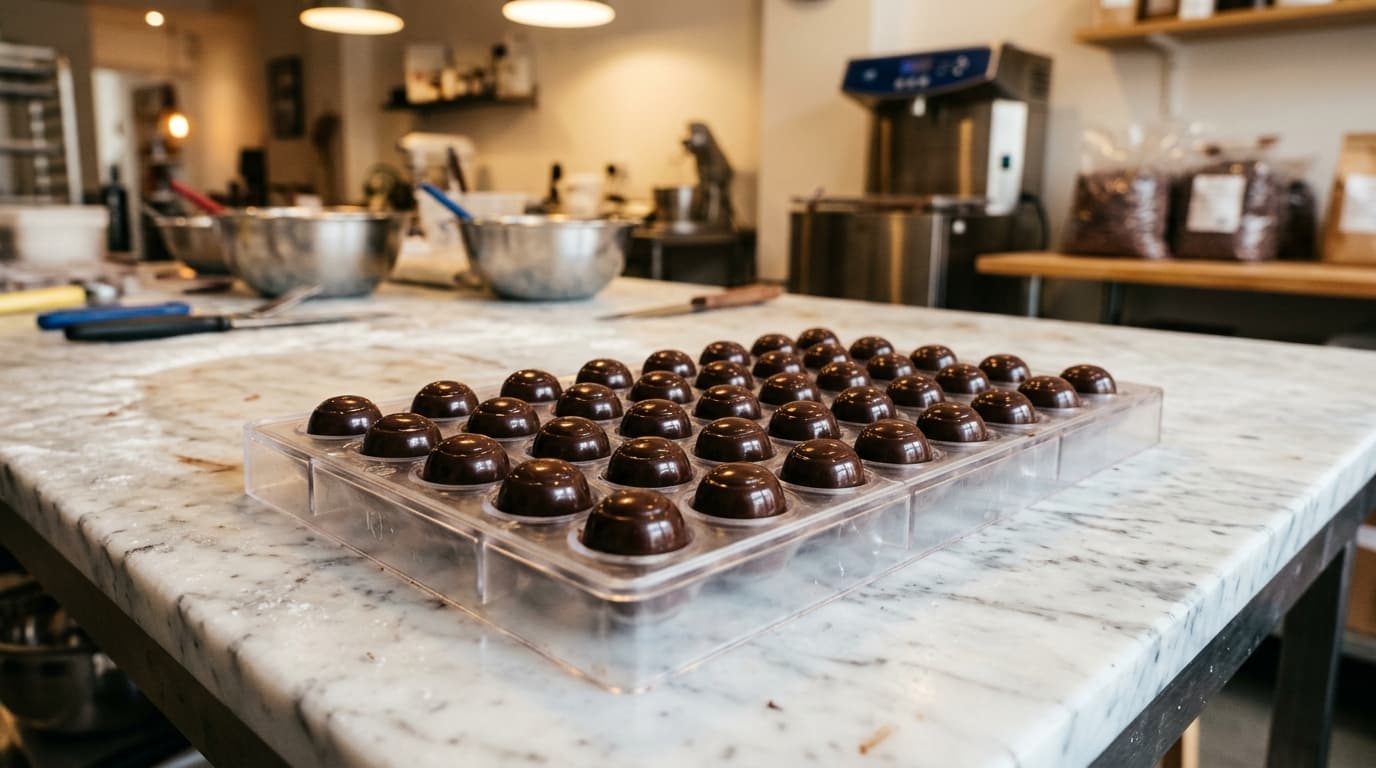
A polycarbonate chocolate mould costs 20.80 € at the Antwerp maker that has been designing 2,500 references since 1985, price read on 19 September 2026. Its shine comes not from the material but from tempered chocolate pulling away from a rigid wall. Without successful tempering, it changes nothing.
Why does polycarbonate give that shine?
Because it does not move.
Correctly tempered cocoa butter crystallises into Form V, and that crystallisation comes with a contraction in volume. Work published in the Journal of Food Engineering on chocolate demoulding puts the figure between 0.1 and 0.5 % for milk chocolate, and around 2 % for dark, which sets harder. It is tiny. It is also the whole difference between a shell that drops onto the worktop by itself and a shell you prise out with a knife tip, breaking one piece in three and blaming a mould that has done nothing wrong.
The wall stays still while the chocolate withdraws. A film of air forms between the two, the piece releases, and the surface keeps the exact finish of the mould. A mirror-polished mould gives mirror-polished chocolate.
Silicone does the opposite. Being flexible, it follows the shrinkage instead of resisting it, and it returns a satin surface, never a mirror. This has nothing to do with the quality of the silicone. It is mechanics.
The mould does not create the shine. It copies it.
Do you really need a polycarbonate mould?
Not for bars. A bar needs no shell, no added base and no shine on five faces: a steel frame set on a guitar sheet gives a result I prefer, and it costs less than a dedicated mould. For mendiants, palets and caraques, a chablon and a sheet do the job too.
Polycarbonate becomes useful at the precise moment you want a closed shell, filled and sealed with a base. The praline, the egg, the hollow figure. There, no serious alternative exists.
And if you do not own a probe thermometer yet, buy the thermometer first. A 20 € mould sitting on approximate tempering produces nothing better than a slab of dull chocolate.
Do all polycarbonate moulds contain BPA?
No, and nobody checks.
Polycarbonate has historically been made from bisphenol A. Yet the French-language pages on this subject almost all state that polycarbonate moulds are guaranteed free of bisphenol A. On 19 September 2026 I read the Antwerp maker's own FAQ, and its answer says the opposite: its polycarbonate moulds do contain BPA, and it presents them as compliant with European rules.
Regulation (EU) 2024/3190 prohibits bisphenol A in materials intended to come into contact with food. Its main transition period ended on 20 July 2026, with derogations and an extension to January 2028 for certain categories. The same maker's shop now offers a "BPA-Free" filter separate from the "Polycarbonate" filter, so two ranges plainly coexist.
I am not ruling on whether a given reference complies: the regulation carries derogations, and only the maker can say which one applies. The buying reflex, however, fits on one line.
Four criteria before opening the catalogue
The Antwerp catalogue runs to 480 pages. Without a reading grid, you buy the design you like and discover the problem at demoulding.
- Cavity weight, given in grams on the product sheet. A 10 g praline and an 18 g praline are not filled with the same bag or at the same pace.
- Cavity count, written as rows by columns. Twenty-four fit on a home worktop, forty do not.
- One-shot compatibility, flagged by a tag on the sheet: shell and filling deposited in a single pass instead of three separate ones.
- Mould type, which drives the price far more than the design: flat frame for pralines, magnetic for transfers, hollow figure for seasonal pieces.
What a mould costs, tier by tier
On 19 September 2026 I read the prices shown on the maker's online shop, reference by reference, across the first page of the catalogue.
| Mould type | References read | Price on 19/09/2026 | Use |
|---|---|---|---|
| Polycarbonate frame, praline or bar | CW12202, CW12008, CW1913, CW1586 | 20.80 € | filled pralines, bars, caraques |
| Frame with deep cavities | CW2116 (cone), CW2448 (faceted bar) | 22.90 € | cones, relief bars |
| Advent calendar frame | CW2505 | 25.20 € | 24 pieces in one pass |
| Magnetic hollow figure | HM020, HM031, HM037 | 68.70 € | hollow figures 110 to 150 mm |
| Magnetic hollow figure, large format | HM044, HM046 | 79.10 € to 93.60 € | figures 150 to 200 mm |
Thirty-nine different references showed the same 20.80 € price on that single page. The tariff depends neither on the design, nor on the cavity count, nor on the signature of the chef who drew it. Two moulds with nothing visually in common cost exactly the same. The price jump happens elsewhere, between the flat frame and the magnetic figure, where the ratio runs from 3.3 to 4.5 depending on format. Closing a hollow figure takes two magnetised half-shells and a fit to the tenth of a millimetre, and that assembly is what you pay for.
The volume discount is published in plain sight by the house: 20 % from thirty frames, 30 % from seventy, 40 % beyond one hundred and fifty. For an amateur the line is out of reach and beside the point. For a workshop starting out, it is the first one to read.
How do you get your first moulding right?
Six steps, and none calls for anything beyond the mould, a scraper and a thermometer.
- Polish the mould with dry cotton, cavity by cavity. No water, no detergent.
- Bring the mould to room temperature, between 20 and 22 °C. A cold mould sets the shell before it has reached the bottom of the cavity.
- Temper the couverture, then fill the cavities to the brim.
- Tap the mould on the worktop for twenty to thirty seconds to drive out bubbles, then turn it over the bath and scrape with the scraper.
- Let it crystallise between 16 and 18 °C. Seen from underneath, the mould clouds over as the shell releases, and that signal is visible precisely because the wall is transparent.
- Demould in one firm flip, without a knife and without twisting.
Can a polycarbonate mould go in the dishwasher?
Never.
Hot water, alkaline detergent and the drying cycle dull the wall together, and a dulled mould never shines again. Same verdict for the green scourer and for the knife tip slid under a stubborn shell. Dry cotton after use, nothing else.
Silicone lives by the opposite rules. Silikomart, which moulds in platinum silicone, states a range of -60 to +230 °C and dishwasher use on its professional lines. That is the one line where it clearly wins.
Where can you buy a polycarbonate mould in Belgium?
In Hoboken, south of Antwerp, at the maker itself.
Chocolate World runs its Discovery Shop at Smallandlaan 4, open Monday to Friday from 9 am to 5 pm, without an appointment and with no minimum order quantity. The house writes it in its own FAQ: private customers are received like professionals, and an order for a single mould is handled like an order for a production line. Parking is free in front of the building, Hoboken-Polder station is a ten-minute walk away, and the train from Brussels takes about an hour.
None of the French pages covering this subject mentions the address, and the Belgian advantage deserves saying: the moulds that equip workshops worldwide are sold retail an hour from the Grand-Place.
For silicone, Silikomart and Matfer are stocked by Belgian pastry equipment retailers. And Callebaut or Belcolade couverture is sold here in supermarkets, which remains a European exception.
On the machine that tempers, do you really need a tempering machine answers the neighbouring question, and often in the negative. If the urge is to taste rather than to mould, our ranking sets out the order of preference among Belgian houses.
Pralines & spécialités comparator
Compare all pralines & spécialités side by side.
Compare now →
Frequently asked questions
Bruxelloise pur sucre, Margaux arpente les chocolateries belges depuis plus de dix ans. Ancienne pâtissière reconvertie dans le journalisme gourmand, elle goûte, compare et raconte le chocolat belge sans complaisance — des grandes maisons aux ateliers de quartier.