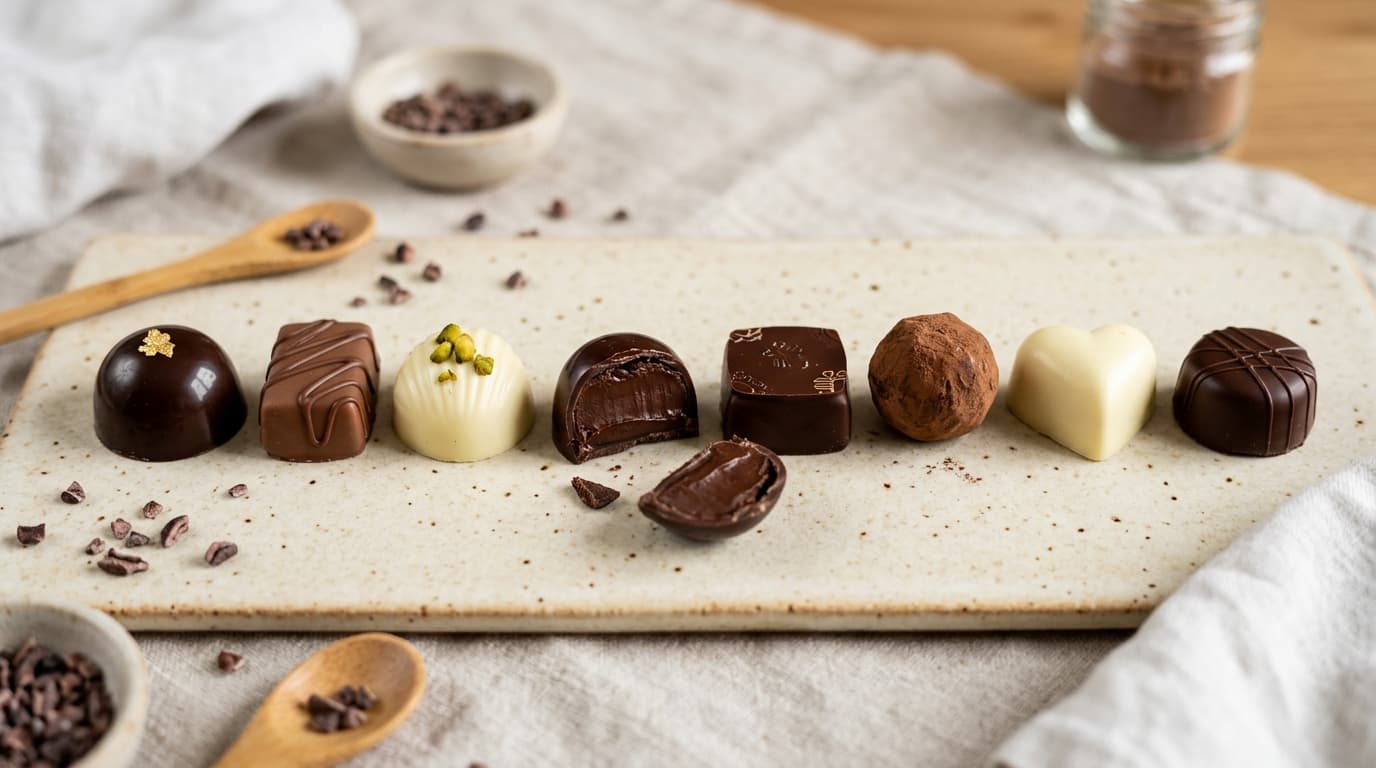
A ganache is chocolate and hot cream brought together in an emulsion. With 55-70 % dark chocolate, the starting ratio is 1 to 1 by weight. Milk chocolate needs about 1.7 times more, white 2.5 times more. Everything else is a matter of adjusting firmness, and a failed ganache can almost always be rescued.
How much cream for a dark chocolate ganache?
One to one. Two hundred grams of dark chocolate, two hundred grams of whole liquid cream, and you get a ganache that coats a cake while warm and spreads with a palette knife once it has cooled.
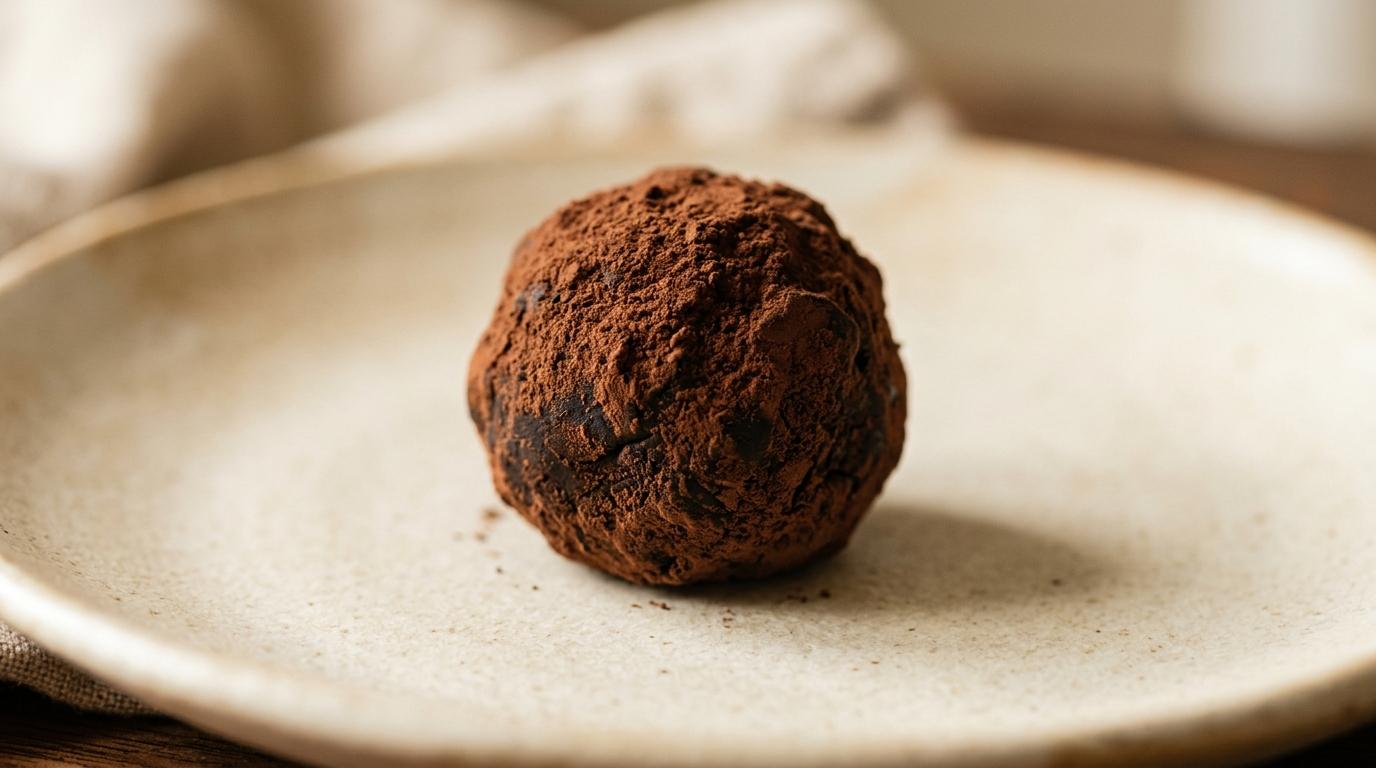
From there, you move one dial only, the chocolate. The cream stays the same. The more chocolate, the firmer the ganache. At 2 to 1, it becomes firm enough to roll into truffles or cut into cubes. Below 1 to 1, it stays runny and serves as a glaze or a sauce.
Callebaut, whose couverture comes out of the Wieze factory, says much the same on its page on the types of ganache: roughly one part cream to one part chocolate in pastry, adjusted to the firmness you want.
Why do milk and white chocolate need more chocolate?
Because they have less to hold the water in the cream.
In dark chocolate, the cocoa solids (the defatted cocoa, full of fibre and starch) soak up part of the water, and the cocoa butter sets as it cools. Milk chocolate dilutes all of this with sugar and milk powder. White chocolate has no cocoa solids left at all: directive 2000/36/EC only requires 20 % cocoa butter and 14 % milk solids, and much of the rest is sugar. Less structure, so more chocolate for the same hold.
I learned that back in my pastry kitchen days, with a macaron filled with a white ganache made on dark chocolate ratios. It ran across the tray before it was even piped.
The ratio table, chocolate by chocolate
The clearest recipes I found are those of Callebaut's Chocolate Academy, which give five ganaches on the same base of 160 g of cream and 40 g of glucose. I scaled them to 200 g of cream so they can sit next to a home recipe.
| Callebaut chocolate | For 160 g of cream (original recipe) | For 200 g of cream | Chocolate to cream ratio | Compared with dark |
|---|---|---|---|---|
| Dark 811 (54.5 %) | 140 g | 175 g | 0.9 | reference |
| Ruby | 200 g | 250 g | 1.25 | × 1.4 |
| Milk 823 (33.6 %) | 240 g | 300 g | 1.5 | × 1.7 |
| Gold (caramelised white) | 300 g | 375 g | 1.9 | × 2.1 |
| White W2 | 350 g | 438 g | 2.2 | × 2.5 |
This table holds for a soft ganache, used at around 30-35 °C. The right-hand column is the one that really matters: it carries over to any dark chocolate recipe. A dark truffle at 2 to 1 becomes, in white, a ganache of around 5 to 1, and at that point you should test a small quantity before making the full batch.
Which chocolate should you choose for a ganache?
A couverture or a good baking chocolate, between 55 and 70 % for dark, ideally as pistoles: even pieces melt together under the cream. No baking chips.
How do you make a whipped ganache?
Allow about one part chocolate to three of cream. Cyril Lignac's whipped ganache, a widely shared recipe, uses 100 g of dark chocolate for 93 g of hot cream and 212 g of cold cream, with a little glucose and gelatine.
The method changes everything:
- Melt the chocolate with the third of hot cream, as for a classic ganache.
- Add the two thirds of cold cream all at once, and stir.
- Cover with film touching the surface and leave in the fridge for at least 2 hours, ideally 4 or overnight.
- Whip with a mixer, only until the cream holds. One minute too long and it turns grainy.
With white chocolate, keep the same logic but raise the chocolate: without that, the whipped ganache collapses within the hour.
Split or too runny: how do you rescue a ganache?
A split ganache is an emulsion that has given way: the fat separates, the surface shines with oil, the texture turns grainy. It is rarely final.
| Problem | Likely cause | What to do |
|---|---|---|
| Oily, split | Cream too hot, too much fat, mixed too roughly | A splash of warm milk or cream, then a stick blender, blade at the bottom |
| Too runny | Too much cream, or too little chocolate | A night in the cool first; if it still runs, add melted chocolate |
| Too firm | Too much chocolate, especially above 70 % | Work in a little hot cream, spoon by spoon |
| Grainy after cooling | Cooled too fast or too cold | Warm gently to about 35 °C, blend without letting air in |
| Whipped ganache will not hold | Rest too short, cream not cold enough | Back in the cold for 2 hours, whip again |
| Whipped ganache turns grainy | Whipped too long | Add a spoonful of cold liquid cream, fold with a spatula |
In the pastry kitchen, we always kept a little cold milk within reach for exactly this. The stick blender does the rest, as long as the blade never comes up to the surface.
Four mistakes come up in almost every failed ganache:
- Pouring boiling cream over white or milk chocolate, which burn faster than dark.
- Using light cream, which holds more water, in the belief that it lightens the recipe.
- Beating with a hand whisk and folding in air, instead of stirring from the centre outwards.
- Putting the ganache in the fridge so it sets faster, which sets it badly and makes it grainy.
How long does a homemade ganache keep?
Made with fresh cream, it remains a fresh product: three to four days in the fridge, with film touching the surface so it does not pick up odours. Take it out half an hour before use, and it gets its softness back at room temperature.
It also freezes, provided you thaw it slowly in the fridge and blend it again. Chocolatiers' pralines keep longer because their recipes are built for it, with sugars that hold on to water; our guide to storing Belgian chocolate gives their benchmarks.
The cost of a homemade ganache, noted on 19 November
On Callebaut's online shop, on 19 November, the 400 g bag of 811 dark callets was shown at 7.62 €, or 19.05 € per kilo, and the one-kilo bag of 823 milk callets at 16.79 €. Both were marked sold out that day. The W2 white showed no readable price.
On the basis of the table, the chocolate for a ganache made with 200 g of cream therefore costs 3.33 € in dark and 5.04 € in milk. Milk is cheaper per kilo, and yet the ganache costs 50 % more, because you need 300 g instead of 175. The same logic applies, more sharply, to white, since you need two and a half times as much as dark: at an equal price per kilo, a white ganache costs more than double.
For the raw material, couverture chocolate explains what sets it apart, and white couverture chocolate helps you choose yours. To see ganache in its best-known Belgian form, read our page on the chocolate truffle, and the ranking of Belgian chocolatiers to find out where to taste it in a shop window.
Pralines & spécialités comparator
Compare all pralines & spécialités side by side.
Compare now →
Frequently asked questions
Bruxelloise pur sucre, Margaux arpente les chocolateries belges depuis plus de dix ans. Ancienne pâtissière reconvertie dans le journalisme gourmand, elle goûte, compare et raconte le chocolat belge sans complaisance — des grandes maisons aux ateliers de quartier.