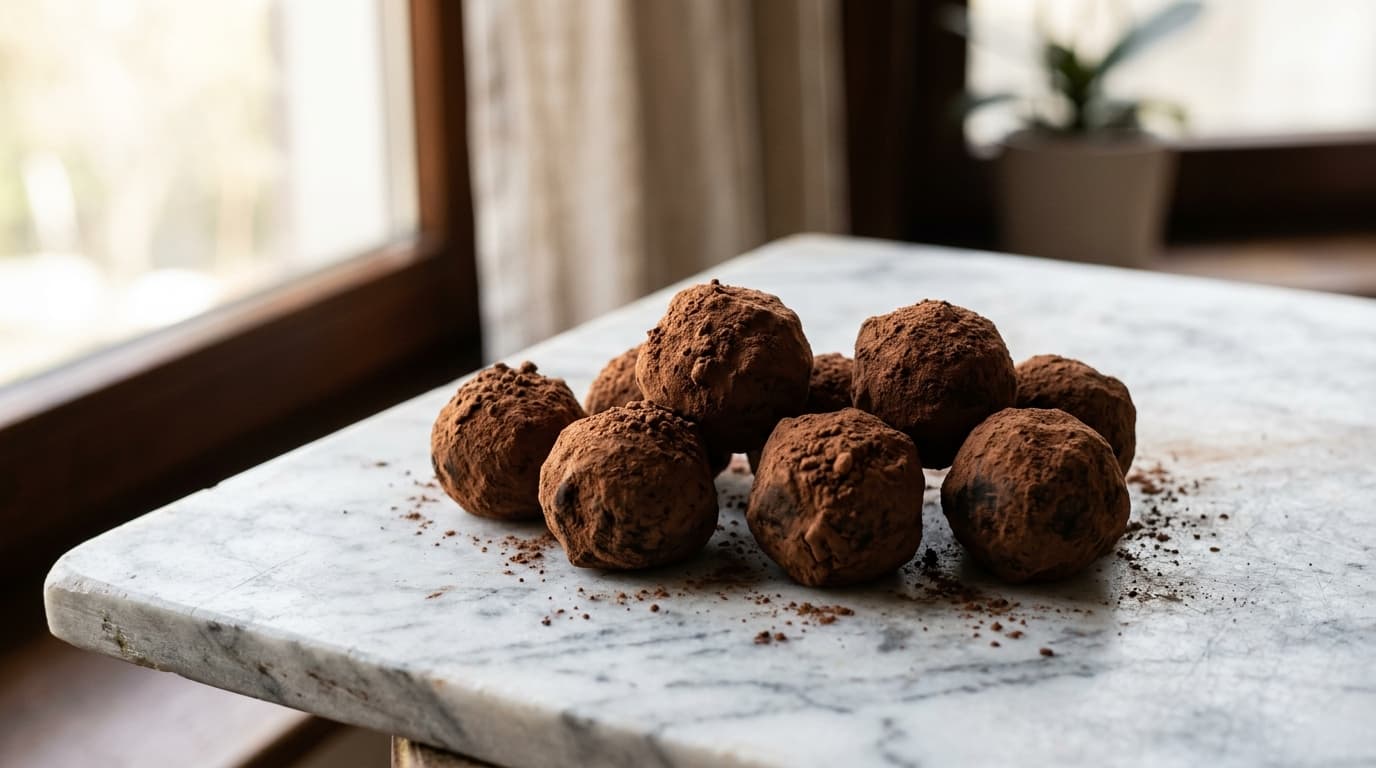
The best Belgian truffle depends on what you're after: Leonidas for the everyday fresh truffle, Neuhaus for the safe bet to give, Pierre Marcolini for the exceptional tasting. We tasted them side by side to help you choose without breaking the bank.
What makes a good Belgian truffle?
A good truffle rests on a fresh ganache — cream and melted chocolate, roughly one part cream to two of chocolate — coated in a thin layer of chocolate, then rolled in cocoa. The rest is decoration.
The ganache is the heart of the truffle: it's what melts in the mouth or stays pasty. When the cream is fresh and the chocolate well tempered, the truffle collapses gently under the tooth instead of clinging to the palate. At tasting, the difference is obvious between an artisan truffle, made in small batches, and an industrial one that keeps three months on the shelf.
The second marker is the coating. A shell that's too thick crushes the ganache; a thin shell lets the bitter cocoa answer the sweetness of the centre. It's that contrast, more than the name on the box, that separates a real truffle from a sugary ball.
Where does the chocolate truffle come from?
The truffle was born in France, in Chambéry, in 1895. The pastry chef Louis Dufour, short of ideas for the holidays, rolled balls of ganache in cocoa powder. The resemblance to the Périgord mushroom gave it its name.
From there, the recipe travelled. Belgian chocolatiers adopted it quickly and folded it into their own praline culture — that one invented at Neuhaus in Brussels in 1912. In Belgium, the truffle arrived in a country that already knew how to work shell and ganache, and found ideal ground there.
The result: when we talk about a Belgian truffle, we're talking about a French bouchée by origin, but refined by houses who had made a craft of it. Neuhaus even named its range with a nod to Périgord truffles, blurring the borders a little further.
Do Leonidas truffles live up to their reputation?
For everyday, yes, without hesitation. Leonidas makes its truffles daily in Belgium, without palm oil, and sells them by weight in store. The classic truffle pairs a dark-and-milk ganache, coated in dark chocolate and dusted with cocoa.
It's the house that democratised the truffle: you find it in almost every station and shopping street, at a per-kilo price far gentler than its rivals — often half of Marcolini. The trade-off is finesse: the ganache is a notch below a sharp artisan. But the freshness is there, and to fill a big box to share, it's unbeatable.
In the window, Leonidas's plain truffles sit beside the caramels and marzipans; you spot the truly fresh ones by their still-matte cocoa, not set hard. It's the truffle I recommend to anyone discovering the genre without blowing their budget.
Why are Neuhaus truffles a safe bet?
Because it's the ballotin that never misses its effect. Neuhaus is the great historic house: its plain truffle marries a cream-and-butter filling to a dark chocolate coating, with faultless consistency. It's the gift that takes no risk.
The price follows that status: expect often €6 to €8 per 100 grams depending on the selection. You also pay for reliability — a Neuhaus box given to in-laws or a client always makes a good impression. The house named its truffles after those of Périgord, a detail that says a lot about its taste for tradition.
Does Pierre Marcolini make the exceptional truffle?
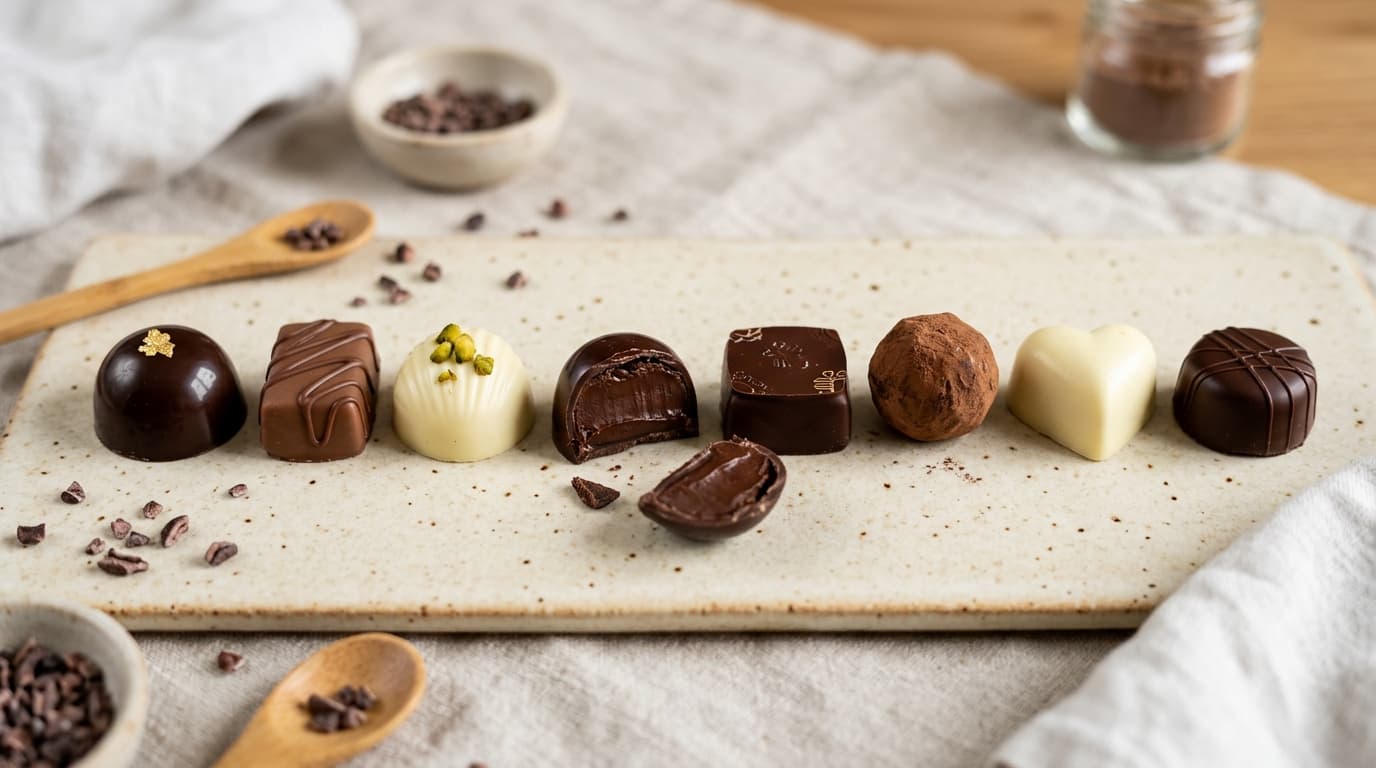
Yes, and this is where he tops the trio. Marcolini works bean-to-bar: he selects and roasts his own beans, giving truffles with a marked profile, sometimes tangy or fruity, far from the classic sweet truffle. For a tasting where every bite counts, it's the reference.
The price climbs accordingly: it's the most expensive of the three, by far. So save it for the occasions that deserve it — an exceptional gift, a discovery for a curious enthusiast, a truffle to savour one by one rather than by the handful. To judge the cocoa work, taste a plain ganache before the more elaborate creations.
Marcolini isn't alone on this high-end field: Wittamer, a Royal Warrant holder, plays in the same league, and Godiva remains a familiar option even if its Belgian roots have thinned. But for the finesse of the bean, we tasted for you: Marcolini keeps a step ahead.
The Marcolini truffle is savoured one by one; the Leonidas one is shared by the handful. Two pleasures, two budgets.
Which truffle for which occasion?
The rule is simple: start from the occasion, not the brand. To give without risk, Neuhaus. To share a big box without blowing the budget, Leonidas. To make a statement, Marcolini.
| Criterion | Leonidas | Neuhaus | Pierre Marcolini |
|---|---|---|---|
| Style | Accessible truffle | Classic truffle | Bean-to-bar truffle |
| Price | € | €€€ | €€€€ |
| Freshness | Made daily | Very consistent | Small batches |
| To give | Fine | Excellent | Exceptional |
| Everyday | Ideal | A bit pricey | Too pricey |
✓ Pros
- Leonidas: the best pleasure-to-price ratio
- Neuhaus: the gift that reassures every time
- Marcolini: bean finesse for a real tasting
✗ Cons
- Leonidas: finesse behind a sharp artisan
- Neuhaus: pricey for everyday
- Marcolini: reserved for big occasions
Want to go further on the houses themselves? We detailed their styles in our comparison of Belgian chocolatiers, and broke down another house specialty in the coffee manon face-off.
How do you keep truffles fresh?
A fresh truffle keeps between 15 and 18 °C, away from light and strong odours. Chocolate absorbs everything: stored next to a cheese or a coffee, it takes on the scent overnight. That's the first reflex, even before the fridge question.
And the fridge, precisely, is not advised. The cold makes the chocolate bloom — that grey veil on the surface — and the moisture spoils the ganache. If the heat leaves you no choice, wrap the box airtight and take it out a quarter of an hour before serving, so it comes back to temperature.
In the heart of a Belgian summer, keep your truffles in the coolest spot in the house, never in a car or on a windowsill. And above all, eat them quickly: a fresh truffle lives a few days, not a few months. That's the price of its texture — and its best proof of authenticity.
Not sure yet what kind of chocolate lover you are? Test yourself with our chocolate quiz before pushing open a shop door.
Pralines & spécialités comparator
Compare all pralines & spécialités side by side.
Compare now →
Frequently asked questions
Bruxelloise pur sucre, Margaux arpente les chocolateries belges depuis plus de dix ans. Ancienne pâtissière reconvertie dans le journalisme gourmand, elle goûte, compare et raconte le chocolat belge sans complaisance — des grandes maisons aux ateliers de quartier.