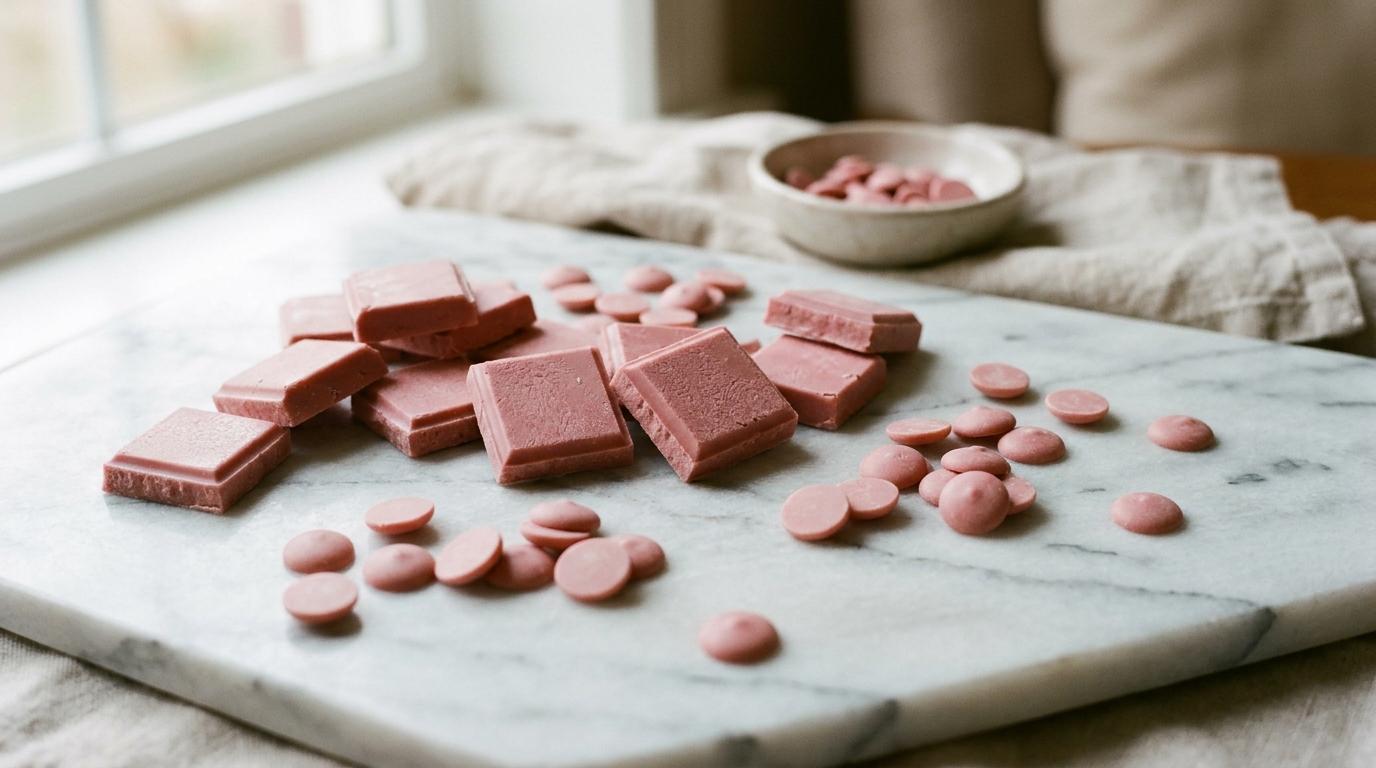
Ruby chocolate is a pink chocolate made from so-called "ruby" beans, introduced by Barry Callebaut in September 2017 as the fourth type after dark, milk and white. The maker says it adds no colouring and no fruit flavouring. The fruity tang comes from the beans and how they are treated.
What exactly is ruby chocolate?
A Belgian couverture, unveiled on 5 September 2017 by Barry Callebaut after more than ten years of research, codename RB1.
The first mass-market product was not Belgian. A pink Kit Kat came out on 19 January 2018 in Japan and South Korea, according to the Wikipedia page on ruby chocolate. Six weeks later, on 1 March 2018, Belgium met the raw material at the Tour & Taxis chocolate fair: La Libre reports that it was then reserved for craftspeople, that two of them, one in Uccle and one in Ghent, used it first, and that general sale through craftspeople was due to follow in early April. No supermarkets at the time. The paper mentions beans from Ecuador, Brazil and Ivory Coast, whereas the current sheet speaks of a blend from Latin America and West Africa.
Where does the pink colour come from, and is there a dye?
Callebaut writes in black and white that no berries, no berry flavouring and no colouring are added. The hue would already be in the bean.
The exact process remains an industrial secret. The 2010 European patent application, summarised by Wikipedia, describes unfermented beans, or beans fermented three days at most, treated with citric acid and then defatted. I cannot confirm that this is the method used today, and the maker does not publish it. A specialist quoted on the same page also recalls that naturally pink beans exist and that Peruvian chocolate makers worked a pinkish chocolate well before 2017.
The hue is therefore real. Whether it is "natural" in the sense of a chocolate type in its own right is, for its part, a matter of debate.
What does ruby chocolate taste like?
Fruity, tangy, closer to a raspberry white chocolate than to a dark one: that is the comparison found on Wikipedia. The Callebaut sheet lists four descriptors: blood orange, elderberry, tangy, buttermilk.
I did not taste any ruby for this article, and I would rather say so upfront than describe a mouthful I never had: this passage rests on two written sources, the maker's sheet and an online encyclopedia, so on second-hand descriptions that you can check yourself in three clicks.
Is ruby really chocolate?
On Belgian and European paper, the RB1 couverture sheet falls into the milk chocolate box. In practice, the maker itself hesitates over the word.
On 7 November 2026 I re-read the Canadian data sheet for the ruby RB1 couverture: at least 33.6% dry cocoa, at least 26.3% dry milk, 36% fat, fluidity 3. I then set these figures against the thresholds of Annex I of Directive 2000/36/EC. This calculation is mine, not that of an authority.
| Criterion | RB1 sheet (7 Nov. 2026) | Milk chocolate | White chocolate | "Dark" chocolate |
|---|---|---|---|---|
| Total dry cocoa | at least 33.6% | at least 25% | no minimum | at least 35% |
| Cocoa butter | not published | no separate minimum | at least 20% | at least 18% |
| Dry milk | at least 26.3% | at least 14% | at least 14% | none |
| Result of the comparison | thresholds exceeded | cocoa mass present, so not white | below the 35% floor |
Ruby clears two milk thresholds and stays under the dark floor. It cannot be white, since it contains cocoa mass. One caveat: the directive also demands a minimum of fat-free cocoa for milk chocolate, and the sheet does not publish it, so I cannot conclude full compliance.
On the American side, the FDA granted a temporary marketing permit in 2019 so the product could circulate as chocolate while consumer data was gathered. The Canadian page of the sheet specifies that the couverture is launched there as "ruby couverture", while waiting for ruby to be recognised with its own chocolate identity.
No European or Belgian authority settles it, to my knowledge. The "fourth type of chocolate" is a house formula, repeated by the press, not a category in the directive.
Where can you find ruby, and can you cook with it?
Yes, with a couverture in callets: the sheet recommends enrobing, flavouring and moulding, and mentions mousses. Fluidity is medium, at 3 on the house scale.
Bags exist in 400 g, 2.5 kg and 10 kg. I noted no price: the sheets I read displayed none, and I do not publish a tariff I have not seen. To learn how to handle this type of material, couverture chocolate and chocolate pistoles explain fluidity, tempering and formats.
Before buying, four checkpoints are enough:
- milk is a central ingredient (26.3% dry milk at least), so neither vegan nor milk-free;
- the name on the pack may be "ruby couverture" or "ruby chocolate" depending on the market, so read the ingredient list rather than the slogan;
- the sheet gives 18 months of shelf life, the date printed on the bag rules;
- the 400 g size is enough to test, before moving to 2.5 kg.
Which case for which decision?
| Your case | What the sheet says | Reflex |
|---|---|---|
| You want to taste it | Fruity, tangy flavour | 400 g callets, a few plain before any recipe |
| Vegan, milk allergy | At least 26.3% dry milk | Rule ruby out |
| You want a classic dessert chocolate | Descriptors blood orange, elderberry, buttermilk | Stay with a milk or dark chocolate |
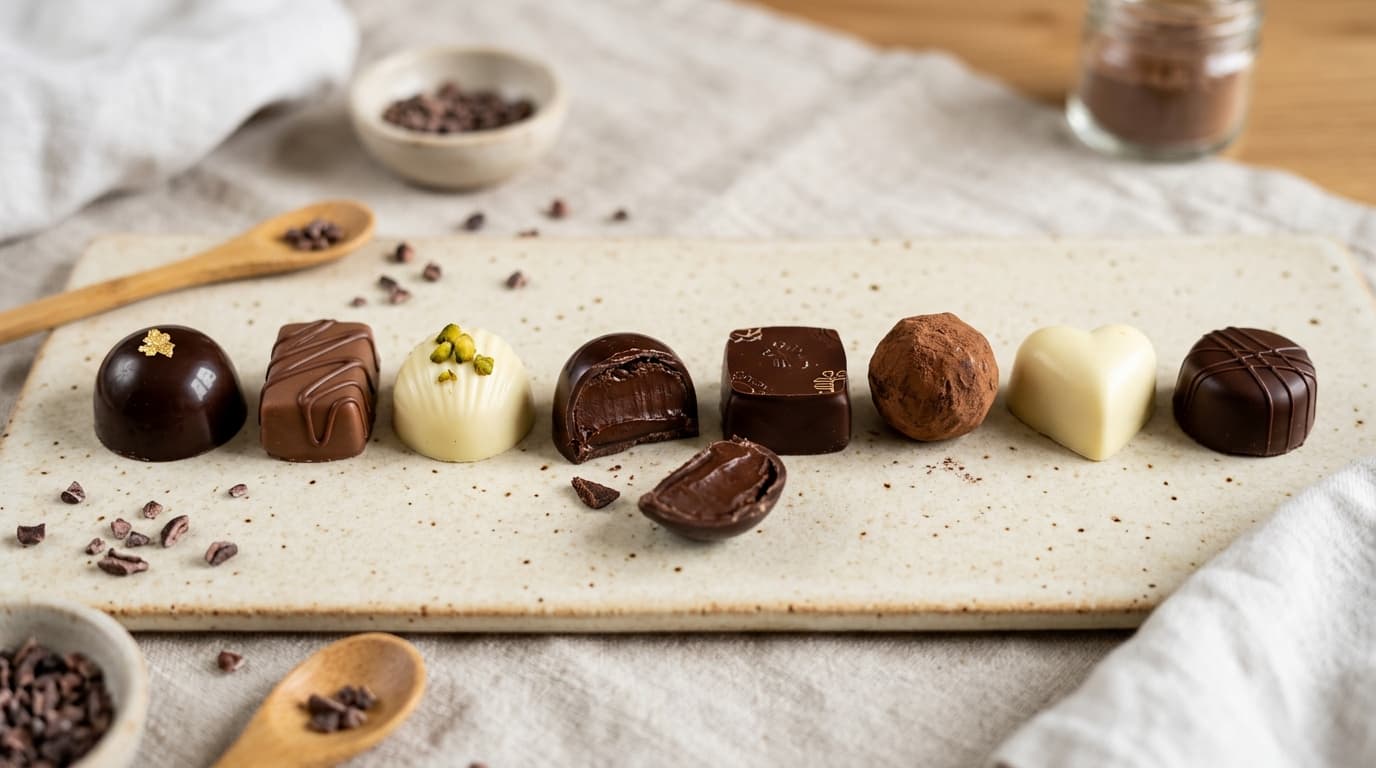
| You read "ruby" on a praline | The word says nothing about the percentage | Ask whether it is the Callebaut RB1 couverture |
My verdict: a curious couverture, worth tasting once
To compare with the dark reference, the cocoa percentage shows how to read a label. The houses that work chocolate in bars and ballotins are in the ranking.
Pralines & spécialités comparator
Compare all pralines & spécialités side by side.
Compare now →
Frequently asked questions
Bruxelloise pur sucre, Margaux arpente les chocolateries belges depuis plus de dix ans. Ancienne pâtissière reconvertie dans le journalisme gourmand, elle goûte, compare et raconte le chocolat belge sans complaisance — des grandes maisons aux ateliers de quartier.