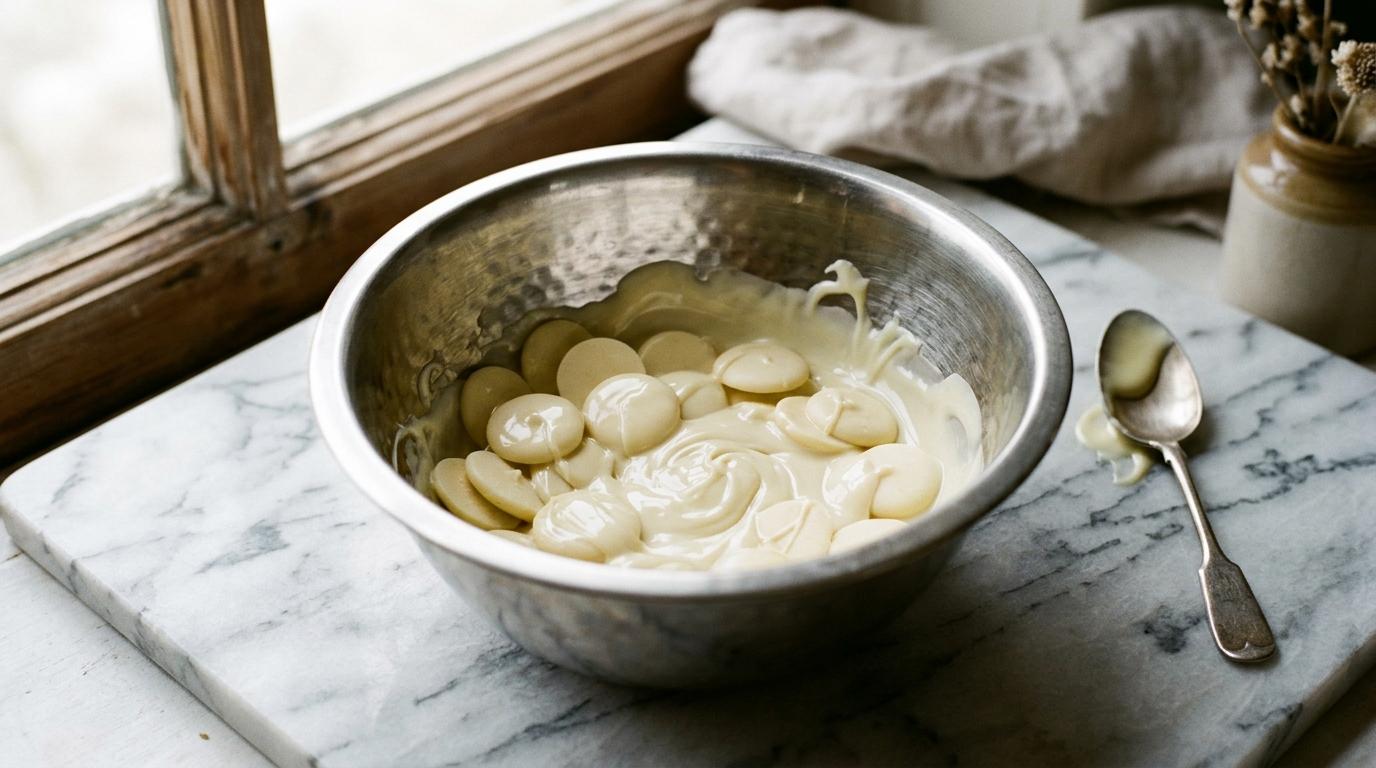
Yes, white couverture chocolate exists, but only in catalogues: EU law gives it no threshold of its own. The bag tells you what matters: its cocoa butter content. And once it is in the bowl, one rule outweighs all the others, never go above 45 °C.
Does white couverture chocolate have a legal definition?
No. And that is the first thing to know before paying.
The European directive 2000/36/EC defines white chocolate: at least 20 % cocoa butter, at least 14 % milk solids, of which 3.5 % butterfat. It also reserves the word "couverture" for dark and milk chocolate, with a floor of 31 % cocoa butter. White chocolate has no couverture version in the text, and makers use the word as trade practice.
The percentage printed on the bag therefore has a particular meaning. White chocolate contains no fat-free cocoa solids, the only part of cocoa it keeps is the butter: when Callebaut writes 28 % for its W2 or Valrhona 35 % for its Ivoire, it is cocoa butter they mean. Yet W2 shows 35.8 % fat on its sheet. The gap comes from whole milk powder, which brings its own fat, softer and quicker to melt.
Four white couvertures, sheet by sheet
On 13 November 2026 I read the makers' sheets and noted the displayed prices, VAT included, at sellers who deliver to private customers. The four sellers are not the same, which skews the comparison a little; neither are the pack sizes, which skews it a lot.
| Reference | Cocoa butter stated | Points from the sheet | Pack noted | Price noted on 13/11/2026 | Price per kilo |
|---|---|---|---|---|---|
| Callebaut W2, callets, maker's shop | 28 % minimum | 22 % milk solids, 35.8 % fat, 3 drops | 10 kg | 157.58 € | 15.76 € |
| Callebaut W2, callets, Horta (Belgian garden centres) | 28 % minimum | same | 2.5 kg | 42.90 € | 17.16 € |
| Cacao Barry Zéphyr 34 %, French reseller | 34 % (name) | skimmed and whole milk, soya lecithin | 1 kg | 26.00 € | 26.00 € |
| Valrhona Ivoire 35 %, fèves, French reseller | 35 % | 43 % sugar, 21 % milk, 41 % fat | 250 g | 12.90 € | 51.60 € |
| Belcolade Selection Blanc 30 %, Cacao-Trace sourcing | not detailed by the maker | "vanilla and cooked milk" | not noted | not noted | not noted |
Brought back to the kilo, Ivoire costs a little over three times as much as W2. The 250 g bag inflates the gap, and Valrhona also sells 3 kg bags that I did not find at retail that day. Belcolade, a Belgian couverture made by Puratos, publishes only one line of description on its page: without a sheet, I do not rank it.
W2 is a chocolate I worked with a lot in the kitchen back when I was a pastry chef. It is frankly sweet, very milky, vanilla-led, well-behaved. I did not taste all four side by side for this article, and I will not pretend otherwise.
20 %
Minimum cocoa butter to say white chocolate
45 °C
Melting ceiling for white
× 3.3
Price gap per kilo, W2 against Ivoire
Do you need a white couverture for baking?
For many recipes, no. The extra cocoa butter matters when the chocolate stands alone, thin and visible; drowned in cream, it no longer plays any part. Before buying, I go through these points:
- You mould shells, bars or Easter figures: couverture required, 3 drops is enough.
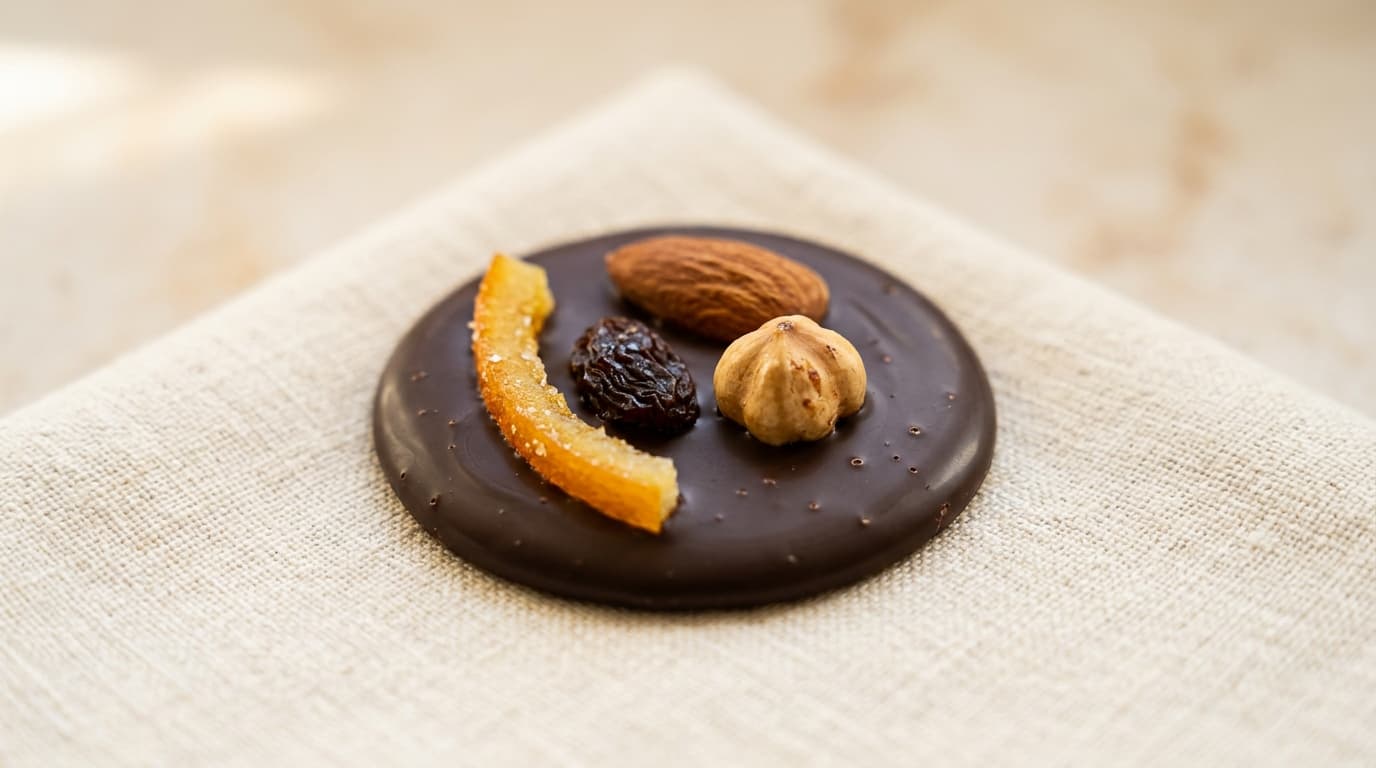
- You coat truffles or dip mendiants: couverture advised, for thinness and gloss.
- You make a mousse, a whipped ganache or a cheesecake: supermarket white baking chocolate gives the same result.
- You want less sugar: compare the "sugars" line on the labels, the product name will tell you nothing.
- You are feeding people with allergies: read the exact reference, soya at Callebaut and Cacao Barry, traces of nuts at Valrhona.
How do you melt white chocolate without burning it?
By heating it less than you think. Ivoire has 43 % sugar according to the sheet repeated by its reseller, W2 at least 22 % milk solids, and that mixture clumps into a grainy paste well before a dark chocolate suffers; I lost a whole bowl of callets one December evening, in the microwave, by running a full minute instead of three times twenty seconds, and the mass had turned sandy, dull, impossible to pour.
- Weigh, and chop if needed: whole discs melt evenly, a block must be grated.
- Choose your heat. In a bain-marie, the water barely simmers and the bottom of the bowl does not touch it. In the microwave, medium power, steps of 15 to 20 seconds.
- Stir at every stop with a dry spatula, bringing the edges towards the centre.
- Stop while a few pieces remain, and let the residual heat finish.
- Check with a thermometer: 45 °C at most for W2 according to Callebaut, 45 to 48 °C for Ivoire according to the sheet repeated by the reseller.
A drop of water or steam is enough to make it seize. Wipe the bowl before lifting it off the bain-marie.
What tempering curve for white chocolate?
| Chocolate | Melt | Cool | Work | Source |
|---|---|---|---|---|
| Callebaut W2 | 45 °C | 27 °C | 28 to 29 °C | Callebaut tempering guide |
| Valrhona Ivoire 35 % | 45 to 48 °C | 26 to 27 °C | 28 to 29 °C | sheet repeated by the reseller |
| Cacao Barry Zéphyr 34 % | 40 to 45 °C | 25 to 26 °C | 29 to 30 °C | sheet repeated by the reseller |
| Benchmark: Valrhona Guanaja 70 % dark | 55 to 58 °C | 28 to 29 °C | 31 to 32 °C | sheet repeated by the reseller |
White chocolate is worked three degrees lower than dark: milk fat lowers its melting point. A dark curve leaves it too warm, soft, never crystallised. The full method, by seeding or on marble, is in our guide to tempering chocolate.
Three failures that are not the chocolate's fault
White chocolate that yellows while melting has been heated too long, even below 50 °C. Tempered white that comes out streaked with greasy marks was cooled too fast or put in the fridge too early: the mechanism is explained in why chocolate turns white. And white chocolate that thickens in the bowl while you mould has not failed, it is crystallising: bring it up one degree, no more.
Which pack size should you buy?
One kilo, unless you mould every week. W2 keeps for 12 months according to its sheet, Ivoire 15 months, and a flavour as discreet as white chocolate's quickly betrays the slightest odour it picks up. An opened 2.5 kg bag next to the spices is lost in a winter.
Callebaut produces in Wieze, Belcolade in Erembodegem: finding a white couverture in a home-sized bag at a provincial garden centre is a very Belgian luxury. To compare with dark chocolate and its drops, couverture chocolate sets out the rules, and chocolate pistoles detail the formats and their prices.
To see which Belgian houses work their own chocolate on the shop-window side, the ranking of Belgian chocolatiers takes over, and the Wikipedia page on white chocolate traces its industrial history.
Pralines & spécialités comparator
Compare all pralines & spécialités side by side.
Compare now →
Frequently asked questions
Bruxelloise pur sucre, Margaux arpente les chocolateries belges depuis plus de dix ans. Ancienne pâtissière reconvertie dans le journalisme gourmand, elle goûte, compare et raconte le chocolat belge sans complaisance — des grandes maisons aux ateliers de quartier.