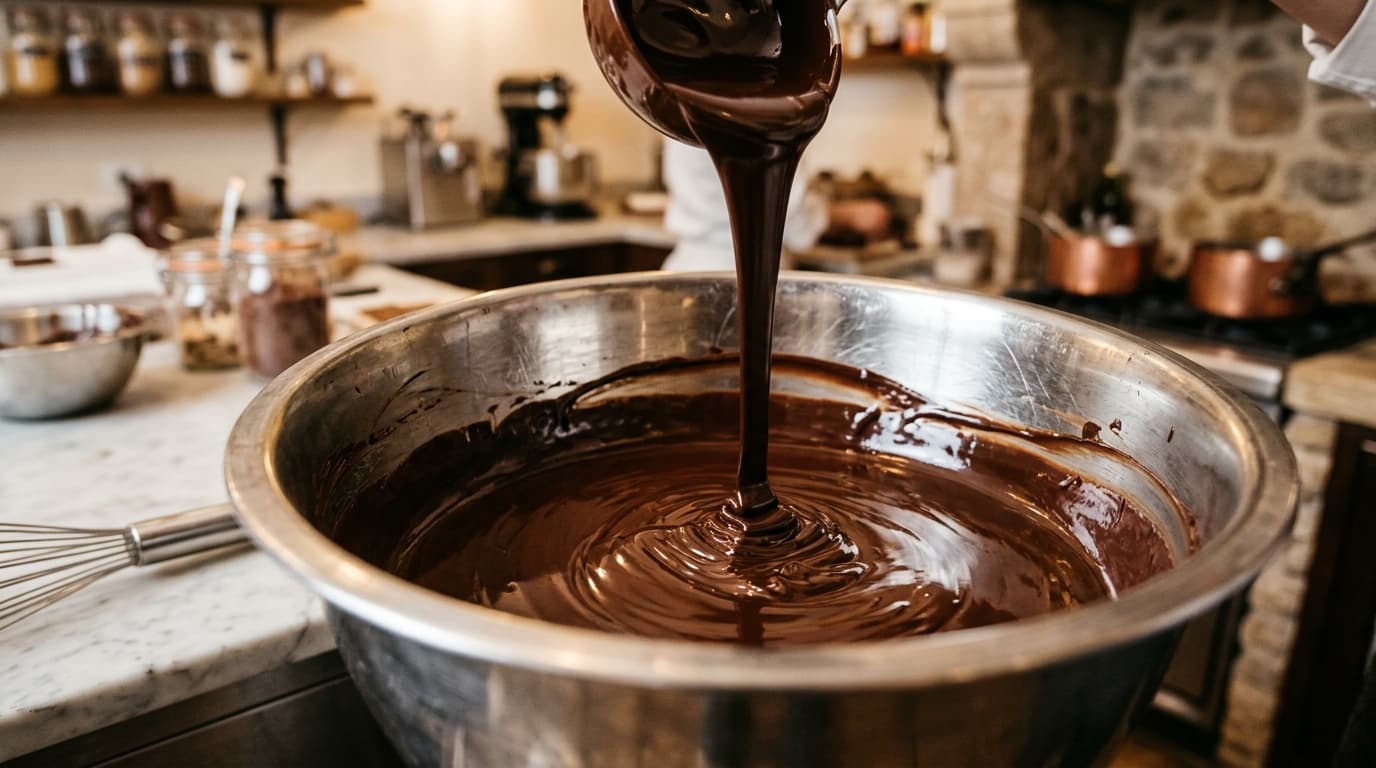
Conching is the step where liquid chocolate is stirred, hot, for hours, to dry it, drive off its acids and round off its grains. Quoted durations run from 4 to 78 hours, temperatures from 49 to 82 °C. Without it, a bar would be sandy and a little sour. Here are the figures, source by source.
What is chocolate conching?
A prolonged stirring of the chocolate paste, hot, after grinding and before moulding.
The Office québécois de la langue française defines it as a "refining of chocolate meant to bring out the aroma", which yields a soft, smooth paste through friction and stirring, followed by a final addition of cocoa butter and lecithin. Before this step, the mass is coarse, damp and slightly acid. Afterwards, it flows.
The word comes from the shape of the first vessels, which resembled a conch shell. According to Wikipedia, the work goes through three phases: dry, pasty, then liquid.
Who invented the conche, and why does Lindt keep coming up?
Because the inventor is Rodolphe Lindt, in Bern, in December 1879, according to Wikipedia's entry on Lindt. He had just founded his factory in the Matte district.
The story of the weekend when his machine supposedly ran by itself is probably apocryphal, notes the page on conching. It makes a surer remark: before the conche, moulded chocolate was often just cocoa paste and sugar, and cocoa butter became widespread after its adoption.
In 1899, Lindt sold his factory and the secret of conching to Chocolat Sprüngli for 1.5 million gold francs. The process was worth a fortune before it became a glossary word.
How long does conching last?
Between 4 and 78 hours depending on the source, a factor of 19. I found no duration printed on the Belgian product sheets I read.
| Source | Quoted duration | Quoted temperature | Nature |
|---|---|---|---|
| Venchi, Italian chocolatier | 12 to 72 h depending on variety | not given | brand blog |
| Wikipedia (EN), citing Ziegler and Hogg 2008 | up to 78 h; under 12 h in a modern rotary conche | not given | sourced encyclopaedia |
| Same page, citing Ranken et al. 1997 | about 4 h in a continuous conche, for milk chocolate | not given | same |
| Same page, citing Afoakwa 2010 | not given | 49 °C for milk, up to 82 °C for dark | same |
| OQLF, Grand dictionnaire terminologique (1990) | not given | 50 to 70 °C | official dictionary |
| Chocolate Alchemy, American amateur maker | 48 to 72 h or more mentioned, himself rarely more than 24 h | usually 54 to 57 °C (130 to 135 °F), sometimes 66 °C | craftsman's blog |
Temperatures diverge too: 33 degrees separate milk from dark within a single source.
From nose to tongue: acids driven off, grains under 20 micrometres
Four operations take place in the vessel:
- it dries the mass, because a little residual moisture is enough to thicken chocolate sharply, which is why machines are cleaned with cocoa butter rather than water;
- it removes part of the acetic, propionic and butyric acids thanks to the circulating air;
- it lets some roasting compounds oxidise, which rounds off the aroma;
- it polishes the cocoa and sugar grains down to around 20 micrometres, the size below which the tongue detects nothing, according to Wikipedia.
Above 20 micrometres, the mouth feels sand. Below, it feels cream. It is the only criterion the palate checks without a laboratory.
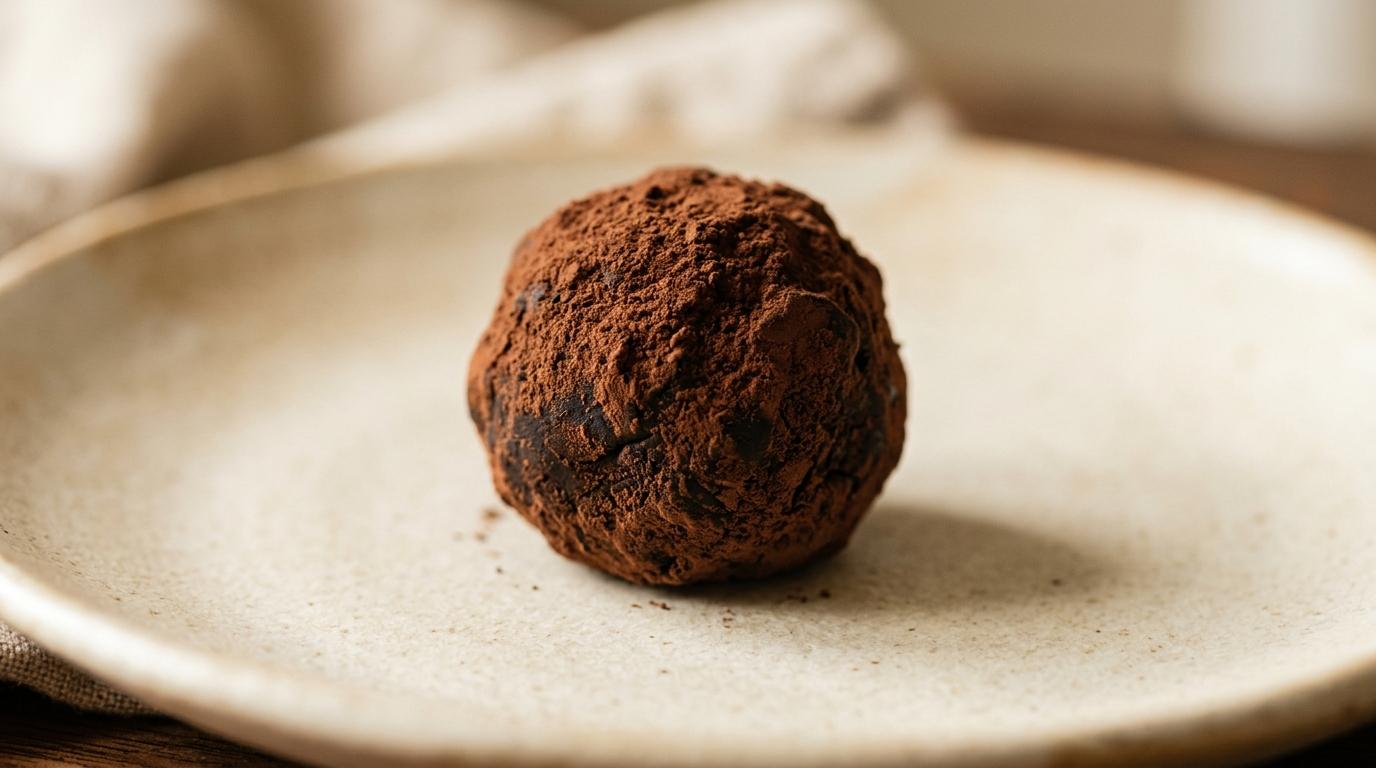
Soy lecithin: the last addition, and the only one visible on the label
At the end. The liquid phase allows viscosity to be adjusted with fats and emulsifiers depending on the intended use, and that is where lecithin comes in. It was introduced in the 20th century to improve texture and consistency.
It remains the only written trace of conching on a pack. I looked up the list for a common Belgian couverture, Callebaut 811 at 54.5% cocoa, from the sheet in the professional catalogue PS in foodservice, which names Barry Callebaut Belgium N.V. as manufacturer.
| Rank | Ingredient listed | Role |
|---|---|---|
| 1 | cocoa mass | base of the recipe, ground then stirred |
| 2 | sugar | grains polished during conching |
| 3 | cocoa butter | fluidity, partly added at the end of conching |
| 4 | emulsifier: soy lecithin | viscosity adjustment |
| 5 | natural vanilla flavouring | aroma |
The price of this couverture in a 2.5 kg bag was €35.06 at Cook & Bake on 1 November 2026, promotion included (recommended price €41.24), or €14.02 a kilo. On 29 August I had noted €35.79.
Soy must appear on the label among the allergens, under European Regulation 1169/2011. Belcolade states "100% cocoa butter" and natural vanilla for its Selection Noir, but its page does not list the emulsifier. Read the bag.
Can you conch chocolate at home?
Yes, with a granite stone melanger, but it is not a pastry cook's gesture.
In pastry, nobody conches. You melt a couverture that is already conched, then temper it, as in our guide to tempering chocolate. An American amateur maker cited above says he almost never goes beyond 24 hours and sees little difference between 24 and 48 hours. I do not own a melanger: I report his experience, I do not claim it as mine.
Does longer conching make better chocolate?
Not automatically. The Wikipedia page states that duration determines the final fineness, and that holds up to a point nobody publishes.
Past that point, heat works against aroma. The same American craftsman saw delicate beans turn flat and dull around 52 °C, and a hair dryer strip the aroma from a test. No rule fits every bean, which explains why houses keep their curves to themselves.
To understand what a couverture's fluidity changes in use, our article on couverture chocolate details Callebaut's drops. The cocoa percentage explains what the label says about the rest of the recipe, and why chocolate blooms extends the same story of crystals. Belgian houses that work their own paste are in the ranking. Durations come from Venchi and Chocolate Alchemy.
Pralines & spécialités comparator
Compare all pralines & spécialités side by side.
Compare now →
Frequently asked questions
Bruxelloise pur sucre, Margaux arpente les chocolateries belges depuis plus de dix ans. Ancienne pâtissière reconvertie dans le journalisme gourmand, elle goûte, compare et raconte le chocolat belge sans complaisance — des grandes maisons aux ateliers de quartier.