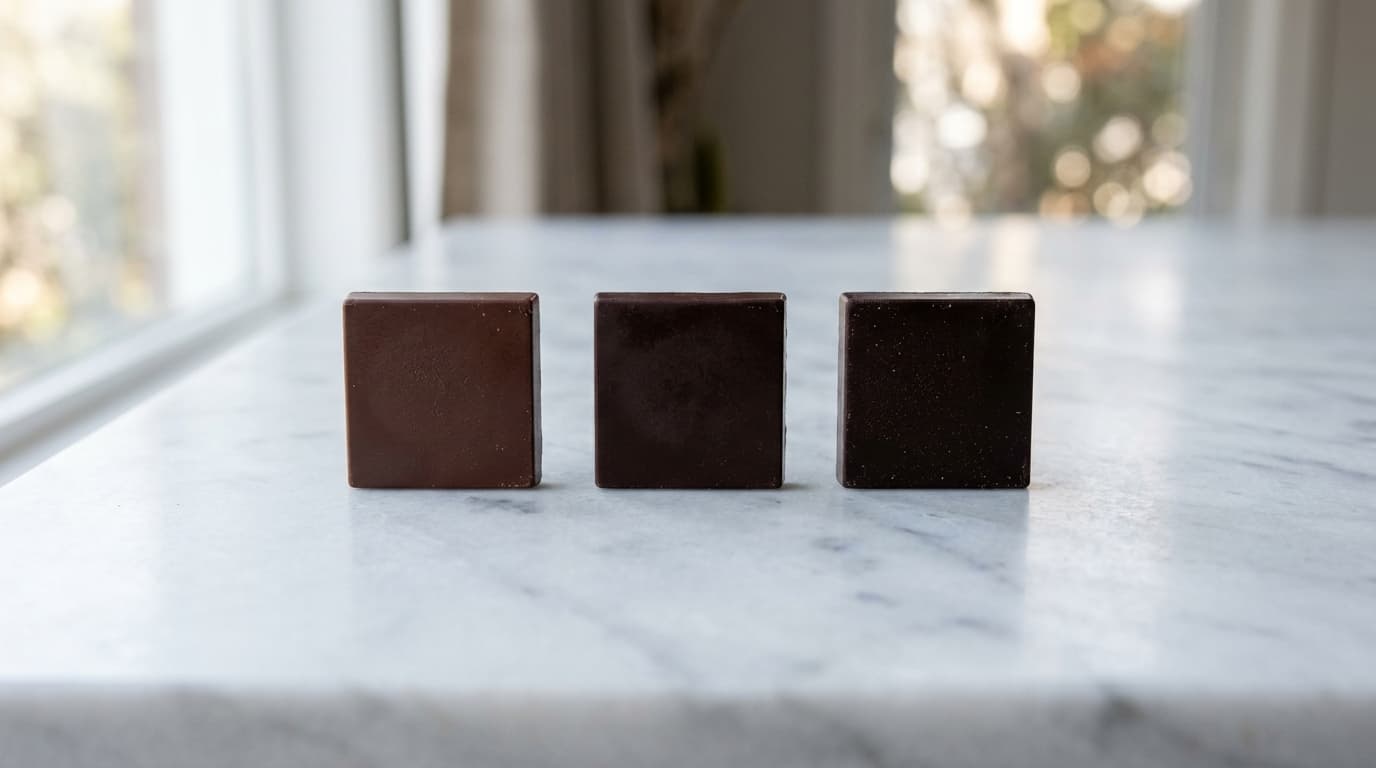
The cocoa percentage adds up what comes from the bean: mass, butter and powder. Everything else, or nearly, is sugar. A 54% dark chocolate holds around 44 g per 100 g, a 90% under 10. The number measures how much bean is in the bar, not how good the chocolate is.
From what percentage is a chocolate dark?
None. European law does not know the word "dark".
Directive 2000/36/EC, transposed in Belgium by the royal decree of 19 March 2004, defines a single "chocolate": at least 35% cocoa in total, including 18% cocoa butter and 14% fat-free cocoa solids. The shop-floor "dark" is not a legal category, it is a habit, and its only floor is those 35%. The other types are measured differently, as Annex I shows.
| Type (Annex I of the directive) | Minimum total cocoa | Minimum cocoa butter | Minimum milk solids |
|---|---|---|---|
| Chocolate (the "dark" of the shelf) | 35% | 18% | none |
| Milk chocolate | 25% | no separate minimum (total fat 25%) | 14% |
| White chocolate | no minimum | 20% | 14% |
| Couverture | 35% | 31% | none |
In practice, nobody sells dark at 35%. The two Belgian references read below start at 54%.
1884: Belgium sets the threshold before anyone else
The number everyone reads on a bar is a Belgian inheritance. In 1884 a law against food fraud demands 35% cocoa to use the name chocolate, while neighbouring countries settle for 32%. The royal decree of 18 November 1894 confirms the standard, which European directives and then the Codex Alimentarius take over, according to the summary by the European chocolate association Caobisco.
Mass, butter, powder: the percentage adds up three lines
Everything that comes from the bean, and nothing else: cocoa mass, cocoa butter and fat-free cocoa powder. The three are added into a single figure, which the label must repeat in the ingredient list in the form "cocoa: 70% minimum", according to the Test-Achats guide to dark chocolate. A minimum, then, not an exact dose.
What is left is calculated in one stroke: 100 minus the percentage. A 70% leaves 30 g per 100 g for sugar, soy lecithin, vanilla and, depending on the recipe, milk powder. Test-Achats gives the same benchmark: around 30% sugar for a 70% chocolate.
That subtraction is the one thing to remember.
54%, 70% or 90%: three dark chocolates, three amounts of sugar
On 29 October 2026 I read the data sheets of four products made in or sold in Belgium, and put their figures in a single table. I did not taste these bars side by side for this article: this is a reading of labels, not a tasting.
| Product read | Declared cocoa | Sugars per 100 g | For a 10 g square | Sheet |
|---|---|---|---|---|
| Côte d'Or Noir de Noir, 2 × 200 g, €12.88 per kilo | at least 54% | 44 g | 4.4 g | sugar first in the list, whole milk powder |
| Callebaut 811, couverture | 54.5% | 43 g | 4.3 g | cocoa mass first in the list, fluidity 3 drops |
| Callebaut 70-30-38, couverture | 70.5% | not published (free room: 29.5 g at most) | 2.95 g at most | 38.9% fat, fluidity 2 drops |
| Lindt Excellence 90% | 90% | 7 g | 0.7 g | community Open Food Facts sheet, flagged incomplete |
Only one of these figures comes from a sheet I would call fragile, the last one. I keep it because it gives the order of magnitude of a 90%, and I flag it so that you do not mistake it for a lab analysis.
A 200 g bar of Côte d'Or Noir de Noir therefore carries at least 108 g of cocoa and nearly 90 g of sugar. The figure makes you think: you buy dark chocolate believing you are avoiding sugar, and sugar makes up more than 40% of the weight.
Is a 70% always less sweet than a 54%?
With a comparable recipe, yes, and by a wide margin: this is arithmetic, not gastronomy.
Take the two 54% bars in the table. They leave 46 g and 45.5 g per 100 g once the cocoa is counted, and sugar fills 44 g and 43 g of it, more than 94% of the free room in both cases. The cocoa leaves the room, the sugar takes it. Move to 70% and the free room falls to 30 g: same logic, less space for sugar.
One reading trap remains. Ingredients are ranked by decreasing weight, and at Côte d'Or sugar comes first, ahead of the cocoa mass. That does not contradict the 54%: the cocoa is split across three lines (mass, butter, fat-free powder) that the percentage adds back together. At Callebaut 811 the cocoa mass opens the list, for a nearly identical rate. Two ways of writing the same recipe.
Another detail the name of the bar does not tell you: according to the retailer's page, Noir de Noir contains whole milk powder. A dark chocolate is therefore not necessarily milk-free, which matters for an allergy or a plant-based diet, covered in our guide to vegan Belgian chocolate. Check it on the packaging, since a shop's data sheet does not have the value of a label.
Is an 85% better than a 70%?
It is more bitter and drier, which is not the same thing as better. Less sugar to balance means less roundness: the mouth picks up tannin and astringency first, and only then the aromas, when it picks them up at all.
The percentage says nothing about bean origin, roasting, conching or how finely the mass is ground: two 70% bars can have nothing in common on the palate. It says nothing about health either. Our article on the benefits of dark chocolate shows that flavanol content cannot be predicted from the percentage, and that the dark colour sometimes comes from the very treatment that destroys them.
To choose, five checkpoints are worth more than the figure in large print:
- look for "cocoa: x% minimum" in the ingredient list, not only on the front;
- read the first ingredient: cocoa mass or sugar;
- compare the "of which sugars" per 100 g, never the slogan;
- spot vegetable fats, which the directive allows up to 5% provided they are written down, as our article on palm-oil-free chocolate explains;
- check for milk if you avoid it.
In the 2023 comparative test cited by that same Test-Achats guide, no sample contained added vegetable fat. The figure is reassuring, but it does not excuse you from reading.
Milk, white, ruby: three cases where the number changes meaning
Milk chocolate drops to 25% cocoa minimum, with 14% milk solids. White chocolate has no cocoa percentage in the sense of a dark bar: it rests only on cocoa butter, 20% at least, and on 14% milk solids.
One borderline case deserves a line. Callebaut's ruby couverture (RB1) shows 33.6% dry cocoa solids and 26.3% dry milk solids, and the house states that it sells it as "ruby couverture" while waiting to have it recognised as a chocolate with its own identity. It stays below the 35% floor of dark chocolate: a product the percentage alone cannot sort.
Which percentage for which use?
To go further on the material itself, couverture chocolate explains what the "fluidity" column of Callebaut's sheets means, and is Belgian chocolate really Belgian? comes back to the 35% threshold. The houses that work dark chocolate in bars are in the ranking.
Pralines & spécialités comparator
Compare all pralines & spécialités side by side.
Compare now →
Frequently asked questions
Bruxelloise pur sucre, Margaux arpente les chocolateries belges depuis plus de dix ans. Ancienne pâtissière reconvertie dans le journalisme gourmand, elle goûte, compare et raconte le chocolat belge sans complaisance — des grandes maisons aux ateliers de quartier.