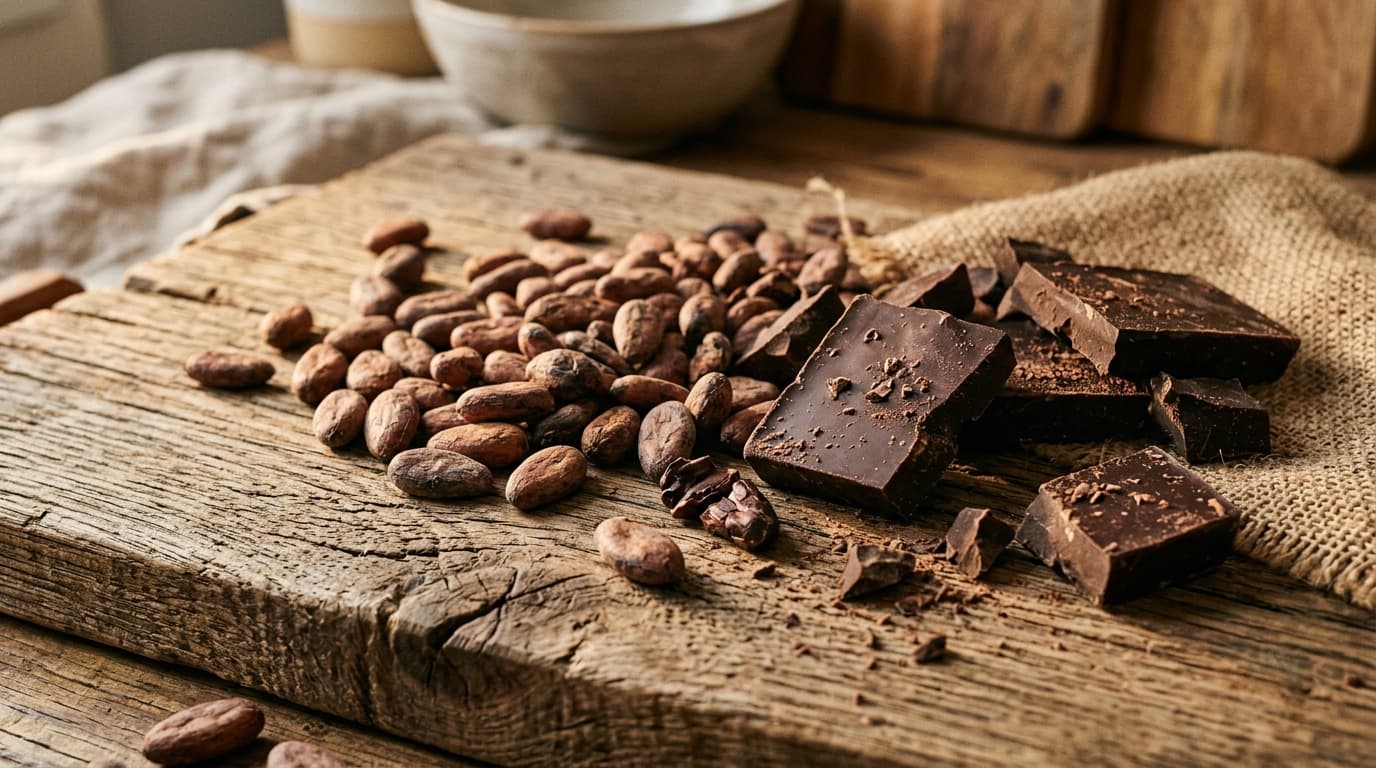
Cocoa has lost more than half its value since its December 2024 record. And yet, in the shop window and on the supermarket shelf, Belgian chocolate hasn't moved a cent — when it hasn't gone up again. This gap isn't a scandal: it comes down to the way chocolate makers buy their raw material. Here is the mechanism, with the numbers.
What is the price of cocoa today?
Between $3,200 and $5,700 a tonne, depending on when in 2026 you look. That's a wide range, and the range is the story: cocoa has become a jumpy market.
For nearly twenty years, the tonne sat quietly around $2,300. Then everything took off: an all-time record of $12,906 a tonne in December 2024, a fall to roughly $3,200 in April 2026, a recovery to $3,895 on 1 June, then around $5,700 in mid-August 2026. The London contract was trading near $4,120 over the same period.
Two exchanges quote cocoa, and they don't say quite the same thing. The New York contract (ICE US) is priced in dollars and references cocoa from Latin America and Asia. The London contract (ICE Europe) is priced in pounds sterling and covers African cocoa — the beans that mostly end up in our pralines. When an article quotes "the" cocoa price without saying which one, or when, be sceptical.
Why did cocoa prices spike and then crash?
Because supply ran short, then came back. Côte d'Ivoire and Ghana together supply most of the world's cocoa, and both countries strung together three difficult seasons: excessive rain, pod diseases, ageing plantations yielding less.
Global stocks emptied out. Investment funds piled into the gap, amplifying the move well beyond the real physical shortfall — a classic pattern on agricultural commodities, documented by the World Bank in its commodity tracking.
The swing back was just as brutal, for a reason that often gets forgotten: demand fell. By passing the increase on to consumers, manufacturers pushed grinding volumes down. Add better weather in West Africa and more attractive guaranteed prices for farmers, and supply picked up again. The International Cocoa Organization recorded a global surplus for the 2025/26 season.
None of it is settled. In July 2026, broker StoneX cut its 2026/27 surplus estimate from 149,000 to just 25,000 tonnes, pointing to an El Niño episode threatening the next harvest.
How much cocoa is actually in a bar of chocolate?
Far less than the public debate suggests. This is the calculation nobody runs, and it's the one that puts everything back in proportion.
A 100 g bar of 70% dark contains roughly 75 g of cocoa products. At $3,500 a tonne, beans cost $3.50 per kilo, around €3 at summer 2026 exchange rates. Those 75 g therefore cost about 22 cents in raw material. At the December 2024 peak, the same 75 g came to about 83 cents.
| Product | Cocoa (bean equiv.) | At $3,500/t | At the Dec 2024 peak | Difference |
|---|---|---|---|---|
| 70% dark bar, 100 g | ~75 g | ~€0.22 | ~€0.83 | +€0.61 |
| 33% milk bar, 100 g | ~35 g | ~€0.10 | ~€0.39 | +€0.29 |
| One 12 g praline | ~5 g | ~€0.015 | ~€0.055 | +€0.04 |
Orders of magnitude calculated from the bean price, excluding processing costs, at summer 2026 exchange rates. Read them as a benchmark, not as accounting.
The conclusion is blunt: even at the height of the spike, raw cocoa added only about sixty cents to a dark chocolate bar, and four cents to a praline. When a ballotin goes from €22 to €30, cocoa explains only a small part of the gap. The rest is sugar, milk, butter, the energy of conching, packaging, shop rent, wages and the margins of every intermediary.
At the height of the spike, raw cocoa added about four cents to the price of a praline. Everything else happened elsewhere.
Why isn't Belgian chocolate getting cheaper?
Because of hedging — in the financial sense, not the couverture sense. Manufacturers and the big houses don't buy their cocoa day to day: they lock it in 9 to 12 months ahead through forward contracts.
In practice, the chocolate you buy today was paid for with cocoa ordered last year, when prices were still flirting with their highs. The current fall will only reach the shelves once those stocks run out and new contracts, signed lower, take over.
The small artisan faces the same lag, only worse. They buy their couverture from a supplier such as Barry Callebaut — which supplies the bulk of Belgian chocolate — and inherit rates negotiated well upstream, with no way to hedge themselves. In Braine-l'Alleud, chocolatier Marie-Caroline Vroman explained in April 2026 that her couverture had gone from €6 to about €11 a kilo in a few years.
A fall in prices never passes through as fast as a rise, either. Nobody, in any supply chain, rushes to hand back a margin they've just rebuilt.
What does chocolate cost in Belgium today?
Distinctly more than before the spike, and the gap isn't closing. In spring 2026, while general inflation in Belgian supermarkets had fallen back to 2.22%, chocolate stood apart.
The figures reported by RTL in April 2026 show the scale of it: milk chocolate cost 16% more year-on-year, and 73% more than in January 2022. Dark chocolate was up 10% year-on-year and 87% since 2022. In plain terms, dark chocolate has almost doubled in four years.
Benchmarks recorded in shops in April 2026:
- At the Braine-l'Alleud chocolatier, a kilo of chocolate went from €48 to €68, with figurines from €3 to keep something affordable on the shelf.
- At Delhaize, Galler eggs reached about €40 a kilo, Milka products around €28, and own-brand lines around €20.
What strikes you most in store isn't the price tag: it's the format. Ballotins have slimmed down, hollow figures have got thinner, festive boxes hold one or two pieces fewer than before. The increase comes through weight as much as through the displayed price, and that is far more discreet.
Does the farmer see any of this money?
A little more than before, and that's the good news in this crisis. Historically, Ivorian and Ghanaian growers recovered only a few percent of the price paid at the till — most of the value being created in processing and distribution, a long way from the plantations.
The spike forced producing states to raise their rates. Côte d'Ivoire lifted its guaranteed farmgate price to 2,200 CFA francs per kilo in 2025, a historic record. That's a real increase, but it bears no comparison with the fivefold rise seen on futures markets over the same period: most of the spike played out between traders and financiers, not in the orchards.
Alternative supply chains work differently, decoupling the price paid to producers from market swings. Ethiquable applies a floor price of €5,000 a tonne. Tony's Chocolonely publishes its premium and its traceability. In Belgium, Belvas works with 100% organic and Fairtrade cocoa, while the big houses — Neuhaus, Leonidas — move collectively through Beyond Chocolate, the Belgian partnership launched in 2018. Pierre Marcolini plays a different card, buying direct from producers with traceability by origin, which leaves it less exposed to futures-market swings.
Will the EU deforestation regulation push prices up again?
Probably a little, and not straight away. Regulation (EU) 2023/1115, known as the EUDR, bans placing on the European market any product from land deforested after 31 December 2020. It covers seven commodities, including cocoa and cocoa butter.
The timetable has slipped: EU legislators agreed in December 2025 to a twelve-month delay and a simplification of the text. Application is now set for 30 December 2026 for large and medium companies, and 30 December 2027 for micro and small operators. The Belgian FPS Public Health sets out the obligations on the Belgian side.
What it changes in practice: every cocoa lot will have to be geolocated down to the plot. That's real progress for Ivorian forests, and an extra administrative cost that will end up in the price — modest next to the 2024 swings, but real. Small artisans, exempt until the end of 2027, will mostly depend on their couverture supplier's ability to document its origins.
Should you expect chocolate prices to fall?
Some easing, yes. A return to 2021 prices, no — and it's better to say so plainly than to keep the hope alive.
Three reasons. First, the hedges bought high will run out gradually through 2026 and 2027, which should ease prices without collapsing them. Second, cocoa is only a fraction of a bar's cost, and everything else — sugar, milk, energy, packaging, wages, rent — never came back down. Third, the global surplus is fragile: StoneX's July 2026 revision shows how fast a forecast can turn.
What to check in the window before you buy
The price climate changes how you buy, not the pleasure. Four reflexes are enough to avoid paying for the spike twice.
Compare the price per kilo, every time — it's the only figure that neutralises shrinking formats. Watch the weight of gift boxes from one year to the next, especially at Easter and Saint Nicholas, when hollow figures quietly get thinner. Prefer pralines sold by weight over pre-packed boxes: you buy the quantity you want, at the real price. And for everyday chocolate, own it: Côte d'Or and Galler deliver a pleasure-to-price ratio few artisans can match on that ground, as we set out in our round-up of the best Belgian supermarket chocolate.
Beyond that, the increase hasn't changed the pecking order between houses: it has simply made a wrong choice more expensive. Our ranking of Belgian chocolatiers and our comparison of which Belgian chocolatier to choose remain the best starting points — and if you're wondering what justifies that reputation, we took it apart in why Belgian chocolate is so renowned.
Histoire du chocolat comparator
Compare all histoire du chocolat side by side.
Compare now →
Frequently asked questions
Bruxelloise pur sucre, Margaux arpente les chocolateries belges depuis plus de dix ans. Ancienne pâtissière reconvertie dans le journalisme gourmand, elle goûte, compare et raconte le chocolat belge sans complaisance — des grandes maisons aux ateliers de quartier.