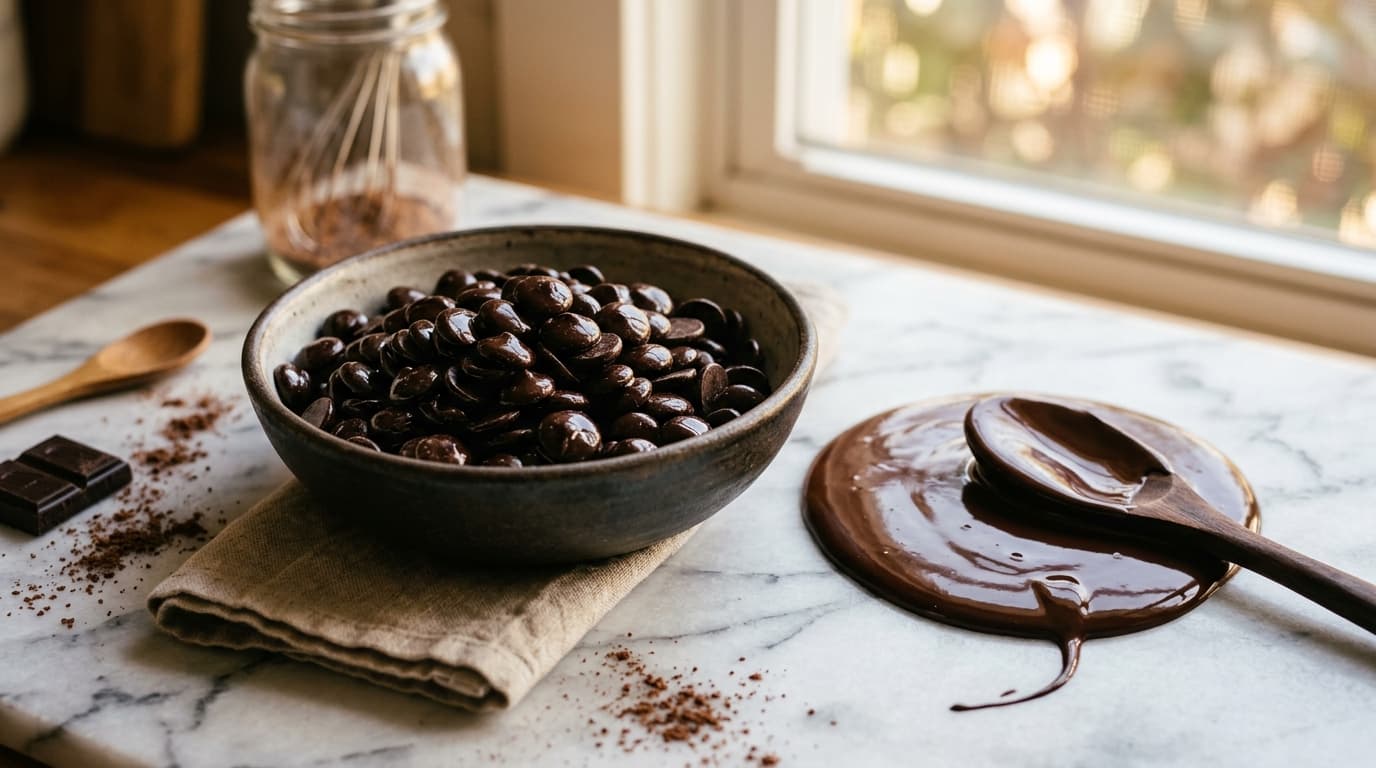
To bake in Belgium, the best value still comes from Callebaut 811 or 823 callets, at around €18 to €21 per kilo in retail. Belcolade follows close behind on quality, and Côte d'Or does the job perfectly for a brownie. Here is what to buy for which recipe, at what price and in which aisle.
Couverture or baking chocolate: what is the difference?
Only one thing really separates them: cocoa butter. Couverture chocolate contains at least 31%, which makes it fluid when it melts and glossy when it sets. Standard baking chocolate contains less, costs less, and stays thicker and matt.
That difference is invisible inside a cake and obvious on a surface. I ran the test one Sunday, the same mendiant recipe twice: with a supermarket bar, the chocolate set dull and bloomed within three days; with couverture callets, it still shines a week later and snaps cleanly under a finger. In a fondant, nobody would have spotted a thing.
Hence the simple rule: couverture is for when the chocolate stays visible and has to hold on its own. As soon as it is buried in a batter, a cream or a mix, a bar is plenty, and you save half the budget.
Which Callebaut should you choose: 811, 823 or W2?
The 811 for dark, the 823 for milk, the W2 for white. Those three references cover 90% of home baking, and they are the only ones easy to find on a Belgian shelf.
54.5%
Callebaut 811, dark
33.6%
Callebaut 823, milk
28%
Callebaut W2, white
The 811 is the workhorse dark: strong enough to stand up to the sugar in a ganache, gentle enough not to flatten a dessert. The 823 is the milk half the world's chocolatiers use — cocoa, milk, a hint of caramel — and it forgives beginner mistakes. The W2, at 28%, is trickier: white chocolate burns fast, so melt it low and never leave it alone over a bain-marie.
Callebaut was founded in 1911 by Octaaf Callebaut in Wieze, East Flanders, and merged in 1996 with the French house Cacao Barry to form Barry Callebaut. Wieze is now the largest chocolate production site in the world, and the group announced several hundred million euros of investment in its Wieze and Halle sites in early February (La Libre, 5 February 2026). In other words: the chocolate you buy in a 400 g bag comes out of the same factory as the chocolate many professionals use.
Belcolade or Callebaut: which one to buy?
Callebaut if you want to be able to restock on a Sunday evening, Belcolade if cocoa traceability matters as much as the recipe. Tasted blind, the gap between a 55% dark from each house is slim — far slimmer than the debate it triggers in home-baking groups.
Belcolade was created in 1988 by Puratos, a Belgian group headquartered in Groot-Bijgaarden, and its chocolate is made in Erembodegem, some twenty kilometres west of Brussels. The brand built its case on the Cacao-Trace programme, which pays farmers a premium for quality beans and returns a bonus for every kilo of chocolate sold, and its plant has been announced as the first carbon-neutral Belgian chocolate factory: 100% renewable electricity, no fossil fuels, and 90% of its water collected as rainwater.
The real tiebreaker happens in the aisle. Callebaut sits at Colruyt, in the supermarket, in handy bags. Belcolade is mostly found through specialist resellers, catering suppliers and baking-supply shops, often in 5 kg sacks. For home use, that is a genuine constraint.
✓ Pros
- Callebaut: available in Belgian supermarkets
- Callebaut: 400 g bags, right size for home baking
- Belcolade: Cacao-Trace cocoa, documented traceability
- Belcolade: made in Erembodegem, carbon-neutral plant
✗ Cons
- Callebaut: traceability less prominent on the classic recipes
- Belcolade: hard to find at retail, often only in 5 kg sacks
Can you bake with a Côte d'Or bar?
Yes, with no guilt, as long as the chocolate ends up buried in a preparation. Côte d'Or dark runs at 46% cocoa, melts well, costs less per kilo than couverture, and makes a thoroughly honest fondant.
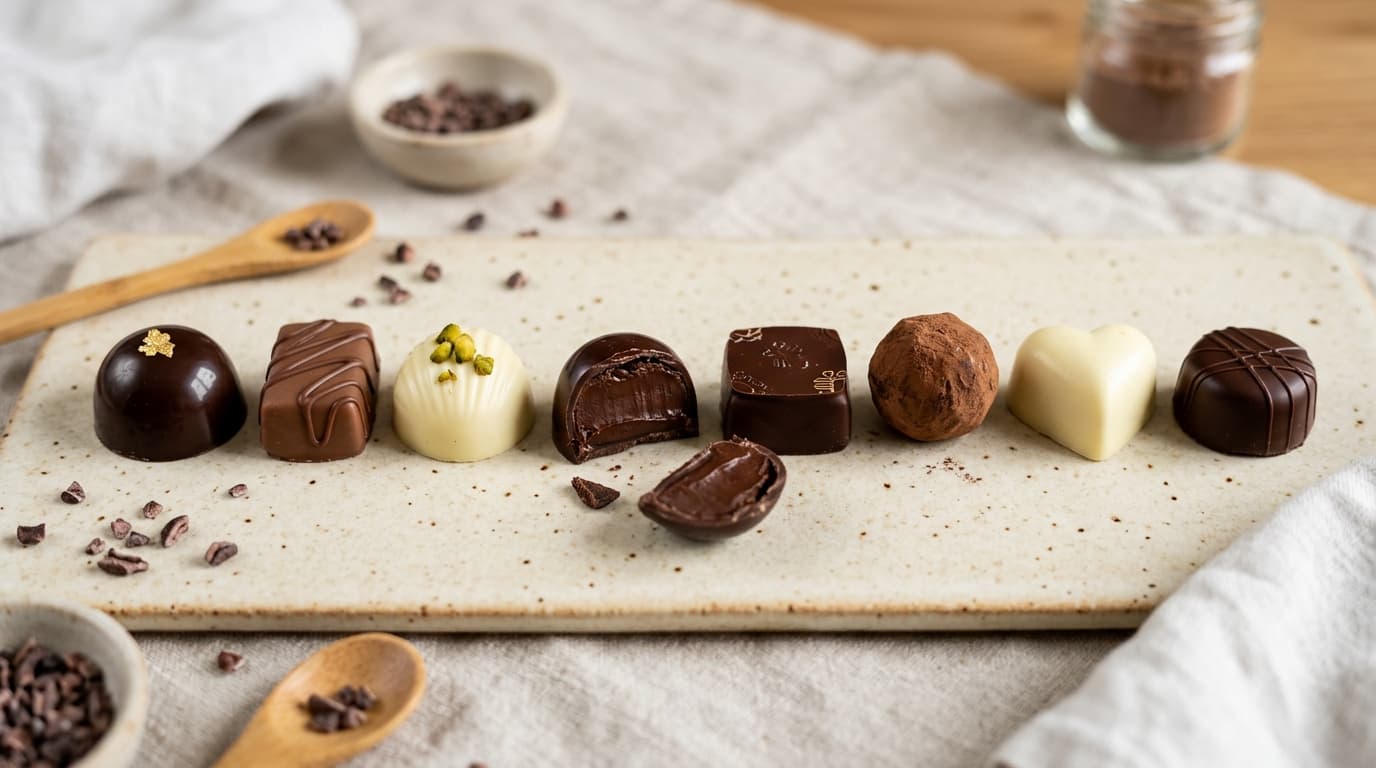
The limit arrives when it has to set. The bar contains soy lecithin and not enough cocoa butter to temper cleanly: praline shells will stick in the mould, decorations will bloom, coating will turn matt. That is not a manufacturing flaw — it is a product designed to be eaten, not worked.
Côte d'Or, a Belgian brand founded in 1883 and now part of the Mondelez group, is therefore perfect in a precise role: the Sunday chocolate mousse, the brownie, the warm sauce. For the rest of the supermarket aisle, we set out the right reflexes in our guide to the best Belgian chocolate at the supermarket.
The real waste is not buying couverture that is too expensive: it is melting 200 g of a fine origin bar into a brownie that would have tasted identical with a €3 tablet.
Where can you buy couverture chocolate in Belgium?
Colruyt is the easiest entry point: Callebaut callets sit in the baking aisle, in 400 g bags and 2.5 kg sacks, in dark, milk and white. As far as I know, it is the only major Belgian chain that carries all three recipes permanently.
Then come the specialist channels. Aveve, in its baking section, stocks couverture blocks and bags. Cook&Bake lists the full Callebaut range. Baking-supply shops — La Chapelloise in Wallonia, Hobbyscuit and the catering resellers — open the door to Belcolade, Cacao Barry and 5 kg formats. That is where you go when you move from "I'm making a cake" to "I'm making pralines".
Delhaize, Carrefour and the discounters bet on bars instead. Excellent for cooking, but back to the previous category: don't expect serious tempering from them.
How much does couverture chocolate cost per kilo?
Around €18 to €21 per kilo for Callebaut callets at Colruyt as I write this. The 400 g bag of 54.5% dark is listed at €8.39, just under €21 per kilo; white at €7.19, about €18 per kilo; and the 2.5 kg sack sits near €45, bringing the kilo down to roughly €18.
Set against a supermarket bar at €8 to €10 per kilo, couverture looks expensive. Brought back to a single recipe, it isn't: 200 g of 811 in a chocolate tart for eight is about €4 of chocolate. The price gap plays out on large volumes, so on people who produce — not on a Sunday dessert.
The only trade-off that really counts: if you bake more than once a month, take the 2.5 kg sack. Sealed, away from light and nowhere near the fridge, couverture keeps for well over a year without losing anything.
Which chocolate for which recipe?
No single reference wins everywhere. Here is how to decide at a glance, from the simplest to the most technical.
| Recipe | Chocolate to use | Why |
|---|---|---|
| Brownie, fondant, soft cake | Côte d'Or dark 46% bar | The chocolate is buried, couverture adds nothing |
| Chocolate mousse | Callebaut 811 or a dark bar | Some fluidity helps, but it isn't required |
| Tart or macaron ganache | Callebaut 811 (dark) or 823 (milk) | Smooth texture, stable emulsion in the fridge |
| Praline shells, moulding | Couverture only (811, Belcolade Noir) | Only pure cocoa butter tempers and releases |
| Coating, decorations, shavings | Dark or milk couverture | Gloss and a clean snap, no blooming |
| White chocolate, glazes | Callebaut W2 28% | Melts at low temperature, very heat-sensitive |
| Homemade hot chocolate | 823 or cocoa powder | Milk brings the melt, cocoa brings the intensity |
For that last line, everything actually hinges on the powder: our comparison of the best cocoa powder goes through the brands that hold up.
Should you trade up to a single-origin chocolate?
Only when the chocolate is the star of the plate. An origin bar from Pierre Marcolini, Millésime Chocolat or Benoît Nihant brings an acidity, a fruitiness, sometimes a frank bitterness that no industrial couverture delivers — but it also costs three to four times as much per kilo.
The right use: a plain, barely sweetened ganache where you want to taste the bean. The wrong use: any recipe loaded with butter, flour and sugar, which flattens the aromatic profile within ten minutes in the oven. We tasted both versions of the same ganache for you, one made with 811, the other with an Ecuadorian origin bar: the gap is obvious on the first third of the spoon, and invisible once the ganache sits in a tart with a shortcrust base.
One honest note about these houses: they sell tasting bars, not professional couverture. They melt beautifully, but they are neither calibrated nor designed for tempering. If you want to understand what origin work really changes, our piece on Belgian dark chocolate covers the ground.
The three mistakes that ruin a tempering
They come back every time, and none has anything to do with the brand you bought.
The first: too much heat. Above roughly 50°C for dark, and lower still for white, chocolate thickens and turns grainy. Use a barely simmering bain-marie, never boiling, and take it off the heat before everything has melted.
The second: a drop of water. A poorly dried whisk, steam falling back into the bowl, and the chocolate seizes into a compact paste. That is unrecoverable for coating — turn it into a ganache and start again.
The third: working in a 26°C kitchen. Tempering depends as much on the room as on the bowl. Chocolatiers work at around 18 to 20°C, and that is exactly why a coating fails in July and succeeds in January with the very same chocolate.
Want to know what kind of chocolate lover you are before stocking your cupboard? Take the chocolate quiz.
Pralines & spécialités comparator
Compare all pralines & spécialités side by side.
Compare now →
Frequently asked questions
Bruxelloise pur sucre, Margaux arpente les chocolateries belges depuis plus de dix ans. Ancienne pâtissière reconvertie dans le journalisme gourmand, elle goûte, compare et raconte le chocolat belge sans complaisance — des grandes maisons aux ateliers de quartier.