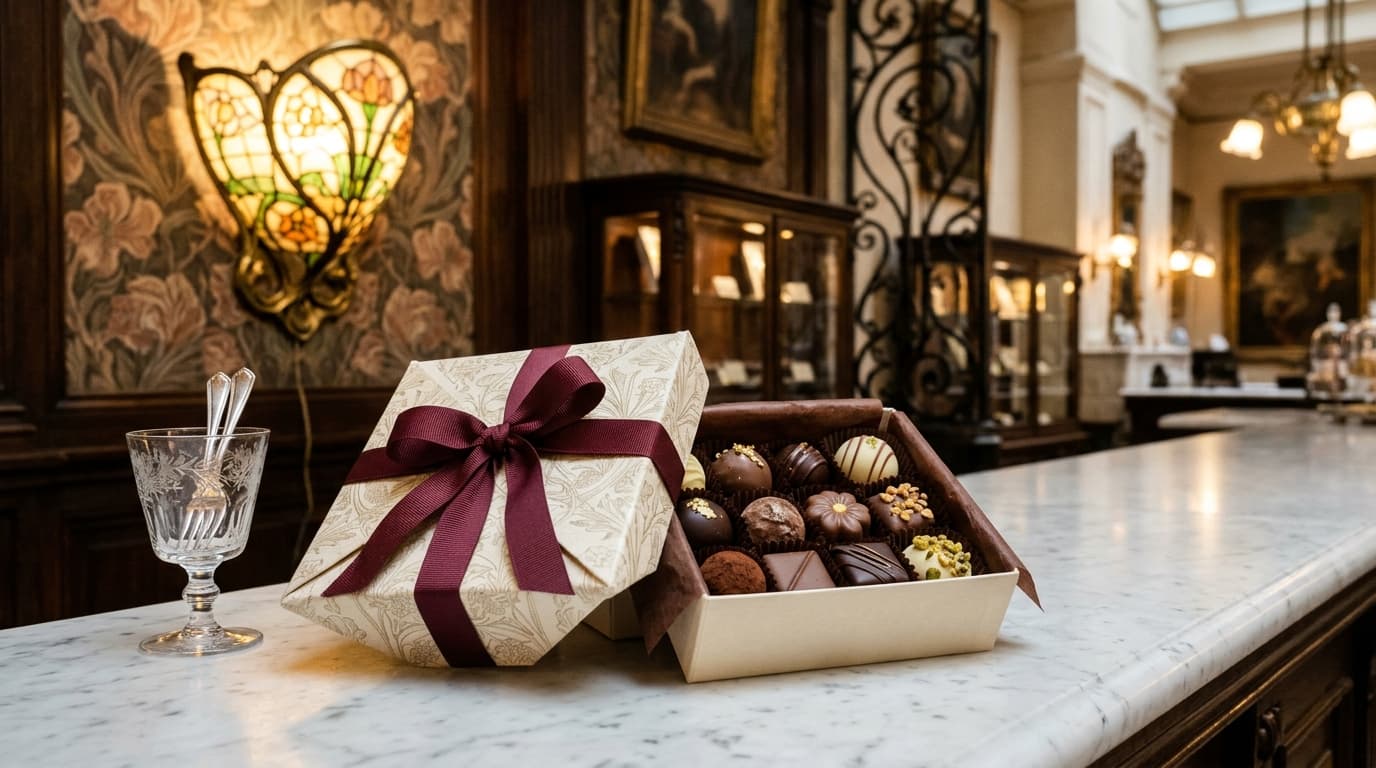
A 470 g Corné Port-Royal ballotin costs €33 on 27 October 2026, so €70 a kilo. That is a third less than a Neuhaus ballotin, the house that bought Corné in 2013, and 68 percent more than a Leonidas ballotin. Here is what the house's pages say, and what they leave out.
On 27 October 2026, I read Corné Port-Royal's official pages, then recorded prices wherever they exist. The house's website displays none. It points to a web shop run by a gift platform, and that is where I took my figures, completed with those of a Belgian retailer in Hannut. I did not go back to a shop for this survey, and I did not taste a ballotin on the occasion: the inquiry covers prices, addresses and ownership.
How much does a Corné Port-Royal ballotin cost?
€33 for the 470 g ballotin, whatever its contents: assorted, all dark or all milk, the price is the same on the web shop the house points to. That works out at €70.21 a kilo.
Here are all my 27 October 2026 records, brought back to the kilo.
| Product | Source | Weight | Price | Price per kilo |
|---|---|---|---|---|
| Assorted ballotin, dark or milk | web shop the house points to | 470 g | €33.00 | €70.21 |
| Chocolate truffles, about 11 pieces | web shop the house points to | 175 g | €15.50 | €88.57 |
| Orangettes, about 30 pieces | web shop the house points to | 175 g | €20.00 | €114.29 |
| Chocolate truffles, about 11 pieces | Belgian retailer (Hannut) | 175 g | €16.70 | €95.43 |
| Bar, dark 60%, dark 88% or milk 37% | Belgian retailer (Hannut) | 70 g | €4.89 | €69.86 |
| Assorted ballotin, four sizes | Belgian retailer (Hannut) | 235 to 705 g | €9.60 to €52.90 | cannot be calculated |
The last line needs a word. The retailer lists four ballotin sizes (235 g for 17 pralines, 353 g for 26, 470 g for 34, 705 g for 50) and a price range, but attaches no price to any size. If the €52.90 corresponds to the 705 g, the kilo falls to €75.04, a little above the web shop's €70.21. That is a hypothesis, not a record.
The seasonal catalogue goes well beyond this table. The Hannut retailer lists an Advent calendar at €34.00, with no weight, Christmas filled ballotins from €17.60 to €52.90 and a red "leather" box of 20 pieces at €29.50; several Christmas and Easter items were out of stock when I looked. Without a weight, I do not bring them back to the kilo, and I do not compare them with the other houses' calendars, which our table of Advent calendars brings together.
To place these figures, my 7 September survey, published in the article on the Belgian ballotin, found €41.80 a kilo at Leonidas and €105 at Neuhaus. At €70, Corné Port-Royal sits a little above the middle of the gap, on the Leonidas side. The comparison remains indicative: the other two prices come from the houses' own shops, this one from a third-party platform that may have its own margin, and the contents of a ballotin vary from one brand to another.
A kilo of truffles at €88, a kilo of orangettes at €114
Format sets the price, as at every house.
Sold in a 175 g box, the truffles cost 26 percent more per kilo than the 470 g ballotin, and the orangettes 63 percent more. Per piece the difference reads differently: a truffle works out at €1.41 (€15.50 for about eleven), an orangette at €0.67 (€20 for about thirty), and a ballotin praline at a little under a euro if you take the 34 pieces the retailer lists for the 470 g.
Truffles are nonetheless the specialty put forward by the Galeries Royales Saint-Hubert website for the gallery shop: butter truffles, in dark chocolate, salted butter caramel and espresso coffee. Paying €88 a kilo for them is reasonable for a house specialty. Orangettes at €114 are another matter.
Founded in 1932 by Maurice Corné, the manon sucre dates from 1935
The house's founder is a young pastry chef, Maurice Corné, who set up as a chocolate maker in Brussels in 1932, rue Montagne aux Herbes Potagères, according to the history page of the official website. Success came quickly, to the point of employing about thirty people. The business was first called simply "Corné", and it took the "Port-Royal" tag to stand out from the family's other praline makers, on a date the website does not give.
In 1935 came the manon sucre: fresh cream, nougatine and walnut kernel, coated in chocolate, still made by hand according to the house. It has remained the brand's emblem.
The shop in the Galerie de la Reine, at number 5, welcomed Maurice Chevalier, according to the Galeries Royales Saint-Hubert website, which describes it in an Art Nouveau setting and says it opens every day from 9:00 to 23:30. The house's website today speaks of about fifty craftspeople.
Who owns Corné Port-Royal today?
Neuhaus, indirectly, but nobody says so on the house's website.
This is the sharpest contradiction in my inquiry. The Wikipedia page on the brand tells a succession of owners that stops in 1990, with the takeover by Chocolats Vanparys, and states that the products are made by Vanparys and distributed under franchise. It mentions neither Neuhaus nor any more recent date. Its timeline starts in 1932 with a chocolate maker called "Corné Côte de France", passes through a move to Istanbul and the sale of the Brussels activities to the Mondose chocolate company in 1977, then arrives at Vanparys. The page itself flags a lack of sources on several of these lines. It spells the name two different ways within the same text. Anyone relying on it today therefore believes they are buying a product made by a different group from the one that bought the house thirteen years ago.
Yet on 13 May 2013, RTBF announced that Neuhaus Holding, a group managing several chocolate brands, was buying the Wavre chocolate maker. The article gave three commitments: 45 jobs kept, pralines still made in Wavre, and Corné Port-Royal's management remaining independent. The financial terms were not disclosed, and the article does not say whether the purchase covered the company, the factory or the brand.
Thirteen years later, La Libre writes that Bois Sauvage, the Paquot family holding company, already owns 100 percent of Neuhaus, and has just bought the third of Jeff de Bruges it did not yet hold (announcement of 5 March 2026). The holding's chocolate division, Neuhaus included, reached €300 million in turnover in 2025.
That leaves the missing link. I found no document after 2013 stating in black and white that Bois Sauvage owns Corné Port-Royal through Neuhaus. The "Neuhaus & Corné Port-Royal Outlet Wavre" label on Neuhaus's website points that way without proving it, and Corné's website has no legal notice page, no company number and no name of a manager.
Where to find a shop: eight addresses recorded, twenty claimed
The text of the official website speaks of about twenty shops in Belgium and fifteen in France. Its own shop list, consulted on 27 October 2026, shows eight in Belgium and none in France on the page I could read. A franchise directory, updated on 1 April 2026, counts twelve in total. Three figures, three sources, and nothing to reconcile them.
The eight addresses on the official list:
| Town | Address |
|---|---|
| Brussels | rue au Beurre 46 |
| Brussels | Galerie de la Reine 5, open 9:00 to 23:30 every day |
| Brussels | Gare du Midi, inside the "Belgian Chocolate House", avenue Fonsny 47B |
| Zaventem | Brussels Airport, terminals A and B |
| La Hulpe | La Mazerine shopping centre, avenue Albert Ier |
| Wavre | avenue Vésale 12, open Monday to Saturday from 10:00 to 18:00 |
| Hannut | route de Landen 61 |
| Jodoigne | Les Gotteaux, rue de Piétrain 7 |
The gap is perhaps explained by franchised points of sale, corners and retailers, which the list may omit. That is a guess: the house writes it nowhere.
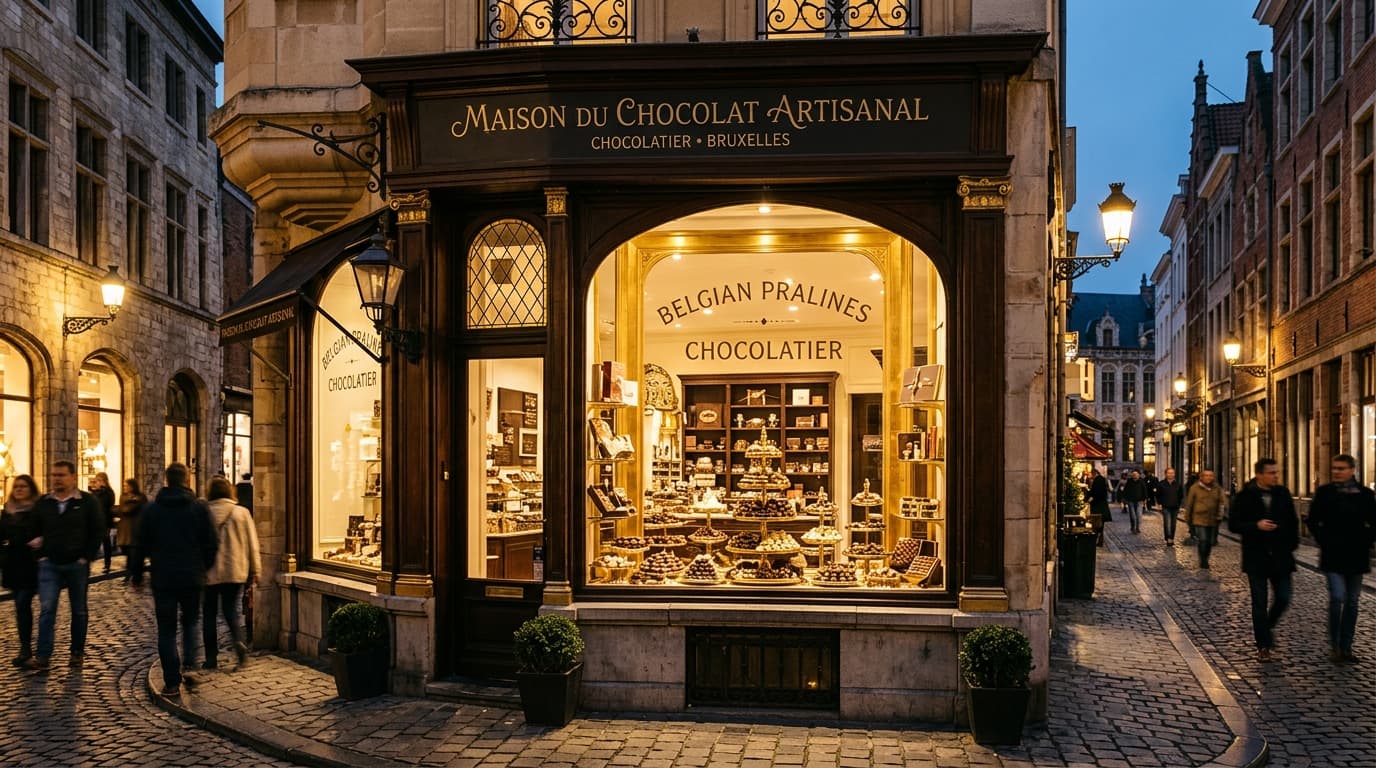
Is there a Corné Port-Royal outlet in Wavre?
Yes, according to Neuhaus, whose website lists "Neuhaus & Corné Port-Royal Outlet Wavre", avenue Vésale 12, Monday to Saturday from 10:00 to 18:00, closed on Sunday, with in-store collection and access for people with reduced mobility. The page announces closures on 1 and 11 November, 25 December and 1 January.
The same address appears on Corné's website, with the same hours, but under an ordinary shop heading. Neither says what is sold there or at what price.
The only price evidence I found dates from June 2013: a blog described a factory shop at avenue Mercator 10, in Wavre, selling pralines "rejected" for a packaging or appearance flaw at €10 a kilo from three kilos. That is a different address and thirteen years apart. Draw no promise of a price from it: call 02 568 23 65 before making the trip.
The commitments on display, none verifiable from here
The house's website claims an "ethical and sustainable" chocolate, with no added vegetable fat, made with whole milk and fresh butter, and a marzipan at 40 percent Faro almonds, from Portugal. These are manufacturer's statements. I have neither the ingredient list of each piece, nor a certification cited by the house, nor a visit to the Wavre workshop to my name.
A practical detail follows. The Hannut retailer describes its assorted ballotin as "without fresh cream", whereas the manon sucre, the house's emblem, is made with fresh cream. The classic ballotin may therefore not contain the manon. If you are buying for it, ask for the composition or take the box that names it.
Four checks before buying
- Ask for the ballotin's composition if you want the manon sucre.
- Compare per kilo: €70 for the 470 g ballotin, €88 for the truffles, €114 for the orangettes.
- Call before going to the Wavre outlet: 02 568 23 65.
- Keep the box between 15 and 18°C, never in the fridge.
A white film does not change the taste, says the house
The house's FAQ advises 15 to 18°C and keeping it out of the fridge. If a white film appears, it comes from temperature or humidity; the house says it does not change the taste, and our article on chocolate that turns white explains why.
The reservations, because they count as much as the rest
The prices in this article come from a gift platform and a retailer, not from a shop of the house: the in-store price on rue au Beurre or in the Galerie de la Reine may differ. The retailer attaches no price to a ballotin size. I did not taste the products for this survey, so no tasting opinion appears here.
Ownership is pieced together from a 2013 article and a 2026 article about Neuhaus, not from a document that names Corné. The number of shops comes in three versions. Finally, a house whose official website shows no prices, no owner and no consistent shop list leaves the customer to do the checking in its place.
To place the house among the others, read our comparison Neuhaus or Leonidas, our guide which Belgian chocolatier to choose and the list of the best chocolatiers in Brussels. The ranking gives the order of preference among the big Belgian houses.
Chocolatiers & maisons comparator
Compare all chocolatiers & maisons side by side.
Compare now →
Frequently asked questions
Bruxelloise pur sucre, Margaux arpente les chocolateries belges depuis plus de dix ans. Ancienne pâtissière reconvertie dans le journalisme gourmand, elle goûte, compare et raconte le chocolat belge sans complaisance — des grandes maisons aux ateliers de quartier.