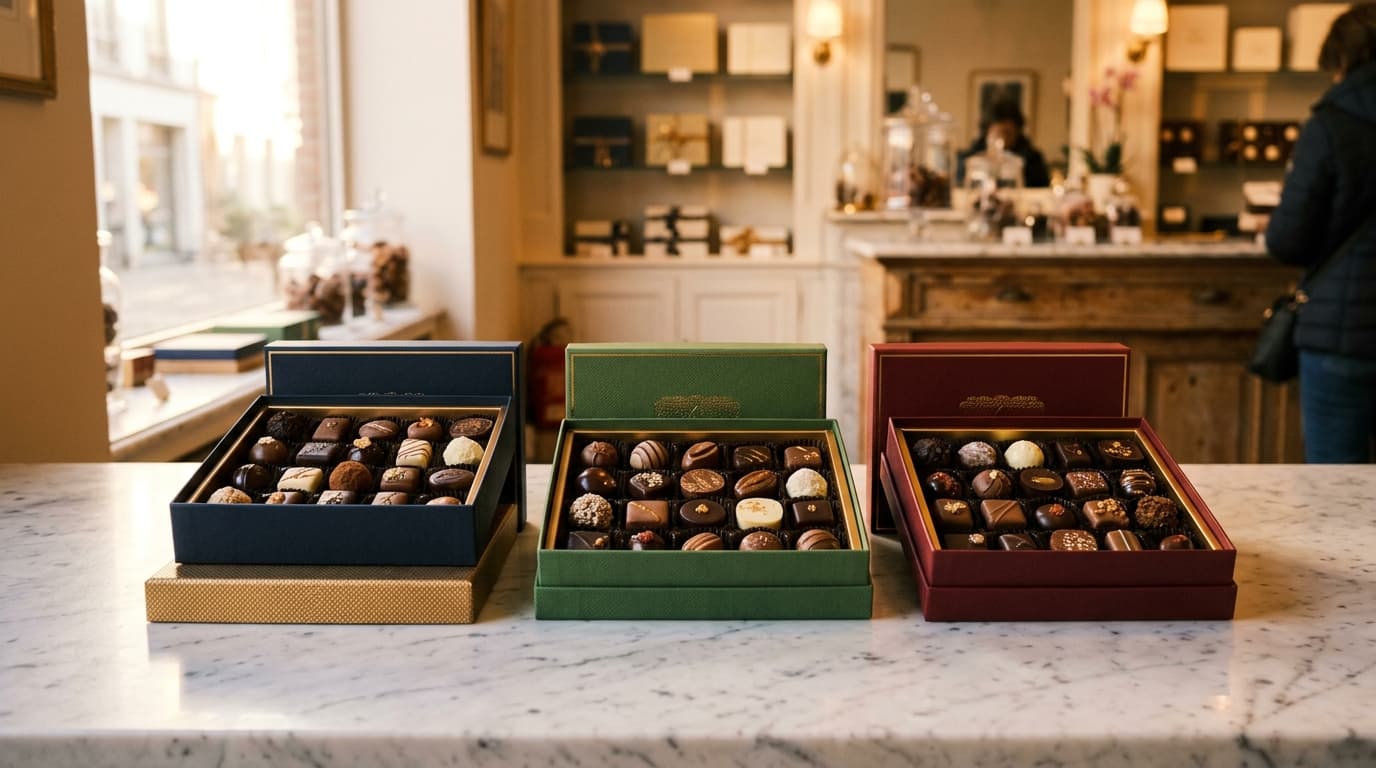
In front of the window, we always hesitate. Neuhaus, Leonidas, Pierre Marcolini: these three names sum up Belgian chocolate on their own, yet they don't speak to the same cravings or the same budgets. Here is how to decide based on what you're looking for — a gift, an everyday treat, the best cocoa or the most ethical brand.
What really sets the great Belgian chocolatiers apart?
What separates a chocolatier from a bar brand is the fresh filled praline — a Belgian invention, born at Neuhaus in 1912. A real chocolatier works praline paste, gianduja and ganaches by hand, in small batches that keep for only a few weeks.
In practice it shows in the window: bare, dated pralines sold by weight in a ballotin. At tasting, the difference is obvious — a fresh ganache melts, where an industrial bar stays firm. It's this freshness, more than price, that should guide your choice.
Is Neuhaus worth its price?
Yes, if you're after the ballotin to give. Neuhaus is the great historic house: the classic praline, the unmistakable packaging, faultless consistency. It's the gift that takes no risk.
Expect a premium price, often around €6 to €8 per 100 grams depending on the selection. For that, you also pay for reliability: a Neuhaus box given to in-laws or a client always makes a good impression. The test to run in store: the coffee manon, fresh cream and coffee, which sums up the house style.
Is Leonidas the best value for money?
For everyday, clearly yes. Leonidas democratised the praline: you find it in almost every station and shopping street, at a per-kilo price far gentler than its rivals — often half of Marcolini.
The trade-off is finesse: the pralines are a notch below a sharp artisan. But the freshness is there, the choice is wide, and to fill a big box to share with family, it's unbeatable. It's the chocolatier I recommend to anyone discovering pralines without breaking the bank.
Pierre Marcolini, for which occasions?
Marcolini is unapologetically high-end. The house works bean-to-bar: it selects and roasts its own beans, giving chocolates with a marked flavour profile, sometimes tangy or fruity, far from the classic sweet praline.
The price rises accordingly — it's the most expensive of the three. So save it for the occasions that matter: an exceptional gift, a discovery for a curious enthusiast, a treat to savour square by square. To judge the cocoa work, taste a plain ganache before the more elaborate creations.
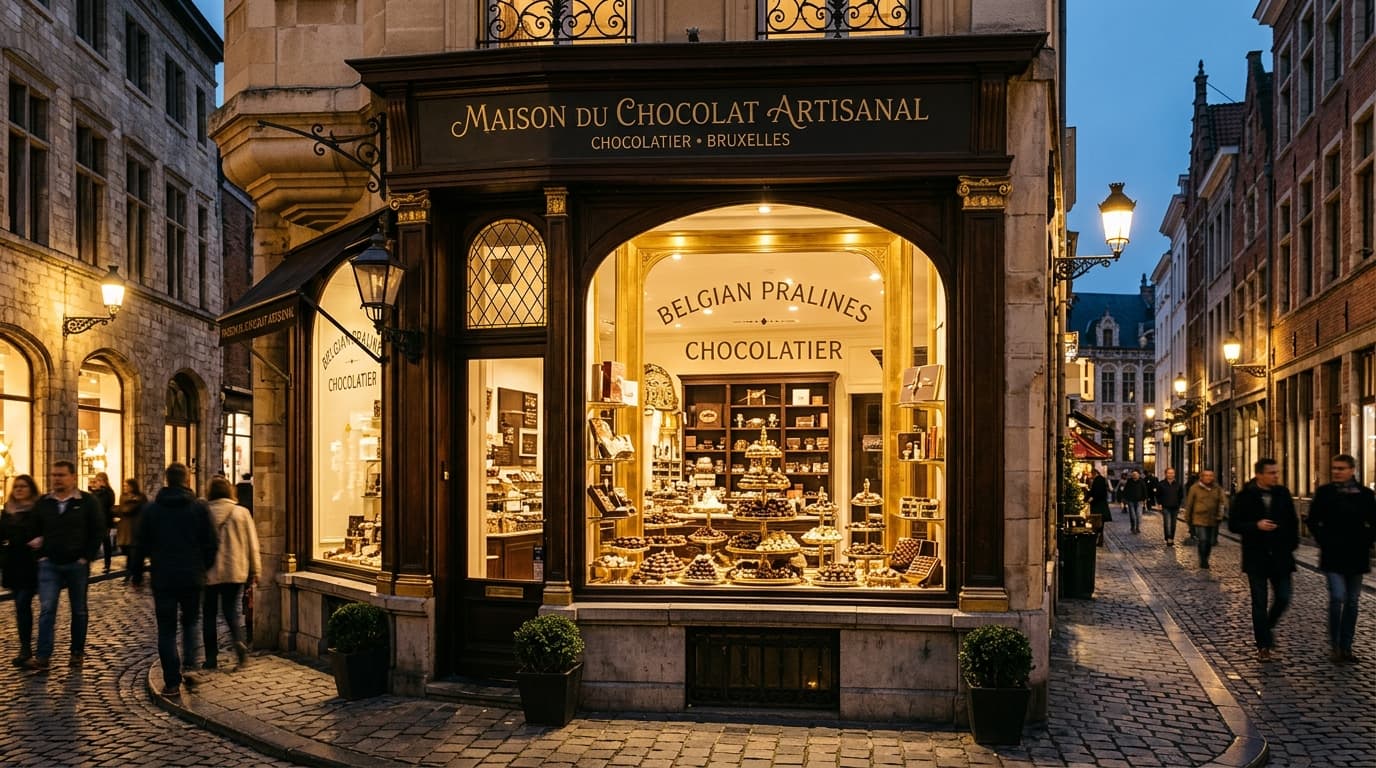
Which chocolate brands use the best cocoa?
The question is trickier than it sounds, because most Belgian chocolatiers do not make their own chocolate: they buy a high-quality couverture — often Barry Callebaut, which supplies the bulk of Belgian chocolate — then melt, assemble and fill it their own way. It is no shameful secret: it is the same principle as a great restaurant that does not grow its own wheat.
One house is the exception at scale: Pierre Marcolini, working bean-to-bar. It selects its beans at origin, roasts them itself and shows traceability by provenance. At tasting you hear it at once: where a classic praline gives sugar and milk, a Marcolini square gives acidity, fruit, sometimes a frank bitterness that unsettles palates used to praliné.
On bars, the intensity-to-price ratio switches camps: Galler's dark and Côte d'Or's Noir de Noir deliver fine cocoa frankness for a few euros. We tasted all three blind the same afternoon: Marcolini wins on complexity, but the gap with a good supermarket dark is far narrower than the story goes.
Which Belgian chocolate brands are the most ethical?
If responsible cocoa matters more than the name on the box, the answer is not a great house. It is Belvas, a chocolate maker in Hainaut working with 100% organic and Fairtrade cocoa, certified an ecological factory under the European EMAS standard. Discreet, rarely cited in rankings, but the most consistent of the lot.
Behind it, Galler has claimed fair-trade cocoa since its 2019 takeover. Pierre Marcolini plays another card: direct buying from producers and traceability by origin, a craft approach rather than a certified one. And the great houses — Neuhaus, Leonidas — move as a group, through Beyond Chocolate: this Belgian partnership launched in 2018 commits its signatories to having chocolate produced and sold in Belgium covered by a certification (Fairtrade, Rainforest Alliance) or by a supply-chain programme such as Cocoa Horizons (Barry Callebaut) or Cacao-Trace (Puratos).
| Brand | Cocoa approach | What it's worth |
|---|---|---|
| Belvas | 100% organic + Fairtrade, EMAS-certified factory | The most demanding, full traceability |
| Galler | Fair-trade cocoa claimed | Solid, widely available |
| Pierre Marcolini | Bean-to-bar, direct buying | Traceable to origin, not certified |
| Neuhaus, Leonidas | Beyond Chocolate signatories | Real progress, but collective |
Côte d'Or and Galler: how do they compare to the praline houses?
They are two excellent choices… but on another field. Côte d'Or (the famous elephant) remains a milk-bar reference, perfect for home and baking. Galler, holder of a Royal Warrant, shines with its filled mini-bars, handy and moreish.
Their common point: mass retail and long shelf life. They don't replace a fresh praline to impress a guest, but for the everyday chocolate cupboard, the pleasure-to-price ratio is unbeatable.
How to choose by budget and recipient?
The simple rule: start from the occasion, not the brand. To give without risk, Neuhaus. To share a big box without blowing the budget, Leonidas. To make a statement, Marcolini. For home, Côte d'Or or Galler. For faultless cocoa, Belvas.
| Criterion | Neuhaus | Leonidas | Pierre Marcolini | Côte d'Or / Galler |
|---|---|---|---|---|
| Style | Classic praline | Accessible praline | Sharp bean-to-bar | Bar / stick |
| Price | €€€ | €€ | €€€€ | € |
| To give | Excellent | Good | Exceptional | Avoid |
| Everyday | Pricey | Ideal | Too pricey | Perfect |
Want to know what kind of chocolate lover you are before pushing open a shop door? Test yourself with our chocolate quiz.
Chocolatiers & maisons comparator
Compare all chocolatiers & maisons side by side.
Compare now →
Frequently asked questions
Bruxelloise pur sucre, Margaux arpente les chocolateries belges depuis plus de dix ans. Ancienne pâtissière reconvertie dans le journalisme gourmand, elle goûte, compare et raconte le chocolat belge sans complaisance — des grandes maisons aux ateliers de quartier.