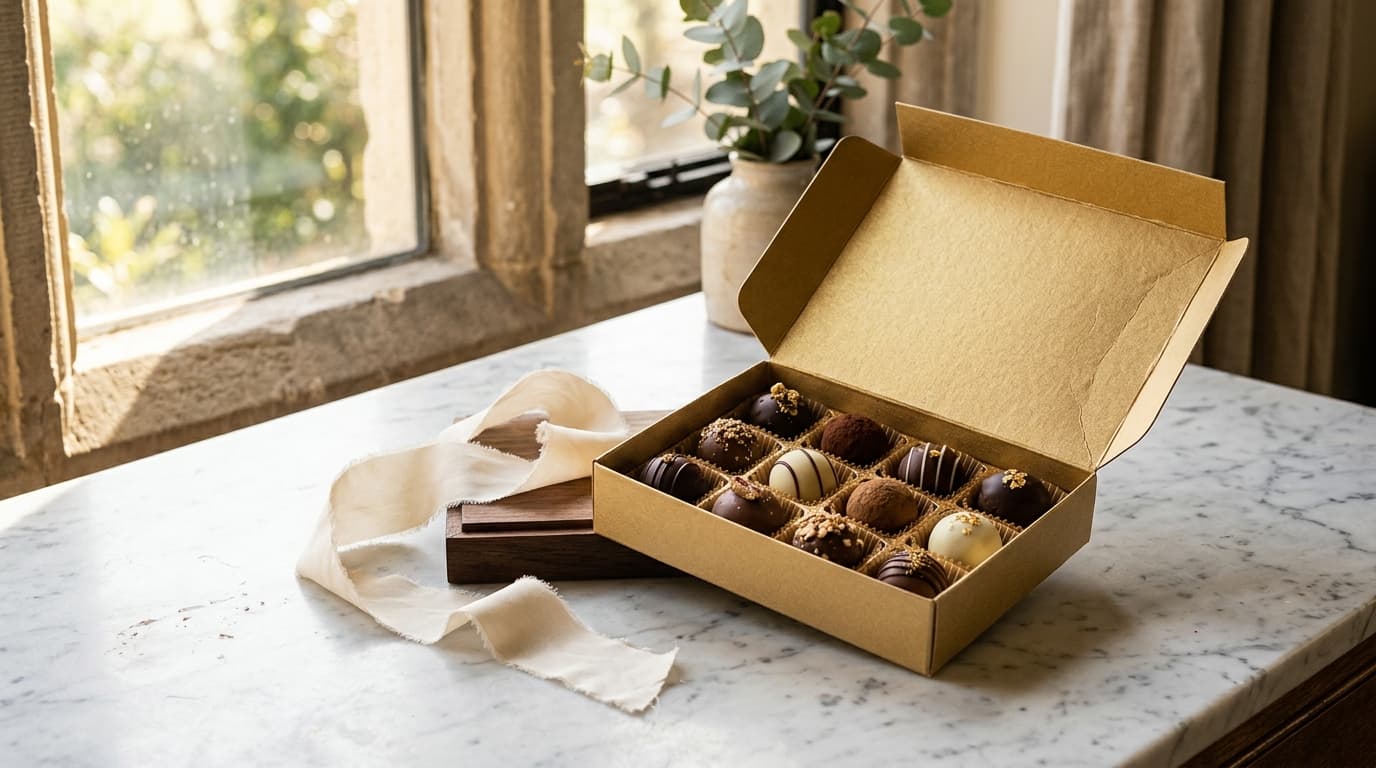
The ballotin was born in 1915 at Neuhaus, in Brussels. Jean Neuhaus filed the registration on 16 August of that year, then gave up protecting it: his fellow confectioners asked him to leave the box to everyone. He agreed. That is why the whole of Belgium still uses it.
Louise Agostini folds the first box in 1915
Jean Neuhaus junior had been selling filled pralines since 1912. The problem showed up immediately: they were wrapped in paper cones, and the cone crushed whatever it carried. A fresh praline taken out of a cone arrived stuck, misshapen, sometimes split open.
His wife, Louise Agostini, was a ballerina. She came up with a one-piece cardboard box, folded by hand, closed with a bolduc ribbon, stiff enough for the pralines to stand upright, flat enough to tuck under an arm, and simple enough for an apprentice to assemble two hundred of them in a day. The word comes from "ballot", a small bundle of goods.
The object looks modest. It solved the one problem that stopped the Belgian praline from travelling, and it solved it so well that the principle has not changed in over a century. The Choco-Story museum devotes a whole display case to it, and what you mostly see there is that today's folds are yesterday's folds.
Why did Neuhaus never file a patent?
Jean Neuhaus did file a registration, on 16 August 1915. Then nothing.
His fellow members of the Royal Master Confectioners Association of Belgium came and asked him not to keep the box for himself. Neuhaus agreed, and the ballotin was never patented. The encyclopaedia entry on the ballotin establishes the fact from three books: Mercier in 2008, Moss and Badenoch in 2009, Rosenblum in 2006.
It is the single most consequential decision in the history of Belgian chocolate, and also the least often told. Several French pages now claim the opposite and describe a patented box. They confuse the August 1915 registration, which genuinely happened, with a patent, which never followed.
The word "patented" turns up everywhere on Belgian packaging, in a sense that has nothing to do with it. "Fournisseur breveté de la Cour de Belgique", patented supplier to the Belgian Court, is a royal warrant, not an industrial property title. Leonidas displays it at the foot of its site, Neuhaus in its footer, and the Mary chocolate house, on rue Royale since 1919, received it in 1942 before having it renewed in 1990, in 1994 and in 2013. Three kings, one wording, and no connection whatsoever to a patent.
An object tied to a single house, left to an entire trade, and turned by that very fact into the visual signature of a whole country.
The ballotin became a Belgian common good
Push open the door of any chocolatier between Ostend and Arlon: the same box. Neuhaus, Leonidas, Corné Port-Royal, Mary, Galler, Godiva, and the hundreds of artisans whose name never travels beyond their own town. None pays a licence, none asks permission, none risks anything.
The shape says "Belgian chocolate" before the name printed on the ribbon says anything at all. No advertising campaign produced that result, and nobody paid for it.
The era was pulling the other way. British confectioners, Cadbury foremost among them, were betting on ornate, illustrated, hinged boxes whose decoration was part of the sales pitch and stayed the exclusive property of the house. Neuhaus made the opposite choice: bare cardboard, a fold, a ribbon. The plainest container on the market became the only one nobody ever managed to copy badly, since there was nothing to copy.
What does a ballotin cost, and what exactly are you paying for?
On 7 September 2026 I recorded every ballotin size sold on the official online shops of Neuhaus Belgium and Leonidas Belgium, then divided each price by its stated weight. I was expecting the usual volume discount, the one that always makes the large size slightly better value than the small. There is none.
| House | Size | Price recorded 07/09/2026 | Price per kilo |
|---|---|---|---|
| Neuhaus | 350 g | €36.75 | €105.00 |
| Neuhaus | 500 g | €52.50 | €105.00 |
| Neuhaus | 750 g | €78.75 | €105.00 |
| Neuhaus | 1 kg | €105.00 | €105.00 |
| Leonidas | 300 g | €12.54 | €41.80 |
| Leonidas | 500 g | €20.90 | €41.80 |
| Leonidas | 1 kg | €41.80 | €41.80 |
Seven sizes, two houses, two numbers. At Neuhaus the kilo is worth €105.00 whether you buy 350 grams or a full kilo. At Leonidas, €41.80 across all three sizes. Not one cent of difference, in either direction, on any line. The price curve is a perfect straight line, and I redid the divisions twice before believing it.
The conclusion is right there in the table: the cardboard is not billed. You pay for the praline by weight, the box comes with it, and so does the ribbon. A patented container would inevitably have become a monetised container, with a surcharge on small sizes or a premium on large ones, exactly as any rigid gift box on the market does. Here, nothing. The box nobody owns is also the box nobody charges for, and there is no better proof of what happened in 1915.
One detail stopped me during the survey: neither house offers a 250 gram ballotin online. Leonidas starts at 300 grams, Neuhaus at 350. The 250 gram is a counter size, weighed out in store, not ordered from a catalogue.
Marcolini chose a different container
One major Belgian house is missing here, and it is the one I most often place first. Pierre Marcolini does not sell ballotins. He sells mallines, flat drawer boxes, designed for him and recognisable from ten metres away.
The choice makes commercial sense, and it costs him something here. On the object that forms the shared heritage of Belgian chocolate, the house is absent. It preferred a container it owns to a container nobody owns, which is the exact opposite of the 1915 gesture.
Does the ballotin sell mediocre chocolate at the price of good chocolate?
Yes, and that is the serious objection. Mort Rosenblum, in his 2006 book, calls the ballotin a brilliant stroke of marketing: the box lets even average Belgian chocolate sell at the price of the good stuff, as long as it is packaged right. The cardboard is flimsy, it looks handmade, and that hand-crafted appearance is worth more to a buyer than the tin boxes of industrial confectionery.
I find the analysis fair, and I have checked it too often two streets from the Grand-Place. The ribbon, the gilded cardboard, the weighing in front of you: the ritual is identical at an artisan who tempers his own couverture and at a reseller who buys his pralines wholesale thirty kilometres away. Nothing in the container tells them apart, since the container belongs to everyone.
The objection cuts both ways, though. A box reserved for Neuhaus would have left every other house with second-rank packaging, and the Belgian praline would have travelled abroad under one brand instead of a hundred. The price paid for that spread is precisely the ambiguity Rosenblum describes. You could not have one without the other.
The object guarantees one thing, and one thing only: that the pralines will arrive intact.
Six things to check in the window before paying
The ballotin says nothing about the chocolate. The rest of the window does.
- The production date, displayed or given aloud without hesitation: a fresh cream praline keeps two to three weeks, not six months.
- Bare pralines, laid out on trays and weighed in front of you, rather than pre-packed under film.
- The price quoted per kilo as well as per box, the only figure comparable from one house to the next.
- Tray turnover: a half-empty tray at the end of the day beats a full, glossy one.
- The presence of fresh cream pralines, which houses geared to long-distance shipping remove from their assortments.
- An unprompted offer to taste one, still the reflex of houses with nothing to hide.
I once carried a one-kilo ballotin on the train from Brussels to Ghent, on a Friday in December, standing, wedged between two suitcases. The cardboard held. It is not built for that, and it holds anyway, which remains the best argument in its favour after a century of service.
To go further into what Belgium owes to those 1912 and 1915 decisions, read why Belgian chocolate is so highly regarded. If the ballotin is meant for someone else, which Belgian chocolatier to choose and giving Belgian chocolate as a gift answer the next part of the question, and our ranking gives the house order of preference.
Histoire du chocolat comparator
Compare all histoire du chocolat side by side.
Compare now →
Frequently asked questions
Bruxelloise pur sucre, Margaux arpente les chocolateries belges depuis plus de dix ans. Ancienne pâtissière reconvertie dans le journalisme gourmand, elle goûte, compare et raconte le chocolat belge sans complaisance — des grandes maisons aux ateliers de quartier.