Chocolatiers & maisons
The best high-end Belgian chocolate: which house to choose?
Marcolini, Wittamer, Neuhaus, Godiva: we compare the high-end Belgian chocolate houses by finesse, cocoa origin and price to help you give well.
For high-end Belgian chocolate, one house sets the standard: Pierre Marcolini, the only great Belgian name working bean-to-bar. But Wittamer, Neuhaus and Mary each defend a style of their own. Here is how to choose based on finesse, cocoa origin and the occasion, without paying for the name alone.
What makes a Belgian chocolate truly high-end?
High-end isn't about price, it's about the cocoa work. An exceptional house is judged on three things: the freshness of the praline, the quality of the couverture and the mastery of texture in the mouth.
In practice, the dividing line is the bean. Most great Belgian houses buy a high-end couverture, often Barry Callebaut, then melt and fill it their own way. There's nothing shameful in it: it's the same principle as a great restaurant that doesn't grow its own wheat. One house is the exception at this scale, and we'll get to it.
At tasting, real high-end shows fast. A fresh ganache melts and releases its aroma, where an industrial praline stays firm and sweet. In the window, look for bare pralines, sold by weight and dated: the sign of a workshop producing in small batches.
Is Pierre Marcolini worth his benchmark status?
Yes, on the criterion that defines high-end: the work on the bean. Marcolini is the only great Belgian name running bean-to-bar, meaning he selects his beans at origin, roasts them and transforms them himself in his Brussels atelier.
The result comes through in the mouth. Where a classic praline gives sugar and milk, a Marcolini square gives acidity, fruit, sometimes a frank bitterness that unsettles palates used to praliné. It's a chocolate with a point of view. World pastry champion in 1995, Pierre Marcolini built his house on this obsession with origin.
The price follows, of course: signature boxes start around €45, and a 75 g grand cru bar tops €10. You pay for total control of the chain, from bean to square. For an exceptional gift or a tasting to savour square by square, it's the house that makes the strongest impression.
Marcolini doesn't sell a box, he sells a point of view on cocoa. That's what sets him apart from houses that buy their couverture.
Why does Wittamer remain a safe bet on the Sablon?
Because Wittamer combines two rare crafts under one roof: pastry chef and chocolatier. Established on Grand Sablon square since 1910, the house is a warrant holder to the Court of Belgium, a mark of consistency more than marketing.
Its strength is pastry finesse carried into chocolate: ganaches of great delicacy, a work on texture rarely found elsewhere. We tasted its praline range one afternoon: less edge than Marcolini on origin, but an elegance and a melt that hit the mark for giving.
In the window at number 13, the offer slides naturally toward pastry, which makes it the ideal address when the gift must also impress at the table. For a festive dessert with a few pralines alongside, Wittamer is hard to beat.
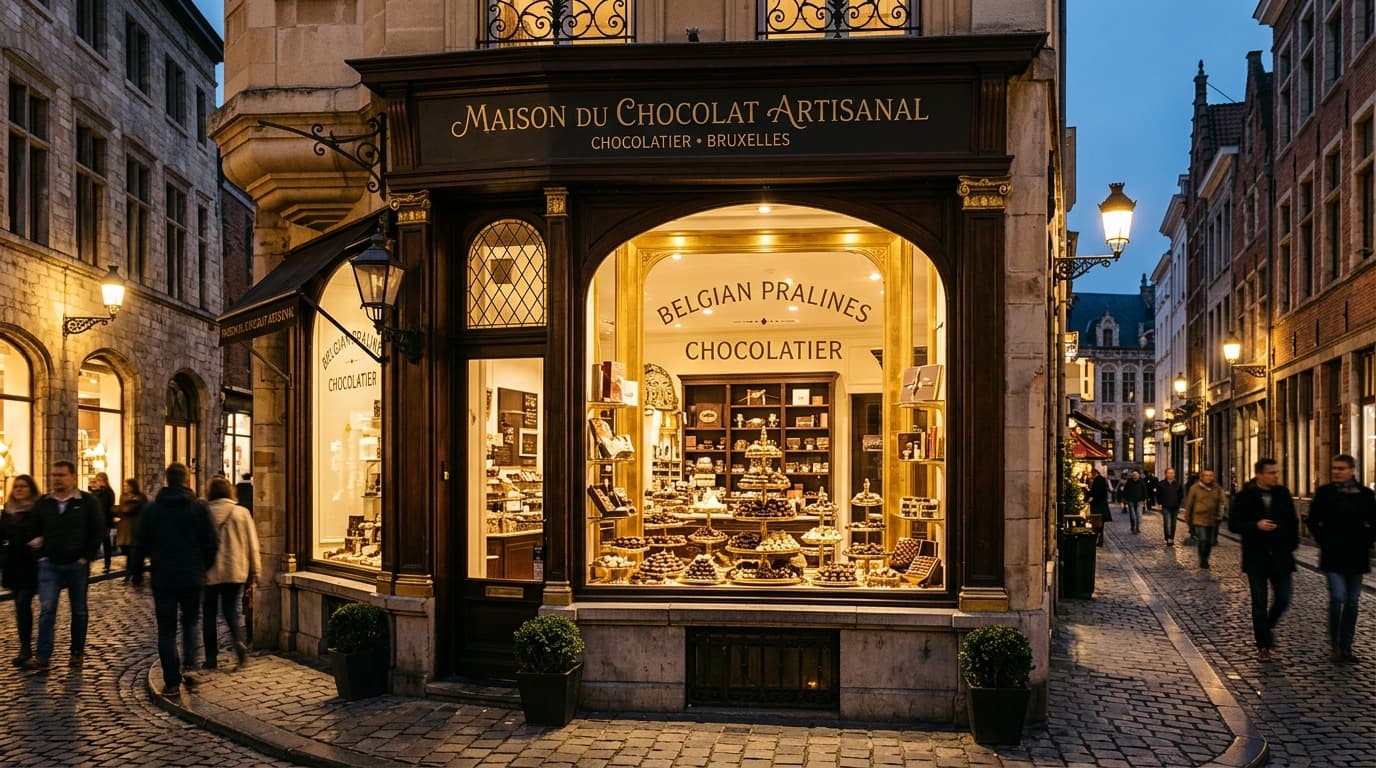
Does Neuhaus justify its price for gifting?
Yes, whenever the goal is the ballotin that never disappoints. Neuhaus is the great historic house: it's here that the filled praline was born in 1912, a Belgian invention that became a world standard.
What you pay for, beyond the chocolate, is reliability. A Neuhaus ballotin given to in-laws or a client always makes a good impression, with packaging recognisable among a thousand. Expect €6 to €8 per 100 grams depending on the selection. The test to run in store: the coffee manon, fresh cream and coffee, which sums up the house style.
Neuhaus doesn't have the edge of a bean-to-bar, but that's not what you ask of it. For a safe, consensus gift, it's the refuge value of Belgian high-end.
Is Godiva still a high-end Belgian chocolate?
On paper, the prestige is there; at tasting, the nuance sets in. Godiva was born in Brussels in 1926, under chocolatier Pierre Draps, and has held a Royal Warrant since 1968. The name carries weight internationally.
But the brand has belonged to Turkey's Yildiz Holding since 2007, and its production has largely left the Brussels-atelier model. At tasting, it sits closer to a well-made premium industrial brand than a Sablon artisan. That's not a flaw in itself, it's a positioning.
For giving abroad, where the Godiva name opens doors, the brand still makes sense. For a Belgian connoisseur, other houses offer more finesse at the same price.
Mary, Gerbaud, Corné: which houses go off the beaten track?
These are the cards to play when you want to surprise an enthusiast who already knows the big names. Each defends a precise angle.
Mary embodies elegance the Belgian way: a warrant holder to the Court, chic boxes, a century of know-how. It's the refined gift that breaks the Neuhaus reflex. Laurent Gerbaud, named best chocolatier in Belgium by Gault&Millau in 2021, works a singular style, low in sugar, marked by fruit and spices, with no alcohol or additives. Corné Port-Royal, since 1932, bets on original creations from selected beans.
1912
Filled praline invented at Neuhaus
1910
Wittamer on the Sablon
1995
Marcolini world champion
For a connoisseur, a Gerbaud ballotin or a Mary selection tells a more personal story than a big name seen everywhere.
Which house should you choose by occasion and budget?
The simple rule: start from the occasion, not the brand. To make a statement, Marcolini. For a festive dessert, Wittamer. To give without risk, Neuhaus. To surprise, Gerbaud or Mary.
| House | Style | Price | Best for |
|---|---|---|---|
| Pierre Marcolini | Bean-to-bar, origin profiles | €€€€ | Exceptional gift, tasting |
| Wittamer | Pastry finesse | €€€ | Festive dessert, the table |
| Neuhaus | Praline of tradition | €€€ | Ballotin to give without risk |
| Mary | Warrant-holder elegance | €€€ | Refined, discreet gift |
| Laurent Gerbaud | Low sugar, fruit and spices | €€€ | Surprising a connoisseur |
| Godiva | International premium | €€ | Giving abroad |
✓ Pros
- Marcolini leads on finesse and origin
- The Sablon gathers most great houses
- A true artisan surprises more than a big name
✗ Cons
- The price climbs fast beyond €8 per 100 g
- A famous name doesn't guarantee the workshop
- Fresh pralines keep poorly, eat them quickly
Want to know what kind of chocolate lover you are before pushing open a shop door? Test yourself with our chocolate quiz, or first compare Wittamer and Pierre Marcolini head to head.
Chocolatiers & maisons comparator
Compare all chocolatiers & maisons side by side.
Compare now →
Frequently asked questions
Bruxelloise pur sucre, Margaux arpente les chocolateries belges depuis plus de dix ans. Ancienne pâtissière reconvertie dans le journalisme gourmand, elle goûte, compare et raconte le chocolat belge sans complaisance — des grandes maisons aux ateliers de quartier.