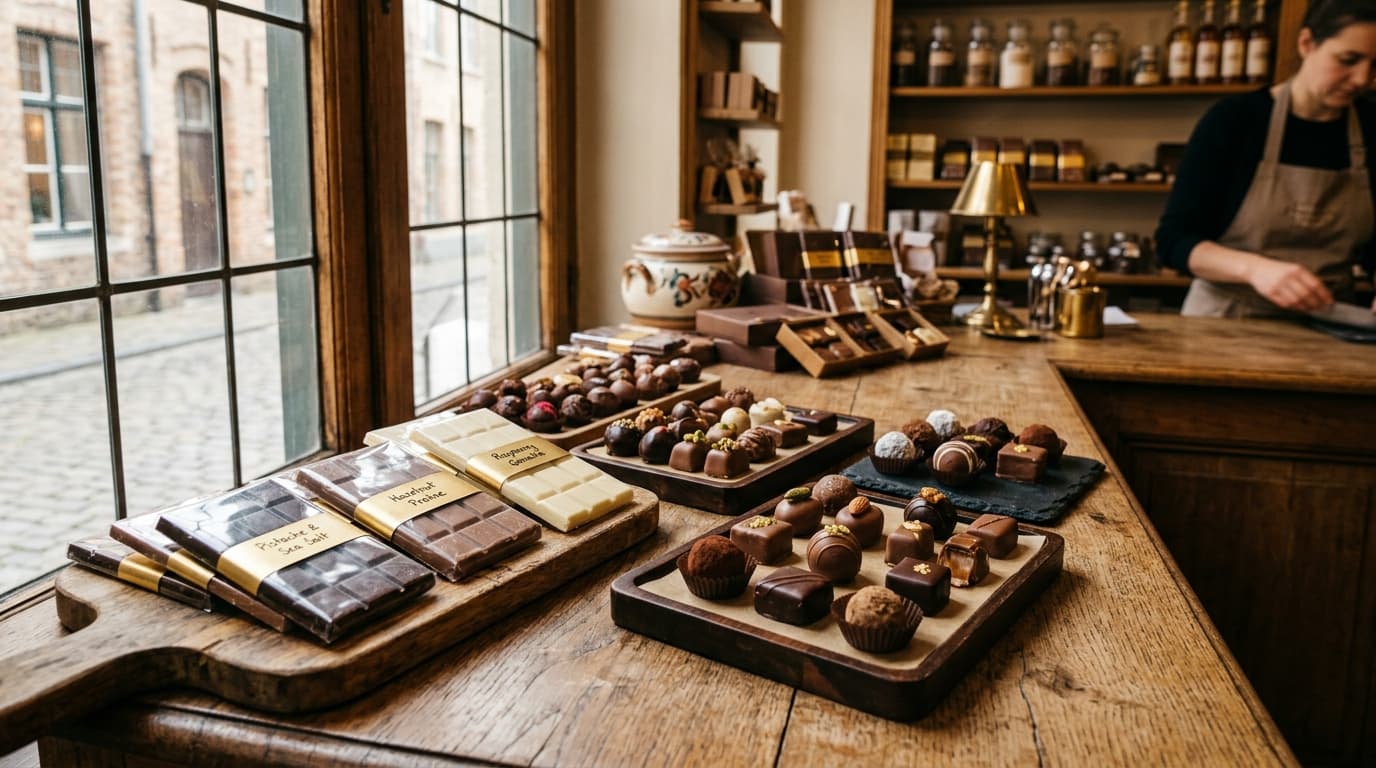
On 26 September 2026, I recorded the prices of Galler chocolate on every channel where the Liège house sells: its web shop, its online outlet section and the Carrefour Belgium website. Same brand, same factory, and a kilo that runs from €22.50 to €128.36. The channel matters less than the format.
A kilo of Galler costs from €22.50 to €128.36
The starting point was a simple question, the one you ask yourself in front of a Galler ballotin in a window: is it expensive? To answer it, every price has to be brought back to the kilo. It is the only unit that lets you compare a 70 gram bar, a 252 gram ballotin and a two kilo parcel.
I divided each displayed price by the net weight stated on the product page. On the Galler side, weights come from the house's web shop. On the supermarket side, Carrefour Belgium displays its own price per kilo, and I recalculated it to check: the figures match to the cent.
The result fits in one line.
The smaller and prettier the format, the higher the kilo climbs, and the spread goes far beyond what you would expect between two products from the same house. A 16-praline box works out 5.7 times more expensive per kilo than a parcel of mini bars and tablets sold in bulk. The brand is the same, the couverture comes out of the same tanks, the fillings come out of the same Liège recipes.
How much does Galler chocolate cost depending on where you buy it?
Here is the full survey, sorted from most to least expensive per kilo. Prices displayed on 26 September 2026, promotions shown in brackets.
| Product | Channel | Price | Net weight | Price per kilo |
|---|---|---|---|---|
| Carré Galler, 16 pralines | Galler web shop | €17.20 | 134 g | €128.36 |
| Carré Galler, 36 pralines | Galler web shop | €34.50 | 302 g | €114.24 |
| Ballotin, 30 pralines | Galler web shop | €22.75 | 252 g | €90.28 |
| Ballotin, 63 pralines | Galler web shop | €44.20 | 529 g | €83.55 |
| Assortment of 16 pieces | Carrefour Belgium | €8.35 | 160 g | €52.19 |
| Filled mini bars, 12 x 12 g | Carrefour Belgium | €5.89 | 144 g | €40.90 |
| Dark 70% tablet, 80 g | Carrefour Belgium | €2.95 | 80 g | €36.88 |
| Lait Piémontais bar, 70 g | Carrefour Belgium | €2.22 | 70 g | €31.71 |
| Lait Praliné bar, 70 g | Carrefour Belgium | €1.81 | 70 g | €25.86 |
| Pack of 10 milk bars | Galler online outlet | €16.90 (instead of €24) | 686 g | €24.64 (€34.99) |
| L'Essentiel parcel, 2 kg | Galler online outlet | €45 (instead of €68.40) | 2 kg | €22.50 (€34.20) |
Three readings stand out from this table.
The first is surprising: the Galler ballotin is not a cheap ballotin. At €83 or €90 a kilo, it sits much closer to the big praline houses than to the entry level. For scale, the survey of 7 September published in our article on the Belgian ballotin found €41.80 a kilo at Leonidas and €105 at Neuhaus. Galler lands between two thirds and three quarters of the way up that gap.
The second concerns the bar, the product that built the house's reputation. In the supermarket it costs between €1.81 and €2.22 depending on the flavour, so €25.86 to €31.71 a kilo. On the web shop, the pack of ten works out at €2.40 a bar at full price, so more than in the supermarket, and €1.69 on promotion, so slightly less. For a single bar, the supermarket almost always wins.
The third is about volume, which crushes everything: the two online outlet lines are the only ones under €25 a kilo.
The 16-praline box, the house's most expensive format
This is the line that stopped me. The 16-praline Carré Galler weighs 134 grams for €17.20, and the 30-praline ballotin weighs 252 grams for €22.75. You pay €5.55 more for almost twice as much chocolate. The box, rigid and neatly closed, mostly bills for its packaging.
The logic holds for every house: the case is paid for by the gram, and the smaller the case, the heavier it weighs in the price. At Galler it plays out on an unusual scale. Between the 16-praline box and the 63-praline ballotin, the kilo drops by 35 percent.
One clarification is needed on the 16-piece assortment sold at Carrefour for €52.19 a kilo. It is not the same product as the web shop box: it weighs 160 grams, not 134, and Galler does not publicly document the contents of either box. I include it in the table because it presents itself for the same use, the small 16-piece gift, without claiming these are the same pralines at two prices.
Galler outlet in Liers: are the seconds worth it?
Very much so, provided you know what you are buying. The Liers shop, chaussée Brunehault 600, is the house's second outlet, opened in 2013 after the one in Vaux-sous-Chèvremont. Galler has renamed it "Chocolate Market" and replaced the words "seconds" and "breakages" with two sections: a "good deals" corner for bulk chocolate, and a "zero waste" corner for pieces that are badly wrapped, badly unmoulded, close to their date or from recipe trials.
The chocolate in the zero waste corner is the same as on the regular shelf. Only the look changes, or the date, and that is the whole point: a badly wrapped bar tastes exactly like a well wrapped one. The short date, on the other hand, should guide the quantity. A two kilo parcel bought three weeks before its best-before date does not always get finished in time, especially the pralines.
The shop is open Monday to Saturday from 10:30 to 18:00, closed on Sunday, according to the official page consulted on 26 September 2026. Three other Chocolate Markets run on the same model, in Fléron, Marche-en-Famenne and Vaux-sous-Chèvremont. The April takeover does, however, plan to close several outlets, and the list has not been made public to date: check the Liers shop page before making the trip.
If you do not live near Liège, the web shop's online outlet carries some of these offers, and that is where the two lowest prices in my survey come from.
Buying Galler chocolate online: Belgium only
The house's web shop delivers in Belgium only. Home delivery costs €6 and becomes free from €80, in three to four working days; collection in store is free, prepared in two to three days. For other countries, the site points to a separate address, chocolats-galler.fr, which I did not survey.
The €80 threshold deserves a calculation. Below it, the €6 shipping is added to the basket: on a 30-praline ballotin at €22.75, it takes the kilo from €90.28 to €114.09. Collecting in store, or a shared basket among colleagues, solves the problem.
The delivery terms mention no refrigerated shipping. In high summer, keep that in mind for filled pralines, which the house asks to be stored below 16°C according to the ballotin's product page.
From Jean Galler to a Walloon consortium, fifty years of owners
The house you buy from today has long ceased to belong to the man whose name it bears. Its ownership history is one of the most turbulent in Belgian chocolate, and it sheds direct light on the current pricing strategy. The milestones up to 2021 are documented on the house's French Wikipedia page, the later ones by the Belgian press.
| Date | Event |
|---|---|
| 1976 | Jean Galler, aged 21, founds the chocolate works in Vaux-sous-Chèvremont with his father, on the equipment of the former Régal des Fées chocolate factory |
| 1994 | The house is granted the warrant of Purveyor to the Belgian Court |
| 1995 | First shop, on the Grand-Place in Brussels |
| 2006 | Two members of the Qatari Al Thani family take a 33 percent stake |
| 2011 to 2012 | The Qatari shareholder becomes the majority owner |
| 2016 | Financial difficulties raise its stake to 75 percent |
| November 2018 | Jean Galler sells his last shares and leaves the company |
| July 2020 | 25 percent of the capital goes back to Belgian investors; the logo becomes "Chocolaterie indépendante"; 100 percent of beans are Fairtrade certified |
| July 2021 | The Vesdre flood devastates the Vaux-sous-Chèvremont factory |
| February 2026 | Silent judicial reorganisation, four-month stay; the Qatari shareholder then holds 50.4 percent |
| 23 April 2026 | Takeover by a Belgian consortium led by Dolfin; 70 of 170 jobs cut |
Two lines in this table weigh more than the others for the customer.
The 2021 line first: losing the production plant cost years of cash, and the house posted a net loss of €1.7 million in 2024 on €32 million of turnover, according to figures reported by Belga. Then the April 2026 line, which sets the course: refocus on supermarket retail.
Who owns Galler today?
An entirely Belgian consortium, since 23 April 2026. It brings together the Dolfin chocolate company, majority shareholder, Wallonie Entreprendre, the financial arm of the Walloon Region, a group of private investors, and Sébastien Desclée, Galler's CEO since November 2025, who invested personally. The Qatari holding company Al Alfia, which held 50.4 percent, has left, as has the Liège fund Noshaq, according to the DH article published on the day of the takeover.
The takeover took place within a judicial reorganisation opened in February, which L'Avenir covered in detail at the time. The announced plan includes closing one of the two production centres, closing several outlets and franchising some shops. Dolfin, positioned on specialist retail, and Galler, geared to supermarkets, are to coexist as two separate brands.
Galler announces it on its own site under the title "Nouveau souffle pour notre Chocolaterie" (a new lease of life for our chocolate works), describing a house that is "100 percent Belgian again". That is accurate on the capital. On the ground, it means fewer company-owned shops: the official list of 23 April names only three open shops, in Huy, Ixelles and Woluwe-Saint-Pierre, the Grand-Place one being "temporarily closed".
Galler becomes Belgian again through its capital at the very moment it chooses the supermarket aisle over the shop window.
Which Galler chocolates should you taste first?
The bars, not the pralines. That is where the house built its name, it is the cheapest format per kilo, and it is the one that suffered least in the difficult years.
I tasted two side by side on 25 September, bought in a supermarket. The Lait Piémontais first, a hazelnut praline filling, melting, more sweet than bitter, with a fine grain that holds under the tooth without sticking. The Noir Café Liégeois next, the more personal of the two: a frank bitterness of roasted coffee, cutting through the sweetness of the filling and a reminder that the house comes from a city where café liégeois is a dessert. Two bars, 70 and 65 grams, for €4.03 in total, and a fairly accurate idea of the Galler signature.
The pralines call for more caution. The 30-praline ballotin lines up varied fillings, yuzu, speculoos, matcha, passion fruit according to the ingredient list, but at €90 a kilo it faces competitors whose main business is the praline.
On substance, the house stands by three verifiable commitments: beans 100 percent Fairtrade certified since 2020, no palm oil, and a rule it calls "euro for euro", which passes on without any intermediate margin the €0.60 per kilo paid on top to the certified grower. They are listed on the web shop, and our article on fair trade chocolate details exactly what the label guarantees.
Four habits for paying a fair price for Galler
- A single bar: in the supermarket, €1.81 to €2.22 against €2.40 on the web shop.
- Pralines to give: the 45 or 63 ballotin, never the 16-praline box.
- Stocking up: the outlet, €22.50 a kilo in a 2 kg parcel.
- On the web shop, below €80, the €6 shipping adds more than 20 percent to the kilo.
The reservations, because they count as much as the rest
Galler is not bean-to-bar. Roasting, grinding and conching of the beans are entrusted to Barry Callebaut, on the house's own recipes; assembly and fillings are done in Vaux-sous-Chèvremont. It is a common and respectable model, but it does not on its own justify a top-end praline price.
The house is emerging from judicial reorganisation, is losing 70 of 170 jobs and is shrinking its shop network. Nothing yet says how the range will evolve under its new shareholders. And the Court warrant granted in 1994 remains a historical fact, not a guarantee of taste for the chocolate you buy today.
A final reservation, the most concrete one: the price of a Galler praline on the web shop has little to do with that of a bar in the supermarket. Judging the house on one or the other gives two opposite verdicts.
To place Galler among the other supermarket brands, read our selection of the best Belgian chocolate in the supermarket. If you are passing through Liège, our address book where to buy chocolate in Liège covers the city-centre artisans, and our ranking gives the order of preference among the big Belgian houses.
Chocolatiers & maisons comparator
Compare all chocolatiers & maisons side by side.
Compare now →
Frequently asked questions
Bruxelloise pur sucre, Margaux arpente les chocolateries belges depuis plus de dix ans. Ancienne pâtissière reconvertie dans le journalisme gourmand, elle goûte, compare et raconte le chocolat belge sans complaisance — des grandes maisons aux ateliers de quartier.