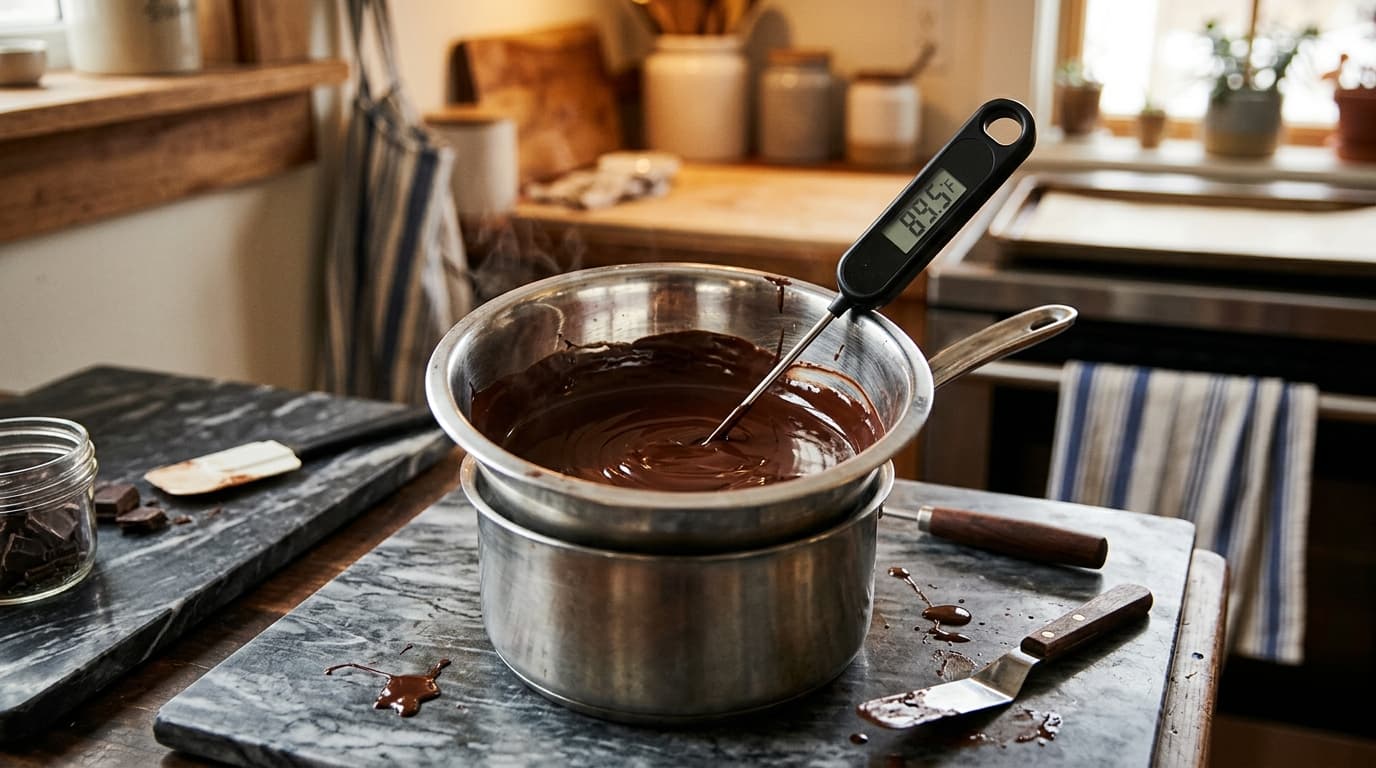
No, in nine cases out of ten. Most appliances sold as chocolate tempering machines are melters: they bring the temperature up and hold it, but they never bring it back down. And tempering is a descent. A thermometer and a slab of marble do that job for far less money.
A melter heats, a tempering machine cools
The distinction comes down to one component: the cooling unit.
Tempering means bringing cocoa butter into its stable crystal form, the beta form, along a curve that rises to 45 °C, falls to 27 °C and climbs back to 31 °C for dark chocolate. A heating element handles the first move and the last. Not the middle one. Nothing in the appliance removes heat, and it is the middle of the curve that decides the shine.
A continuous tempering machine carries a refrigeration circuit. The Selmi One tempers 12 kg of couverture in seven minutes and turns out 55 kg an hour, with a countercurrent exchanger and a 900 frigories per hour cooling unit. It calls for 400 V three-phase power, 16 A, five poles, and stands 1.47 m tall. You will not be plugging that into a kitchen.
Which machine for which budget?
Four levels, and only two of them actually temper.
| Level | Concrete example | Melts the couverture | Takes the curve down | Holds at 31 °C | Price marker, checked 31/08/2026 |
|---|---|---|---|---|---|
| Marble and probe | Thermapen ONE, accuracy ±0.3 °C | no | yes, by hand | no | price of the thermometer alone |
| Seeding | Mycryo by Cacao Barry, 10 g per kilo | no | not applicable | no | price of the powder |
| Table-top melter | Städter 1.5 L, Mol d'Art 3 to 24 kg | yes | no | yes | €85.90 to €625.00 |
| Continuous temperer | Selmi One, 12 kg tank | yes | yes | yes | on quotation, three-phase required |
The two middle rows do all the work of the other two for a fraction of the price, provided you accept ten minutes of handling. The fourth is workshop equipment, not kitchen equipment. And the first is enough for a Sunday of moulding.
Do you need a machine to temper properly?
No, and I think that is the most useful line on this page.
Tempering fails for three reasons: a badly read temperature, not enough agitation, a worktop that is too warm. None of the three is fixed by buying a heated tank. A probe thermometer reading to a tenth of a degree in one second, such as the Thermapen ONE rated at ±0.3 °C between -20 and 120 °C, fixes the first. A spatula and some patience fix the second. A room at 19 °C fixes the third.
The machine changes nothing at all about the result in four situations.
- You mould less than two kilos per session: the time saved is counted in minutes, not hours.
- You work at home with no dedicated room: the tank keeps the chocolate warm while your kitchen sits at 24 °C.
- You mostly make ganaches, mousses and glazes: none of that is tempered.
- You have not yet managed a tempering by hand: the machine will reproduce your mistakes, faster.
Tempering without a machine, in five steps
Seeding with powdered cocoa butter needs a bowl, a scale and a probe. It comes down to five moves.
- Melt 500 g of couverture over a bain-marie or in the microwave in twenty-second bursts, up to 45 °C for dark chocolate.
- Let it fall back to 34 °C off the heat, stirring. For milk or white, aim for 33 °C.
- Add 1% powdered cocoa butter, so 5 g for those 500 g, following the dosage published by Callebaut.
- Stir for thirty seconds. The powder melts at 35 °C and brings back the beta crystals the mass has lost.
- Work at 31 °C for dark, 29 °C for milk and white. Test it on the tip of a knife: after three minutes at room temperature the chocolate should be matt on the surface and dry to the touch.
I tabled on marble for years, on principle, and I still do when I mould thin bars. For twenty shells on a Tuesday evening, seeding wins every time.
What does a €90 melter give you?
A bain-marie that cannot boil over, and that is already useful.
The 1.5 litre Städter, the most common one among French-speaking home cooks, heats through the base and the walls up to 60 °C, with a stainless steel tank and lid. It was listed at €85.90 by a French retailer on 31 August 2026. Its real merit is keeping the couverture at 31 °C while you fill thirty cavities without the chocolate thickening in the bowl. Its flaw is letting you believe that it tempers.
Put another way: buy it as a comfort accessory, never as an answer to tempering.
Why do tempering machines come out of Belgian workshops?
Because the country that moulds the most pralines ended up building its own machines.
Mol d'Art, based at Webbekom near Diest, has been producing its tanks for over forty years and sells them directly on its site, with no trade account. The principle is indirect dry heating: an element on the base and the walls, no contact with water, a mechanical thermostat adjustable from 5 to 65 °C, and a removable stainless steel bowl. That stability is precisely what makes the appliance usable for holding tempered chocolate, and it is also what most competitors get wrong.
An hour up the road, Chocolate World supplies from Antwerp the polycarbonate moulds that equip half the workshops in Europe. A Belgian home cook can therefore buy the tank, the moulds and the Callebaut or Belcolade couverture without ever leaving the country or going through a wholesaler. That is a rare advantage: in France, Germany or the United Kingdom, the same purchase goes through a reseller, with its margin and its lead times.
How many pralines does it take to justify €300?
Around one thousand seven hundred. The sum is worth doing, because nobody does it.
The Mol d'Art 3 kg tank is priced at €300 in the manufacturer's own shop on 31 August 2026, the 6 kg at €400, the 12 kg at €475 and the 24 kg at €625. On 29 August 2026 we recorded a price of €14.32 per kilo for Callebaut 811 in a 2.5 kg bag at a Belgian retailer, in our guide to couverture chocolate. So the €300 of the small tank is worth 20.9 kg of couverture. At twelve and a half grams per praline shell, that comes to roughly 1,700 pralines, or eight 250 g boxes a year for ten years.
The threshold comes down to your volume. A workshop moulding every day pays the tank off in three weeks; a kitchen that runs two batches at Christmas never will, and will store €300 of stainless steel in a cupboard eleven months of the year.
The full method, curves and temperatures included, is set out in our guide to tempering chocolate. To store the opened bag properly between sessions, everything is in our guide to storing Belgian chocolate. The houses that temper all year round are in our ranking of Belgian chocolatiers.
Pralines & spécialités comparator
Compare all pralines & spécialités side by side.
Compare now →
Frequently asked questions
Bruxelloise pur sucre, Margaux arpente les chocolateries belges depuis plus de dix ans. Ancienne pâtissière reconvertie dans le journalisme gourmand, elle goûte, compare et raconte le chocolat belge sans complaisance — des grandes maisons aux ateliers de quartier.