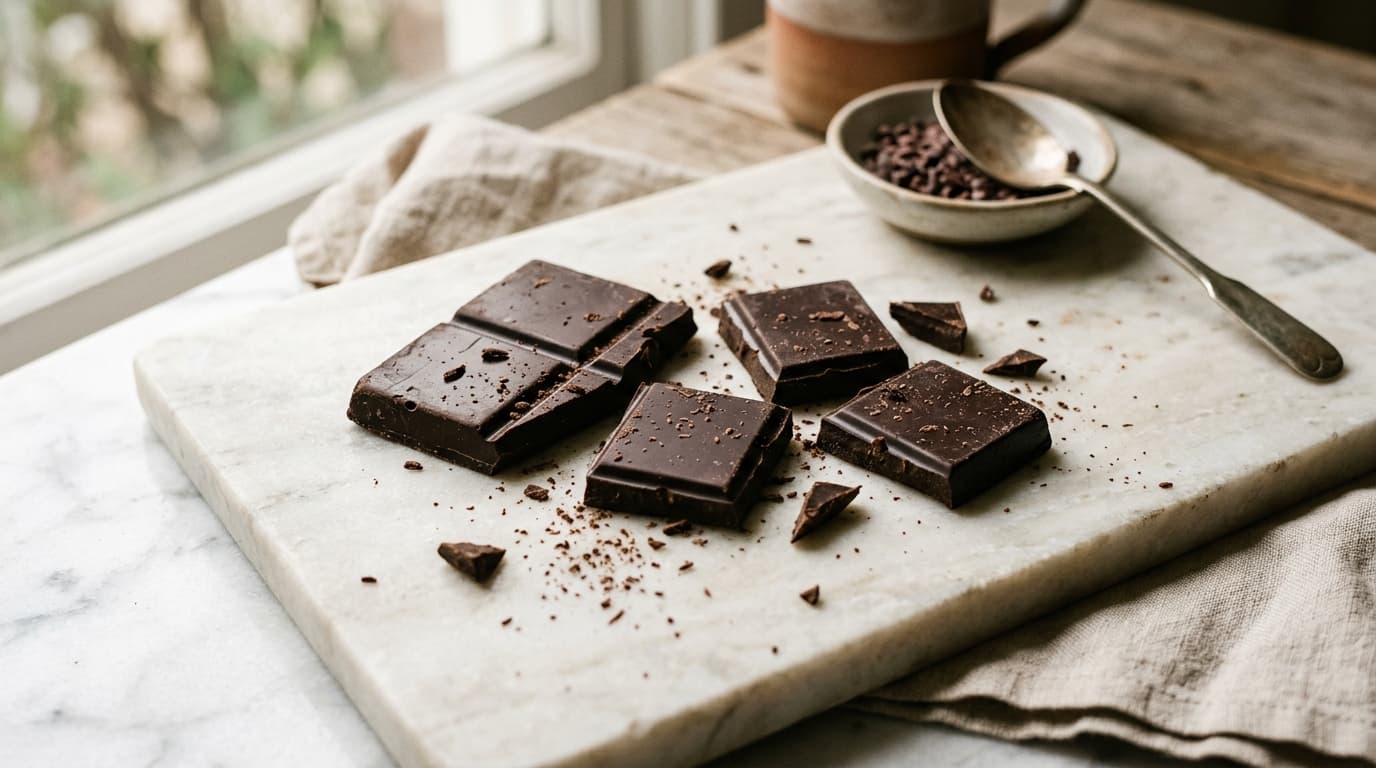
Yes, at a dose far smaller than the one repeated everywhere. The European Union has validated a single health claim on cocoa: 200 mg of flavanols a day, provided by roughly 10 grams of high-flavanol dark chocolate. Everything else circulates without official validation.
Is dark chocolate good for you?
Yes, within limits far narrower than the lists of seven benefits suggest.
Since September 2013, one sentence and one only may legally accompany cocoa in Europe: cocoa flavanols help maintain the elasticity of blood vessels, which contributes to normal blood flow. It appears in Commission Regulation (EU) No 851/2013, published after a favourable EFSA opinion issued in 2012. The dose is spelled out in the text: 200 mg of cocoa flavanols a day, provided by 2.5 g of high-flavanol cocoa powder or 10 g of high-flavanol dark chocolate.
Ten grams. Two squares.
The Belgian detail nobody picks up: the dossier was filed by Barry Callebaut, whose plant at Wieze, in East Flanders, is the largest chocolate factory in the world. The only health mention authorised on chocolate in Europe was therefore won from Belgium, after some twenty clinical trials. Keep the reservation that goes with it: the dossier was filed by the company selling the ingredient, not by a health authority that had set out, on its own account, to find out whether chocolate does any good.
Mood, memory, skin, athletic performance: none of it cleared the European review.
Why 70 % cocoa says nothing about flavanols
The figure printed on the wrapper indicates a proportion of cocoa dry matter. It says nothing about what survives of the flavanols after fermentation, roasting and above all alkalisation, the alkaline treatment that softens bitterness and darkens colour.
A study published in 2008 in the Journal of Agricultural and Food Chemistry measured that loss across commercial cocoa powders. I took its figures and worked out, on 21 September 2026, the quantity you would have to swallow to reach the 200 mg of the European claim.
| Cocoa powder | Flavanols per gram | Quantity for 200 mg |
|---|---|---|
| Natural, non-alkalised | 34.6 mg | 5.8 g |
| Lightly alkalised | 13.8 mg | 14.5 g |
| Medium alkalised | 7.8 mg | 25.6 g |
| Heavily alkalised | 3.9 mg | 51.3 g |
| High-flavanol powder of the regulation | around 80 mg | 2.5 g |
A heavily alkalised powder demands nine times more material than a natural one for the same effect. Fifty-one grams of pure cocoa a day: nobody does that.
The awkward part fits in one line. The dark colour and the round taste, which shoppers read as marks of quality, come precisely from the treatment that destroys flavanols. The visual cue runs backwards.
How much dark chocolate can you eat a day?
Ten grams for the documented effect. Past that you are eating chocolate, which is a perfectly sufficient reason, but it should no longer be called health.
Pages recommending 20 to 40 grams a day rest on no text at all. They double or quadruple an official dose without saying so, and that inflation carries a measurable consequence.
Does cadmium cancel out the benefit?
No, but it sets a ceiling that the most generous recommendations cross.
The cacao tree takes up cadmium from the soil, so dark chocolate concentrates more of it than milk chocolate. Regulation (EU) 2023/915 sets the maximum level at 0.80 mg/kg for chocolate containing at least 50 % total dry cocoa solids, a threshold applicable since 1 January 2019. EFSA, for its part, holds a tolerable weekly intake of 2.5 µg per kilo of body weight, established in 2009 and confirmed in 2011.
On 21 September 2026 I crossed the two figures for a 70 kg adult, whose tolerable intake reaches 175 µg a week. The table assumes a bar sitting exactly at the legal ceiling.
| Daily consumption | Cadmium per week | Share of the tolerable intake |
|---|---|---|
| 10 g, the dose of the regulation | 56 µg | 32 % |
| 20 g | 112 µg | 64 % |
| 30 g | 168 µg | 96 % |
| 40 g | 224 µg | 128 % |
A bar sitting exactly at the legal ceiling is an extreme case, not the norm. Most dark chocolates fall well below it. The reading of the table does not change for all that. The European dose leaves two thirds of the margin free for the rest of the plate, cereals, potatoes and leafy vegetables, which supply most of an adult's daily cadmium. The 40 grams advised by pages that cite no source can, on their own, be enough to exceed the weekly intake.
How much caffeine in a square of dark chocolate?
Around 8 mg for ten grams of 70 % chocolate, against 60 to 80 mg for an espresso. Theobromine, meanwhile, climbs to 80 mg over the same serving.
It is that theobromine, which we clear in a few hours and a dog takes a day and a half to eliminate, that makes chocolate dangerous for dogs and harmless for us.
Can you eat it pregnant, or at night?
Yes in both cases, and caffeine is not the limiting factor.
EFSA considers that an intake of 200 mg of caffeine a day, from all sources combined, raises no problem during pregnancy. At 8 mg per ten gram serving, you would need twenty-five servings a day to approach that threshold, and sugar and cadmium would have become a problem long before. Pregnancy precautions lie elsewhere: alcohol-filled pralines, fresh cream ganaches whose cold chain is uncertain, and unlabelled assortments.
At night the same arithmetic applies. Eight milligrams wake nobody.
Five habits that empty the square of its point
I see them every day at the counter, and I am guilty of two.
- Picking the darkest bar in the belief it is the richest, when the colour often comes from alkalisation rather than from the bean.
- Buying alkalised cocoa powder for a so-called healthy hot chocolate, when it has lost up to nine tenths of its flavanols.
- Melting chocolate into long-boiled milk: prolonged heat degrades what is left.
- Offsetting bitterness with two spoonfuls of sugar, which brings the serving back to the calorie level of an ordinary bar.
- Finishing the whole bar while telling yourself it is good for the heart.
Should you change bars over this?
No. But the answer depends on what you are after.
| Your case | What to do |
|---|---|
| Aiming for the documented effect | 10 g a day, lightly processed cocoa, natural powder rather than alkalised |
| Being pregnant | Dark chocolate passes; the watch is on alcohols and fresh ganaches |
| Chasing flavour | Forget flavanols and judge on origin, fermentation and roasting |
| Living with a dog | Store the bar high up, never on the coffee table |
| Watching sugar | Read the carbohydrates per 100 g, which the cocoa percentage does not predict |
If the subject interests you on the tasting side rather than the nutritional one, Belgian dark chocolate and its origins carries the question further, and the best cocoa powder details the choice between natural and alkalised powder. For the houses themselves, our ranking gives the order of preference.
Pralines & spécialités comparator
Compare all pralines & spécialités side by side.
Compare now →
Frequently asked questions
Bruxelloise pur sucre, Margaux arpente les chocolateries belges depuis plus de dix ans. Ancienne pâtissière reconvertie dans le journalisme gourmand, elle goûte, compare et raconte le chocolat belge sans complaisance — des grandes maisons aux ateliers de quartier.