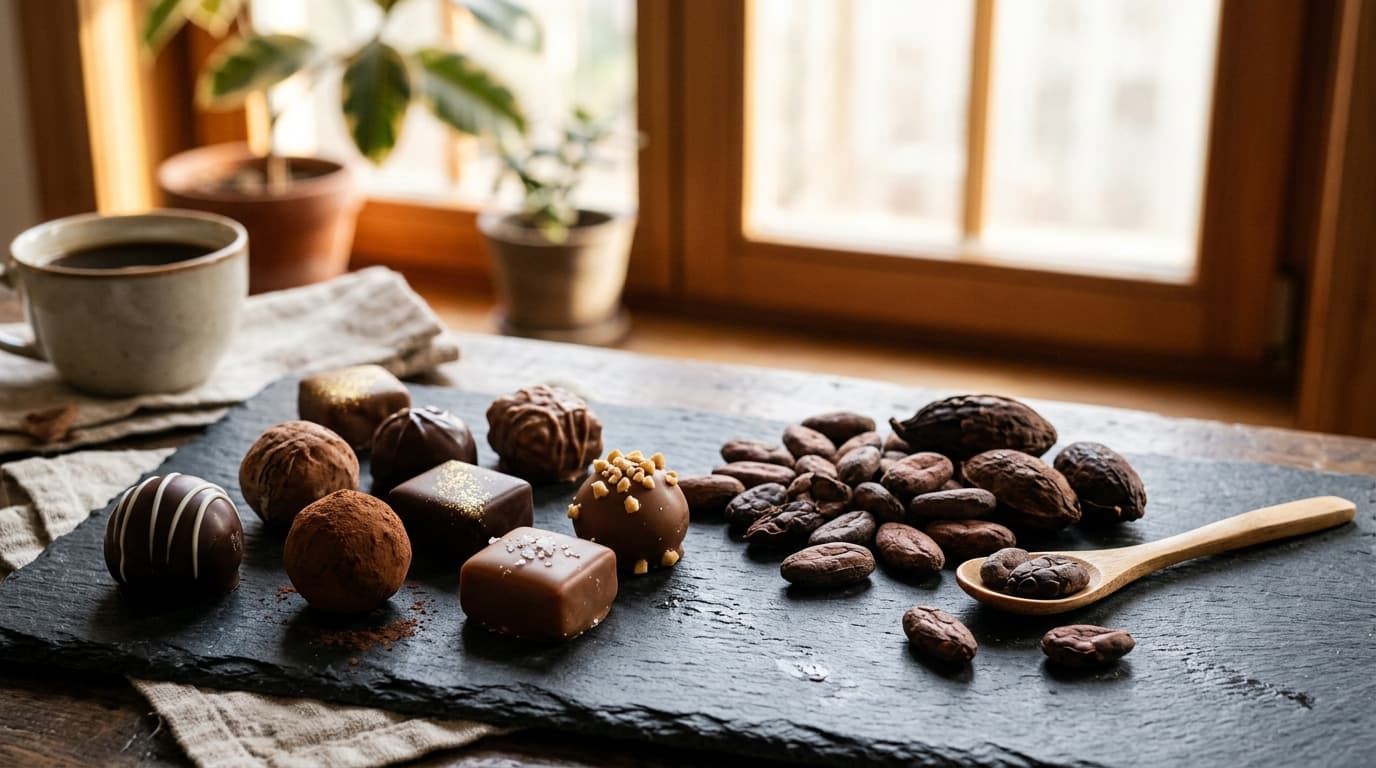
Godiva belongs to a Turkish group, Côte d'Or to an American one, Guylian to a South Korean one, and Pierre Marcolini to a Japanese fund since 2023. So what's actually Belgian about Belgian chocolate? Short answer: the place where it's made, and not much else. Here's what that changes — and what it doesn't.
What exactly makes chocolate “Belgian”?
Where it's made, and nothing else. Chocolate is Belgian if the mixing, refining and conching happened in Belgium — neither the origin of the beans nor the nationality of the shareholder enters the definition.
Those three steps aren't picked at random: they're the ones that give chocolate its melt. Conching above all, that slow churn which breaks down the grains and drives off bitterness. That's where the Belgian reputation for a texture that never grits between the teeth is won. On top sits a house tradition: pure cocoa butter, no substitute vegetable fat, long enforced by Belgian law before Europe took it up.
The consequence is concrete. A bar moulded in Poland from Belgian couverture may print “made with Belgian chocolate” on the wrapper. It may not print “Belgian chocolate”. The distinction is three words long and nobody reads it.
Does the cocoa in Belgian chocolate come from Belgium?
No, and it never has. The cocoa tree grows in a narrow band around the equator: Ivory Coast and Ghana supply most of the volume, Latin America the tasting origins. Belgium has never produced a single gram of cocoa.
The link has been written on the packaging all along, for anyone who reads it. Côte d'Or, founded in 1883 by Charles Neuhaus, takes its name from the Gold Coast — today's Ghana. The elephant, the palm trees, the name itself: the entire iconography of the country's best-selling brand says the cocoa comes from somewhere else. Colonial Congo did the rest of the story, the part rarely printed on ballotins.
So what's Belgian is the gesture: turning a bitter bean shipped 5,000 kilometres into a praline that melts at 34 °C. It's a craft, not a terroir. Belgian chocolate is to Belgium what haute couture is to Paris — nobody grows the fabric there either.
Who actually makes the chocolate used by Belgian chocolatiers?
Barry Callebaut, in the vast majority of cases. The group supplies around 80% of the chocolate produced in Belgium — a figure recalled by Belgian broadcaster RTBF in 2022, during the salmonella contamination that shut the plant down. That plant is Wieze, in East Flanders: the largest chocolate factory in the world, roughly 350,000 tonnes a year.
The mechanism is simple. The chocolatier buys couverture — the base chocolate, rich in cocoa butter — then melts it, tempers it, moulds it and fills it their own way. Callebaut even industrialised the artisan's comfort by launching callets in 1988, those small discs that dose and temper without effort. There's no shameful secret here: it's the principle of the great restaurant that doesn't grow its own wheat.
The irony lies elsewhere. Barry Callebaut was born in 1996 from the merger of Belgium's Callebaut (Wieze, 1911) and France's Cacao Barry, and its head office is in Zurich. The giant that makes Belgian chocolate is therefore a Swiss company. At tasting we ran the test: between two ganaches from different houses built on the same couverture, the difference plays out in the filling and the freshness, not in the base chocolate.
Which Belgian brands are still owned by Belgians?
A minority, and the list keeps shrinking. Of the big names everyone cites, half have changed flag in about fifteen years — without production leaving the country.
| Brand | Owner | Shareholder's country | Made in |
|---|---|---|---|
| Leonidas | Kestekides family (100%) | Belgium | Belgium |
| Neuhaus | Compagnie du Bois Sauvage (Paquot family) | Belgium | Belgium |
| Wittamer | Wittamer family | Belgium | Sablon, Brussels |
| Côte d'Or | Mondelez International | United States | Belgium |
| Godiva | Yıldız Holding | Turkey | Belgium |
| Guylian | Lotte | South Korea | Sint-Niklaas |
| Galler | Qatari investors (full control since May 2018) | Qatar | Vaux-sous-Chèvremont |
| Pierre Marcolini | Orchid / MBK Partners | Japan / South Korea | Brussels |
Leonidas is the clearest case: four generations on, the Greek founder's family still holds 100% of the company, which posted €131 million in revenue for the year ending June 2025 and announced a new plant in Nivelles that December. The paradox is enjoyable: the most “Belgian” house on the list was founded by a Greek who came via the United States.
Guylian went to South Korea's Lotte in June 2008 for €105 million. Godiva had switched to Turkey's Yıldız Holding the same year. The seashells and the horsewoman have been foreign for almost twenty years, and nobody noticed in store.
Is Pierre Marcolini still a Belgian house?
The chocolate, yes. The capital, no. Since April 2023, 100% of the shares are held by the Japanese company Orchid, based in Tokyo, itself controlled by the fund MBK Partners (Seoul). The founder now holds only a minority stake and devotes himself to creation. In March, La Libre was already reporting a possible exit by the fund.
Fundamentally, none of that changes what lands in your mouth — and that's where the house keeps a real lead. Marcolini remains the only great Belgian house working bean-to-bar at this scale: it selects its beans at origin, roasts them itself, and shows traceability by provenance. In other words, it's the only one that doesn't depend on someone else's couverture to exist.
In the window on rue des Minimes you can see it before you even taste: the squares carry an origin, not a flavour. We tasted a plain ganache from the Sablon last month — frank acidity, length, a profile that still unsettles palates used to sweet praliné. The shareholder's passport didn't bleed into the roast.
A Korean fund can buy a Belgian house. It cannot buy the fact that it roasts its beans in Brussels.
Does the “Belgian chocolate” label really protect anything?
Far less than people assume. The Belgian Chocolate Code was signed in 2007 under Choprabisco, the sector's royal trade association, and applied from 1 September 2008. It's a voluntary code of conduct: it binds only its signatories and carries no force of law.
More to the point, “Belgian chocolate” is neither a PDO nor a PGI, unlike champagne or Ardennes ham. The sector floated a European protection request as early as 2013; it never went through. The result: the claim rests on an agreement between professionals and on the trade's own vigilance, not on public enforcement.
Hence the word games. “Belgian style”, “Belgian recipe”, “Belgian-inspired”: phrases that commit to nothing, and exactly what the code was meant to contain. Around the Grand-Place you'll find gilded shopfronts, old dates painted on the glass and zero pralines sold by weight — the set dressing of Belgian chocolate without the craft behind it.
So should we still believe in Belgian chocolate?
Yes, but for the right reasons. What still stands is the gesture: the conching, the pure cocoa butter, the fresh praline filled by hand and sold by weight — invented at Neuhaus in 1912 and never matched anywhere else as a national culture. What has collapsed is the family-heritage story: half the icons belong to foreign funds, and the couverture comes out of a plant run by a Swiss group.
The good news is that these two things are independent. Godiva didn't get worse when it changed shareholder, and Marcolini didn't lose its roasting when it moved under a Japanese flag. The flag on the cap table has no taste.
Curious which houses actually made it through the century? Our tour of the oldest Belgian chocolate shops goes back to 1857. And if you're still hesitating at the window, our comparison of which Belgian chocolatier to choose settles it by occasion and budget — or test yourself with our chocolate quiz.
Histoire du chocolat comparator
Compare all histoire du chocolat side by side.
Compare now →
Frequently asked questions
Bruxelloise pur sucre, Margaux arpente les chocolateries belges depuis plus de dix ans. Ancienne pâtissière reconvertie dans le journalisme gourmand, elle goûte, compare et raconte le chocolat belge sans complaisance — des grandes maisons aux ateliers de quartier.