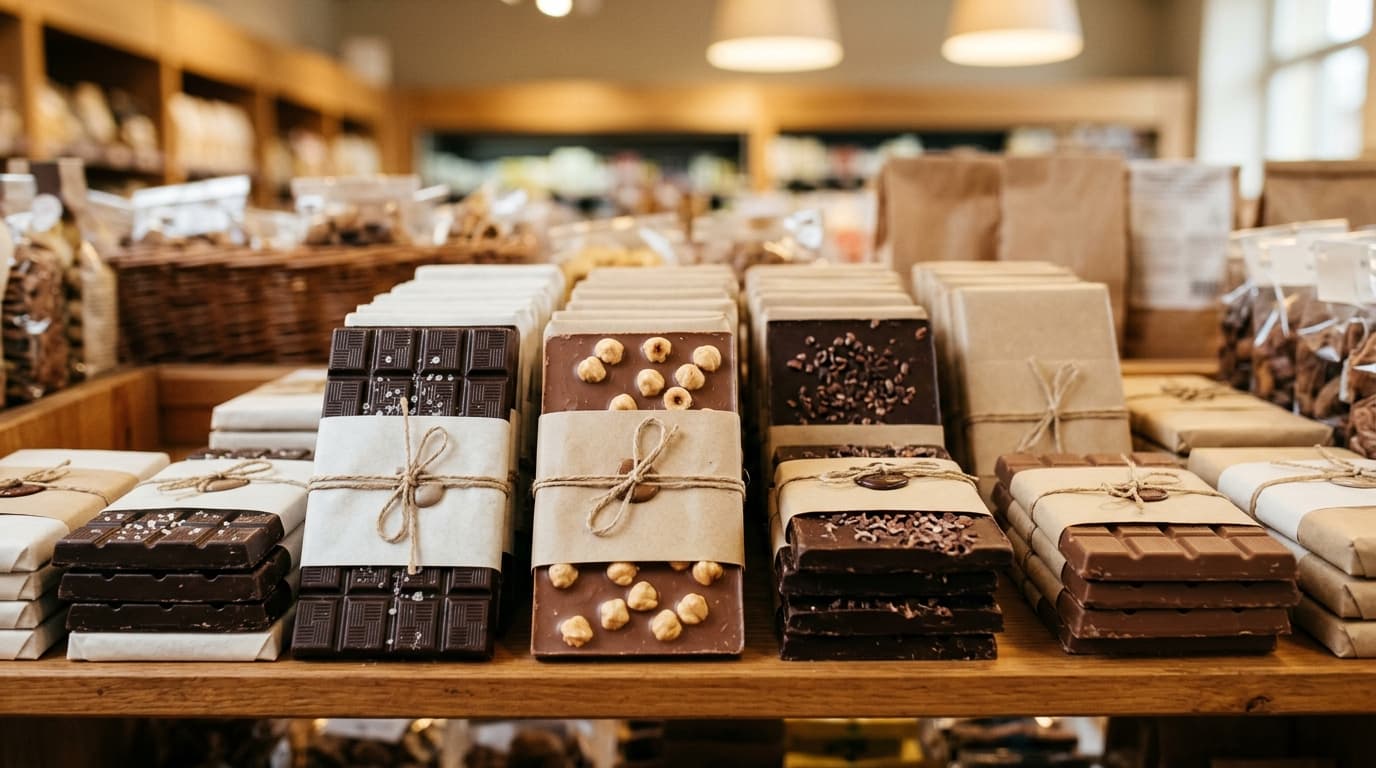
At the supermarket, the best Belgian chocolate comes down to five reflexes: Côte d'Or for everyday milk, Jacques for dark, Galler to step up, Cavalier for sugar-free, and own-brands when price is what matters. The rest is a question of use. Here's how to decide on the shelf, bar by bar.
What Belgian chocolate do you actually find at the supermarket?
In Belgian retail, the aisle is mostly about bars: Côte d'Or, Galler, Jacques, Newtree, Cavalier, plus the own-brands from Aldi, Lidl, Colruyt or Delhaize. Fresh pralines stay the business of chocolatiers. So we're talking everyday chocolate here, not a gift.
The distinction matters because it changes everything at tasting. A supermarket bar is built to last months in a cupboard: firmer, sweeter, more stable. A chocolatier's praline, filled with fresh ganache, keeps for a few weeks and melts differently. Neither is better in absolute terms, just a different product.
Côte d'Or sums up the aisle's role. Founded in 1883, it's the most consumed Belgian chocolate brand in retail, the one behind the milk bars and the Chokotoffs. For many people it's the gateway to Belgian chocolate, long before they push open a boutique door.
Côte d'Or or Galler: which to choose in retail?
Côte d'Or for everyday milk, Galler when you want to move up a notch. Both are Belgian, both are on the shelf, but they don't target the same craving.
Côte d'Or is consistency: the milk block that melts sweet and clean, the smooth 54% dark bar, the family-size formats at a gentle price. We tasted dozens of shelf bars for you, and Côte d'Or stays the reassuring reference — the one you spot with your eyes closed and that never really lets you down.
Galler, a Liège house founded in 1976 and holder of a Royal Warrant, plays another tune. Fairtrade certified, it works exclusively with pure cocoa butter and bets on bolder flavours. Its filled mini-bars (praliné, coffee, speculoos) are its shelf signature, and the most natural bridge between an industrial bar and artisan work.
Is Jacques the best dark chocolate at the supermarket?
For supermarket dark, yes, according to an independent Belgian test. In its comparison of supermarket dark chocolate, Test-Achats named the Jacques Noir intense 72% as Best of Test, with a score of 79 out of 100 for a price around €19/kg.
The panel praised a smooth mouthfeel, slightly less cocoa aroma than average but softer and creamier. Jacques is a historic Belgian brand, born in Eupen, and this top spot confirms you can find a very good dark without leaving the trolley or aiming for the high end.
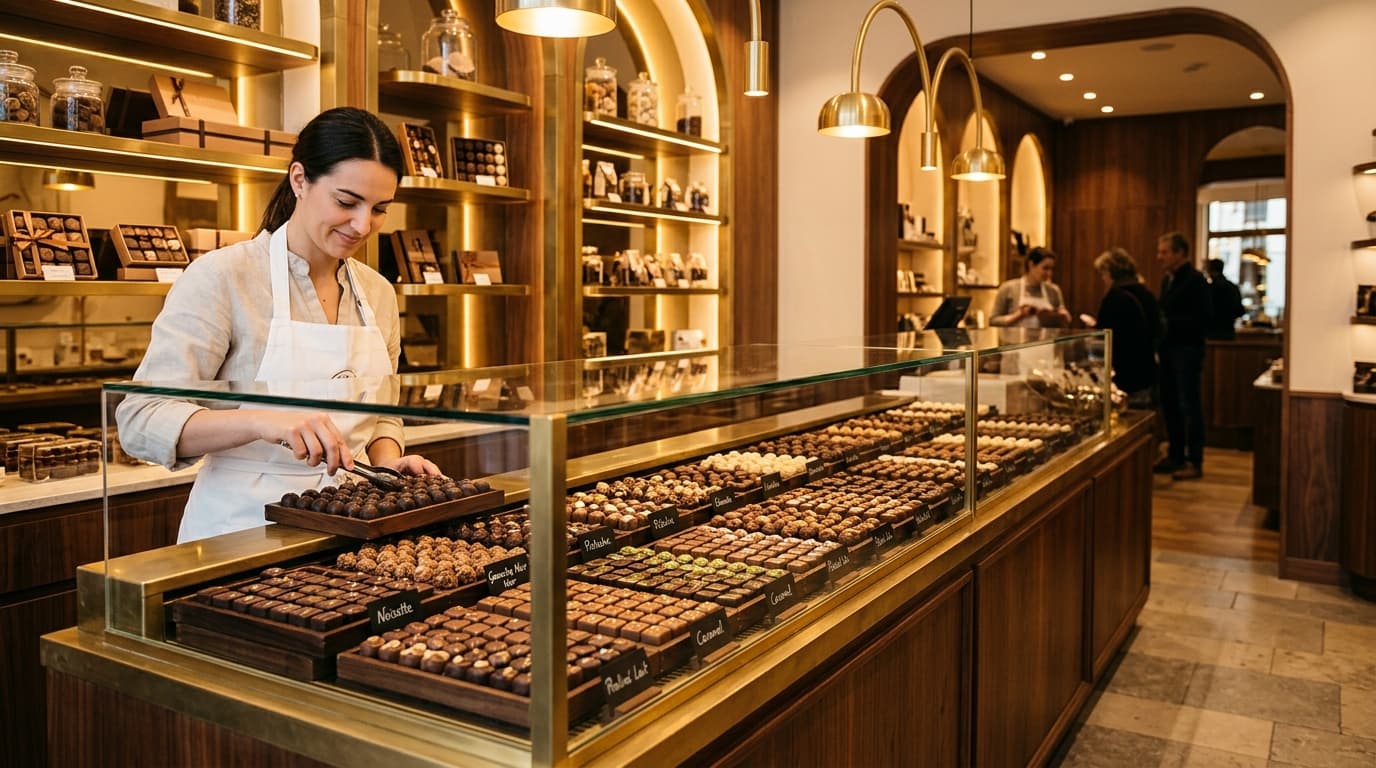
Do you need to pay more than an own-brand?
Not always. The same Test-Achats test ranked dark bars from Aldi (Choceur Choco Changer 70%) and Lidl (Way to Go, Fin Carré range) as Best Buy, with scores of 70 to 71 for a price around €10/kg — half the cost of the award-winning Jacques.
In other words, on dark chocolate, the own-brand holds up perfectly. Price doesn't make quality on the shelf, and paying double for a known logo doesn't always make sense on the palate. Where the gap widens is on filled bars and signature recipes, harder to copy.
Which sugar-free Belgian chocolate should you choose at the supermarket?
Cavalier, without hesitation. This Belgian brand has made only no-added-sugar chocolate for nearly twenty years, sweetened with stevia rather than the polyols that sometimes leave an aftertaste. You find it as milk, dark and praline bars in most chains.
Galler also offers a sugar-free range for anyone who wants a more artisan signature. For a diabetic profile or someone watching fast sugars, these two brands avoid the sad diet aisle: at tasting, the Cavalier milk holds its own against a classic bar. Still, check the fat content, often similar to regular chocolate.
How do you spot a good chocolate on the shelf?
Four cues on the label are enough to decide in ten seconds. They apply to every brand, Belgian or not.
First, the words "pure cocoa butter": they guarantee no vegetable fats or palm oil. Then a clearly stated cocoa percentage — the higher it is, the less sugar. Next, a short ingredient list: cocoa, sugar, cocoa butter, a little milk, some vanilla, and not much else. Finally, a Fairtrade label or equivalent, a sign of a better-paid cocoa supply chain.
These criteria don't replace your palate, but they rule out bad surprises. The rest — milk or dark, sweet or intense, plain or filled — is just a matter of taste, and there, no test will decide for you.
Our supermarket picks, by use
The aisle has no single winner: each brand wins on its own ground. Here's how to find your way at a glance.
| Use | Brand to reach for | Why |
|---|---|---|
| Everyday milk | Côte d'Or | Safe bet, family size, gentle price |
| Dark for tasting | Jacques 72% | Best of Test at Test-Achats (score 79) |
| Small budget | Own-brand | Aldi and Lidl rated Best Buy (~€10/kg) |
| Step up | Galler | Fairtrade, pure cocoa butter, filled mini-bars |
| Sugar-free | Cavalier | Belgian, stevia, full range in retail |
Ready to step up for a gift or a proper tasting? Then you leave the aisle for the boutique: our guide to which Belgian chocolatier to choose compares the great houses, and our piece on buying Belgian chocolate online shows how to get fresh pralines delivered. Not sure of your chocolate profile yet? Take the chocolate quiz.
Où acheter comparator
Compare all où acheter side by side.
Compare now →
Frequently asked questions
Bruxelloise pur sucre, Margaux arpente les chocolateries belges depuis plus de dix ans. Ancienne pâtissière reconvertie dans le journalisme gourmand, elle goûte, compare et raconte le chocolat belge sans complaisance — des grandes maisons aux ateliers de quartier.