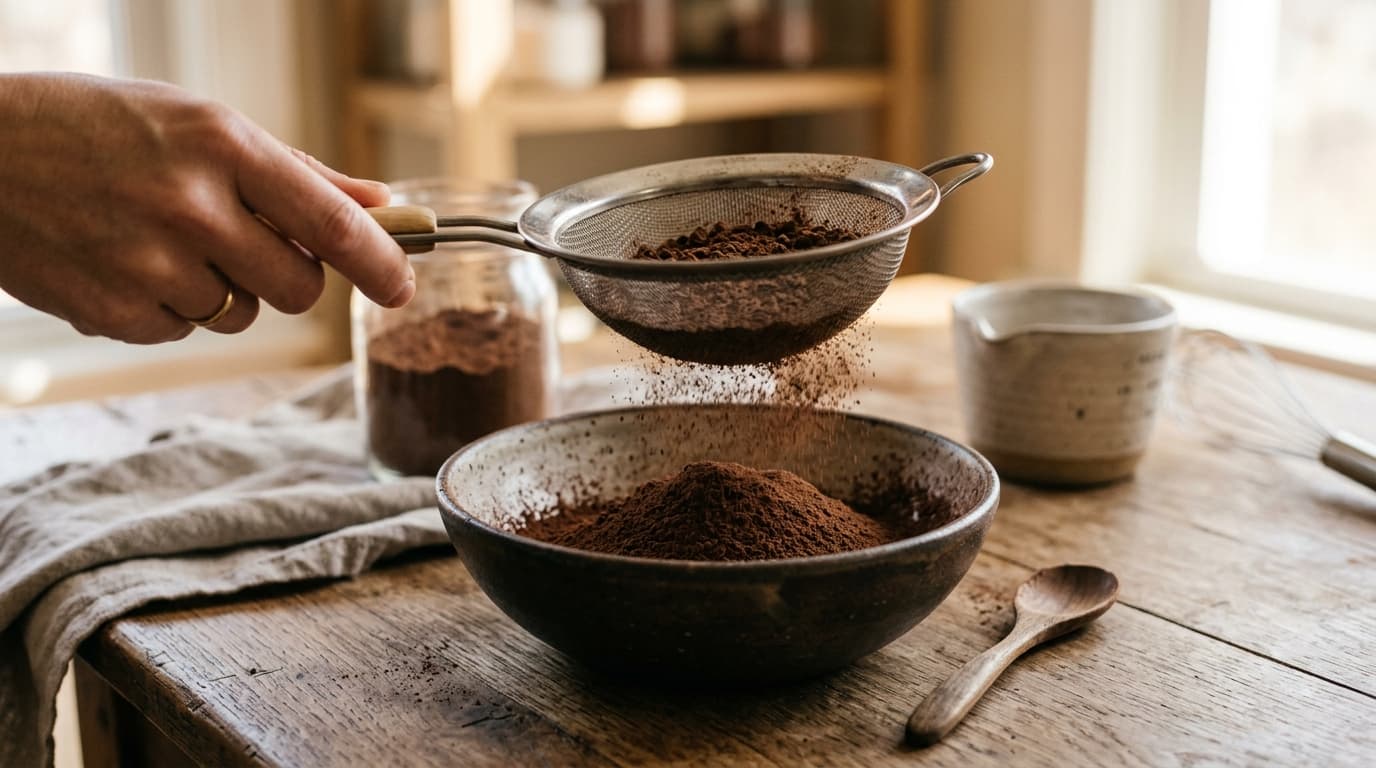
It is the ingredient you buy without thinking, and yet it decides the taste of every chocolate cake you bake. Between pure unsweetened cocoa, the breakfast “drinking chocolate” and the tubs used by professional pastry chefs, the gap is huge — and price does not tell the whole story. Here is how to choose.
What is the best cocoa powder?
It depends on what you do with it, but the hierarchy is stable.
For aromatic finesse, Valrhona leads: an unsweetened powder with complex notes, regularly named by pastry chefs. It is also the most expensive per kilo, and the gap really pays off in a recipe where cocoa stands alone — a ganache, a mousse, a glaze.
For demanding everyday use, Callebaut and Cacao Barry are the professional standard: the same level of sourcing, at a far gentler price once you buy the one-kilo bag. And for the supermarket aisle, Van Houten remains the safe bet — the brand that invented the alkalising process, offering both a pure unsweetened version and an alkalised one.
Alkalised or natural cocoa: which should you choose?
This is THE technical question, and it changes the outcome of your cake.
Alkalised cocoa, also called “dutched”, is treated to neutralise its acidity: it becomes darker, rounder, almost velvety. It is the process invented in the 19th century by the Van Houten house. It dissolves better in hot milk and gives that deep colour you expect from a chocolate cake.
Natural cocoa keeps its acidity and fruity notes. It is livelier on the palate, but above all: it reacts with baking soda. If your recipe calls for baking soda, it was written for natural cocoa — swap in an alkalised one and the cake will rise less.
We ran the test on two identical sponges, same oven, same day: the alkalised one was darker and softer, the natural one tangier and slightly airier. Neither is better — they simply tell different stories.
Which cocoa powders offer the best value for money?
Callebaut and Cacao Barry, as soon as you accept buying in volume. Both brands — part of Barry Callebaut, the Belgian-Swiss giant that supplies the bulk of Belgian chocolate — are what pastry chefs use every day. In a one-kilo bag, the price per 100 g falls well below a small supermarket tin, for higher quality.
If you bake once a month, the investment makes no sense: a tin of pure Van Houten cocoa or an unsweetened own brand does the job perfectly. If you bake every week as a family, the one-kilo bag is the best chocolate purchase you will make this year.
| Criterion | Van Houten | Callebaut / Cacao Barry | Valrhona |
|---|---|---|---|
| Where to buy | Supermarket | Trade shops, online | Fine grocers, online |
| Price per kilo | €€ | €€ | €€€€ |
| Intensity | Good | Very good | Excellent |
| Aromatic complexity | Simple | Fine | Remarkable |
| For whom | The family that bakes | The regular baker | The recipe where cocoa is the star |
Which cocoa powders are the most ethical?
Look at the logo, not the country. A “Belgian” cocoa says nothing about how the bean was bought — Belgium processes, it does not farm.
The reliable markers are certifications (Fairtrade, Rainforest Alliance) and supply-chain programmes: Cocoa Horizons, run by Barry Callebaut, covers the Callebaut and Cacao Barry ranges; Cacao-Trace, run by Puratos, works on the same principle of a premium paid to farmers. For fully organic and fair trade, committed Belgian brands such as Belvas remain the most traceable, even if their cocoa powder is harder to find on the shelf.
Which cocoa powder for desserts and drinks?
An alkalised one, no hesitation. It is the only one that does both properly: it dissolves in hot milk without lumps or harshness, and in baking it delivers that near-black colour we associate with a “real” chocolate cake.
For a hot chocolate worthy of the name, the rule we apply at home: two teaspoons of unsweetened cocoa, one spoon of sugar, a pinch of salt — and above all, slake the powder in a splash of cold milk before adding the hot milk. We compared it with a shop-bought chocolate powder: same cost per cup, twice the cocoa flavour.
How should you store cocoa powder?
Away from air, light and above all humidity. Cocoa powder does not really “expire”, but it fades: after a year in a half-open tin, it has lost most of its volatile aromas and gives nothing but a brown colour and a flat bitterness.
Decant it into an airtight jar, keep it away from the oven and from spices, and never dip a wet spoon into it. A well-stored cocoa easily holds two years without losing much.
Want to go further on tasting? Our comparison of Belgian dark chocolate explains which cocoa percentage to choose for which use, and our chocolate quiz places you in two minutes.
Pralines & spécialités comparator
Compare all pralines & spécialités side by side.
Compare now →
Frequently asked questions
Bruxelloise pur sucre, Margaux arpente les chocolateries belges depuis plus de dix ans. Ancienne pâtissière reconvertie dans le journalisme gourmand, elle goûte, compare et raconte le chocolat belge sans complaisance — des grandes maisons aux ateliers de quartier.