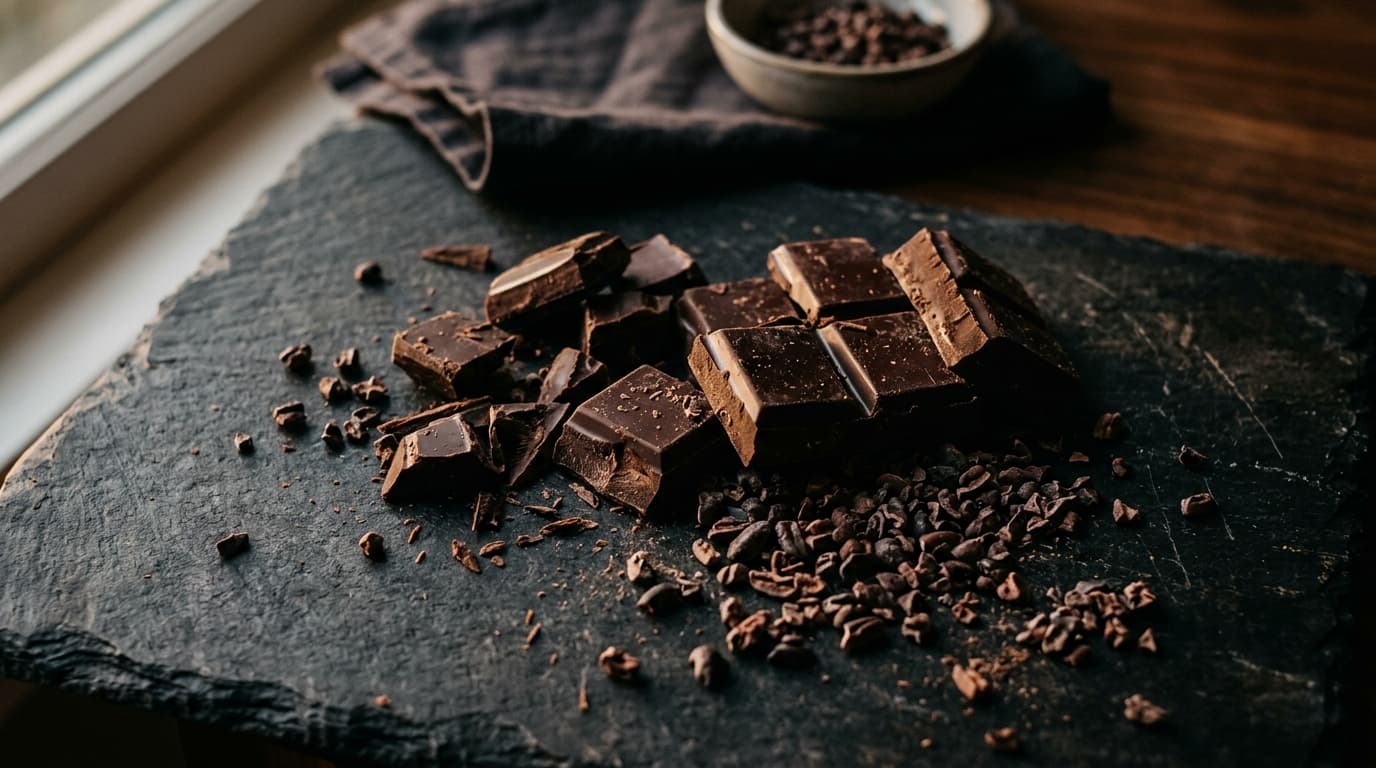
When you love dark chocolate — the real thing, the kind that snaps and leaves a long bitterness — the Belgian window can be confusing. Between atelier grands crus and supermarket bars, everything calls itself "dark". Here is how to decide based on what you're after: the intensity a demanding enthusiast wants, a gift, or the everyday square.
What makes a good Belgian dark chocolate?
A good dark is judged first by its ingredient list: cocoa, cocoa butter, a little sugar, and that's it. No vanilla flavouring to round the edges, no added vegetable fats. The stated percentage (the cocoa content) sets the direction, but it doesn't tell the whole story: two 70% bars can taste radically different depending on the origin of the beans and the roast.
For an enthusiast, the interesting zone sits between 70 and 85%. Below that, you drift towards a soft, sweet dark; above 90%, bitterness takes over. At tasting, a good Belgian dark melts cleanly on the tongue, releases a fruity acidity or roasted notes, then leaves a frank bitterness without ever rasping.
Pierre Marcolini, the best Belgian dark chocolate?
For a lover of intense cocoa, yes, it's the reference. Marcolini is one of the rare Belgian houses to work bean-to-bar: it selects, imports and roasts its own beans at the Sablon in Brussels, rather than buying a ready-made couverture. The result is a flavour profile mastered from bean to square.
The house offers single-origin grands crus — Peru, Madagascar, Cuba, Sao Tomé, India — each with its signature: the sharp acidity of Madagascar, the rounder cocoa character of Peru. That is exactly what an enthusiast is after: tasting the terroir of a bean, not a smoothed-over recipe. The price is the highest of the group, but you pay for a rare raw material and true craftsmanship.
At tasting, a Madagascar grand cru at Marcolini has more to say than ten industrial bars lined up.
So save it for the moments when you take your time: a square after dinner, a slab to share among fellow lovers. It's the house I name first whenever I'm asked where to find a real Belgian dark chocolate for tasting.
Does Neuhaus hold up against Marcolini on dark?
On dark pralines to give, Neuhaus remains a safe bet. The great historic house, inventor of the filled praline in 1912, takes care of its dark ganaches: a coating of frank dark, a melting centre, faultless consistency from one box to the next.
Where Marcolini targets the enthusiast who wants to dissect an origin, Neuhaus targets the one who wants to give without going wrong. The dark here is more consensual, less cutting, but impeccably executed. Expect a premium price, around €6 to €8 per 100 grams depending on the selection. In store, ask for an "intense dark" selection rather than the mixed assortment: you'll target the most cocoa-forward ganaches.
Galler and its 85% dark, who is it for?
For the enthusiast who wants intensity every day without blowing the budget, Galler is the right compromise. The Liège house, holder of a Royal Warrant, offers an 85% dark bar that is dense and properly bitter, well above the usual level of a supermarket shelf.
You're a notch below an atelier grand cru on aromatic complexity, but the consistency is there, and so is the price: a few euros a bar, available everywhere. It's the dark I keep in the cupboard for the end-of-day square, the one you snap without a second thought. For an enthusiast discovering high percentages, Galler's 85% is an ideal gateway before moving up to single origins.
Is Côte d'Or Noir de Noir still worth it?
For the melt and the nostalgia, yes; for intensity, no. Côte d'Or's Noir de Noir (the famous elephant) contains a minimum of 54% cocoa: a soft, very melting dark, closer to a strong milk than to an enthusiast's dark. Perfect for baking, hot chocolate, or those who find high percentages too dry.
Côte d'Or has broadened its range, with organic references at around 85% that step things up. But let's be honest: against a Marcolini grand cru or Galler's 85%, Noir de Noir plays in another category. It's the dark for backup and cooking, not the one you bring out for a tasting.
Bar or praline: which dark for an enthusiast?
Both, but for different uses. The bar is the best ground to taste a pure cocoa: nothing comes between the bean and you, so you judge the origin, the roast, the length on the palate. It's the format for the enthusiast who wants to analyse.
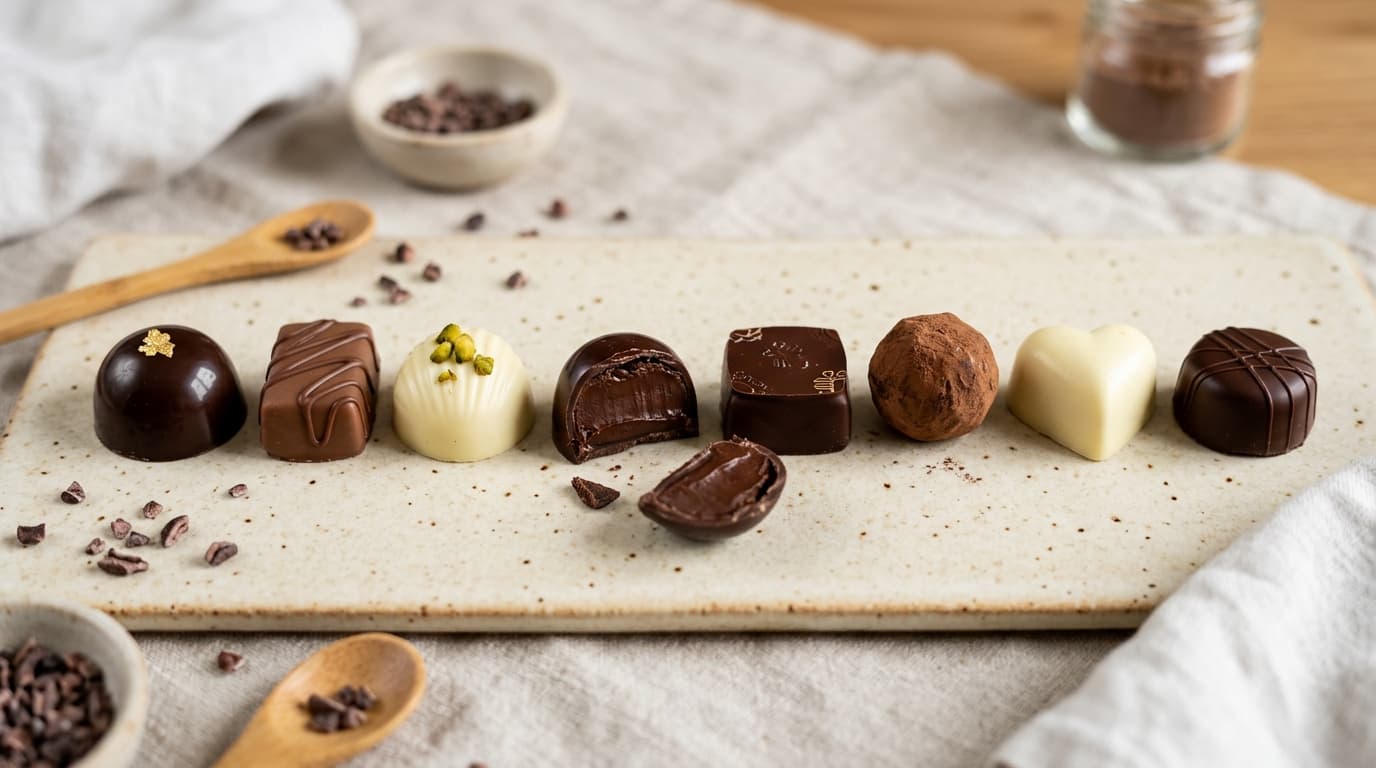
The dark praline, meanwhile, plays on contrast: a coating of frank dark, a centre of ganache, praline paste or caramel. Here you look for balance more than purity. For a gift, the praline wins; for a real tasting from cold, the single-origin bar comes out on top. We tasted both side by side: the bar speaks of the cocoa, the praline tells the chocolatier's gesture.
Which Belgian dark chocolate for your profile?
The simple rule: start from the use, not the name on the box. To explore origins and intensity, Marcolini. To give a dark without risk, Neuhaus. For the everyday square, Galler. For cooking and a soft melt, Côte d'Or. Leonidas, finally, remains the option for the big box to share, with honest dark pralines at a gentle price.
| House | Dark style | Cocoa marker | Price | For the enthusiast |
|---|---|---|---|---|
| Pierre Marcolini | Bean-to-bar, single-origin grands crus | 72-85% + origins | €€€€ | Tasting reference |
| Neuhaus | Dark ganaches and pralines | ~70% | €€€ | To give |
| Galler | Intense dark bar | 85% | €€ | Everyday |
| Côte d'Or | Noir de Noir / organic range | 54-85% | € | Cooking, soft melt |
| Leonidas | Accessible dark pralines | ~72% | €€ | Big box to share |
Not sure yet which dark profile suits you? Take stock with our chocolate quiz, or compare the great houses in our guide to choosing your Belgian chocolatier.
Pralines & spécialités comparator
Compare all pralines & spécialités side by side.
Compare now →
Frequently asked questions
Bruxelloise pur sucre, Margaux arpente les chocolateries belges depuis plus de dix ans. Ancienne pâtissière reconvertie dans le journalisme gourmand, elle goûte, compare et raconte le chocolat belge sans complaisance — des grandes maisons aux ateliers de quartier.