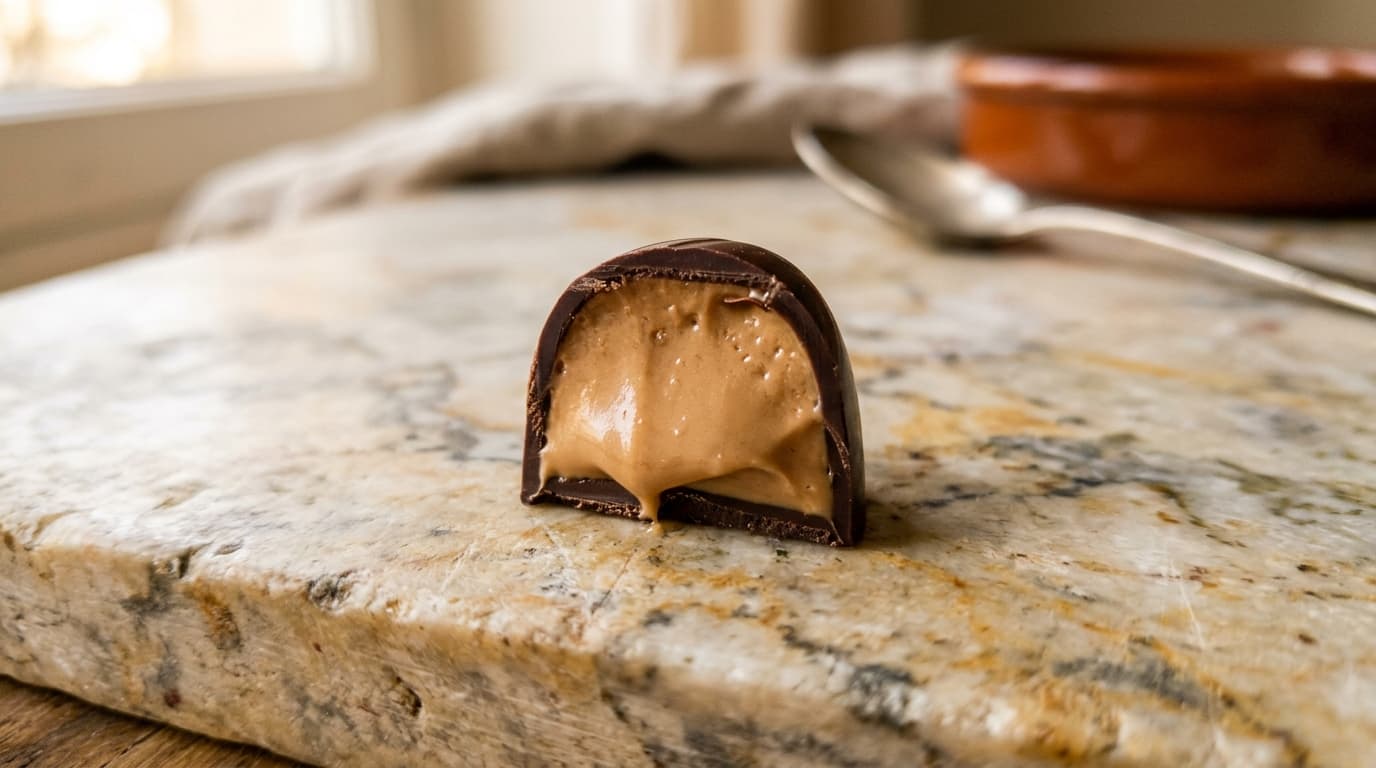
Jean Neuhaus Jr., in Brussels, in 1912: that is the house's answer, repeated almost everywhere. It holds for the molded Belgian praline, not for the filled chocolate, which France describes from 1855 and Bristol sells in 1866. Neuhaus fixed an object, he did not invent an idea.
Neuhaus, 1912: the house's version
The story runs on three dates. In 1857 Jean Neuhaus, a pharmacist, opens a dispensary in the Galerie de la Reine in Brussels and coats his medicines in chocolate to make them go down. In 1912 his descendant Jean Neuhaus Jr. replaces the medicine with a filling. In 1915 the latter's wife, Louise Agostini, devises the ballotin, whose later story is told in our article on the box.
The sentence about 1912 turns up almost word for word from one source to the next. But the verb changes, and that is what caught my attention. On 3 November 2026 I noted the wording on each page.
| Source | Wording | Verb |
|---|---|---|
| Neuhaus, Belgian homepage | "Since Jean Neuhaus Jr. invented the Belgian praline in 1912" (in French); description tag: "Inventor of the praline" | invented |
| Neuhaus, "Our Story" page | "In 1912, his grandson evolved this idea into the Belgian praline as we know it today"; page title: "Inventor of the Belgian Praline" | evolved |
| Focus on Belgium, a site presenting the country | "the first chocolate to feature a soft filling" | invented |
| Wikipedia, "Chocolate praline" | Jean Neuhaus II is "generally credited" with the modern praline, "a moulded chocolate with a filled centre" | is credited |
| Paris Match Belgium, 29 October 2025 | "That is the birth of the praline!" (in French) | was born |
So the house writes "invented" on its commercial shopfront and "evolved this idea" on the page telling its history, which is nonetheless titled "inventor". Both sit on the same site, a few clicks apart.
Cream-filled chocolates are described from 1855
Here is the problem. The filled chocolate does not wait for 1912.
According to the English Wikipedia page on Fry's Chocolate Cream, the Frenchman Louis-Eustache Audot describes in 1855 "pralines de chocolat à la crème", that is, fondant wrapped in chocolate, and the English house is said to have copied those French assortments. This is no forum rumour: the same page relies on printed references and on the BBC for the history of the bar.
| Date | Fact | Source reread |
|---|---|---|
| 1846 | Balzac writes "le chocolat praliné" in La Cousine Bette: the word is in circulation | Wikipedia |
| 1855 | Audot describes chocolate pralines "with cream" | Wikipedia, Fry's |
| 1864 | Auguste Debay distinguishes the roasted-almond praline from the cream praline, chocolate around a soft sugar centre | Wikipedia |
| 1866 | Fry's Chocolate Cream, Bristol: a plain fondant coated in dark chocolate | Wikipedia, Fry's |
| 1868 | Cadbury launches its "Fancy Box" of filled chocolates | a British retailer's blog, not cross-checked |
| 1912 | Jean Neuhaus Jr., Brussels: the molded Belgian praline | Neuhaus, Focus on Belgium |
| 1915 | Paul Zipperer, The Manufacture of Chocolate, still describes the almond praline and the fondant cream | Wikipedia |
The last third of this table is the most telling. In 1915, three years after the canonical date, a manufacturing manual still files under the word praline the almond and the cream centre coated in chocolate. Nobody there reports a Brussels revolution.
The 1868 line remains a reservation: I take it from a sales blog, not from a Cadbury archive, and I keep it for its plausibility, not as proof.
What exactly did Jean Neuhaus Jr. do in 1912?
According to the sources, he changed the way the thing is made. Wikipedia speaks of "a moulded chocolate with a filled centre". The blog of the British retailer Cocoa Runners describes a ganache poured into a chocolate shell prepared in advance. The house's own history page describes no technique at all: it only says "chocolate filled with delight instead of medicine".
Turn the sentence around and the thesis appears. Before, the cream or fondant centre was dipped in chocolate. After, a shell is molded, then filled, then closed. It is not the same gesture, and it opens the door to runnier fillings: ganache, liquid praliné, liqueur. If the credit to Neuhaus is deserved, it is for that.
Yet I found no 1912 catalogue, no invoice, no trademark filing, no contemporary witness. The five pages in the table above give the same date without citing a single archive, and the Caobisco one, which writes that the grandson evolved his forebear's idea, cites nobody either. A date repeated five times is still one source when the five copy each other.
The objection deserves a hearing. A manual that describes a gesture does not prove the age of the gesture, and nothing forbids a confectioner of 1855 from having worked differently from what his book says. Audot perhaps describes a simply coated fondant, while others were already turning out shells. Only, the reasoning works both ways: if an old text does not fix the birth of a technique, a house's account does not fix it either.
One question remains that most pages skip: the criterion. If "inventing the praline" means selling a chocolate with a soft centre, 1855 wins. If it means selling a filled molded shell, 1912 holds, for lack of a known rival in my reading. Everything depends on the word placed behind the verb.
Belgian law today has kept the word's looseness. The royal decree of 19 March 2004 defines the praline as a bite in which chocolate weighs at least 25% of the total, with not a word on the shell or the molding, as our article on the three words recalls.
Was Jean Neuhaus Jr. the founder's son or grandson?
Depending on where you read, one or the other.
The house's history page says "his grandson". So does Focus on Belgium, with life dates, 1877 to 1953. Paris Match writes "his son". And the English Wikipedia entry on the house calls Jean II sometimes the founder's son, sometimes his grandson, while giving 1912 as the year Frédéric, the founder's son, died.
Nothing serious: the genealogy of a house founded in 1857 blurs quickly. But a story whose protagonists change generation from one page to the next deserves more caution than a slogan. Only the 1912 date stays stable, and it is precisely the one nobody documents.
Why did 1912 win out without a challenge?
Because nobody challenges it and everybody repeats it. I found no Belgian house claiming an earlier date.
The slogan has a lot to do with it. The description tag of Neuhaus's Belgian homepage runs to a handful of words: "Belge, depuis 1857. Inventeur de la praline." That is what shows under the link in a search engine. The date also drifted along the way: a New York Times article of 22 December 2011, cited by Wikipedia, writes that Neuhaus invented the praline "100 years ago", which is 1911.
Then there is publishing. In October 2025 a book titled Neuhaus, inventeur de la praline belge by Charlotte Huens and Pacôme Nasier, 176 pages in Dutch, French and English, was presented on 28 October, according to Paris Match, which incidentally names two different publishers for the same work. The effect is mechanical: each new publication leans its account on the previous ones.
And the legend of the Count of Praslin?
It belongs to another story, the story of the word.
Wikipedia reports that "praline" comes from a term for the candied almond, and that its invention is sometimes attributed to a cook of Marshal du Plessis, with no source cited. The accounts diverge down to his name: Clément Jaluzot in our article on praliné, pralin and praline, Clément Lassagne and the year 1636 at the British retailer already cited. Neither of them filled a chocolate.
Five checks before believing an "inventor of"
The method works for any priority claim, chocolate or otherwise.
- Separate what was invented: the word, the shape, the process, the packaging. Neuhaus is credited with the shape and the process, not the word.
- Look for the oldest dated document, not the oldest repetition.
- Read the verb: "invented", "evolved" and "is generally credited" do not say the same thing.
- Compare a house's wording across several of its pages, its commercial shopfront included.
- Be wary of a unanimity of sources that cite each other.
Neuhaus keeps the title, with one precision
This takes nothing away from the house, which still sells its pralines in the gallery where it all began, according to its own pages. It simply obliges it to a more modest sentence than its slogan. To compare the houses on what they sell today, which Belgian chocolatier to choose puts each in its place, and why Belgian chocolate is so renowned gives the industrial and legal backdrop. Our ranking settles it for buying.
The reference pages for this article: Wikipedia, Chocolate praline, Wikipedia, Fry's Chocolate Cream, Focus on Belgium and Caobisco.
Histoire du chocolat comparator
Compare all histoire du chocolat side by side.
Compare now →
Frequently asked questions
Bruxelloise pur sucre, Margaux arpente les chocolateries belges depuis plus de dix ans. Ancienne pâtissière reconvertie dans le journalisme gourmand, elle goûte, compare et raconte le chocolat belge sans complaisance — des grandes maisons aux ateliers de quartier.