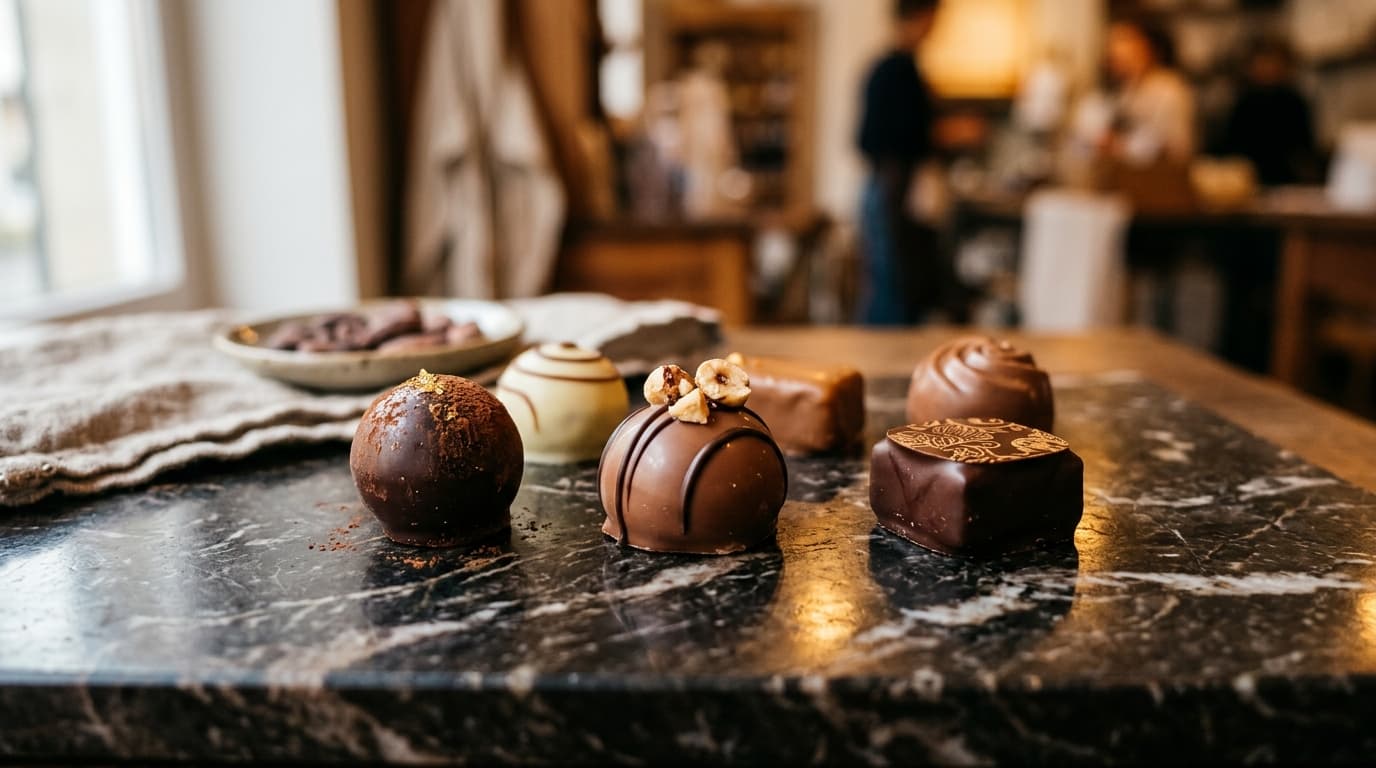
Ask anyone to name a country of chocolate: Belgium almost always comes first. Yet cocoa does not grow at our latitudes. This reputation owes nothing to chance: it rests on an old law, on grinding know-how, on a 1912 invention and on a web of houses ranging from the industrial giant to the artisan of the Sablon. Let's unpack it.
Why is Belgian chocolate famous around the world?
Because quality has been regulated here for over a century, not merely promised. Where many countries let the market decide, Belgium set rules very early on what you are allowed to call "chocolate".
In practice, three pillars stack up: a legal requirement on cocoa content, a grind finer than average, and a specialty — the fresh filled praline — that the whole world envies. None of these on its own would be enough; it is their sum that makes the Belgian signature.
At tasting, this comes down to one simple thing: a Belgian praline melts cleanly, without leaving that greasy film you find on many cheap chocolates. It is this detail, repeated millions of times over a century, that built the legend.
What does the 1894 law change for Belgian chocolate?
It sets a quality floor. Since 1894, a Belgian law has required a minimum of 35% cocoa in chocolate — a rule still in force, and often well exceeded in practice.
This rule has two effects. First, it bans chocolates over-stretched with sugar and cheap fats. Second, the Belgian tradition adds a non-negotiable demand: no fat other than cocoa butter. This is the famous "100% cocoa butter" that serious houses claim, and which explains the clean melt at 36°C, the temperature of the palate.
Why does the fineness of the grind make the difference?
Because it is what you feel on your tongue. Belgian chocolate is ground extremely fine: its structure drops to around 15 to 18 microns, where coarser productions stay above the threshold the tongue reads as "grainy".
Below about 30 microns, the palate no longer distinguishes the particles: the chocolate seems smooth, almost creamy. Above it, you sense a grain of sand. This obsession with fine grinding is a legacy of Belgian chocolatiers of the 19th and 20th centuries, and it remains a point of pride in the sector.
On texture, the gap is striking when you compare two squares blind: we tasted for you an origin bar from a great Belgian house against a budget supermarket bar, and the first melts in a silky sheet where the second "grips". The bean may be identical; it is the craft that separates the two.
The praline, a Belgian invention: why did it change everything?
Because it created a category in its own right. The filled praline — a chocolate shell filled with praline paste, ganache or gianduja — was born in 1912 at Neuhaus, in the Royal Saint-Hubert Galleries in Brussels, driven by Jean Neuhaus Junior.
The idea spread: three years later the ballotin (that light box protecting the fragile pralines) completed the invention and made gifting possible. From then on, Belgian chocolate stopped being a simple bar and became an object of pleasure and offering, sold fresh, by the piece, in a carefully arranged window.
This is the model you still find in windows, street by street: bare, dated pralines sold by weight. When you push open the door of a Neuhaus or a Wittamer, you are buying that tradition first, not a brand on a wrapper.
The praline is not just another sweet: it is the invention that tipped Belgian chocolate from the bar to accessible luxury.
Who really makes Belgian chocolate?
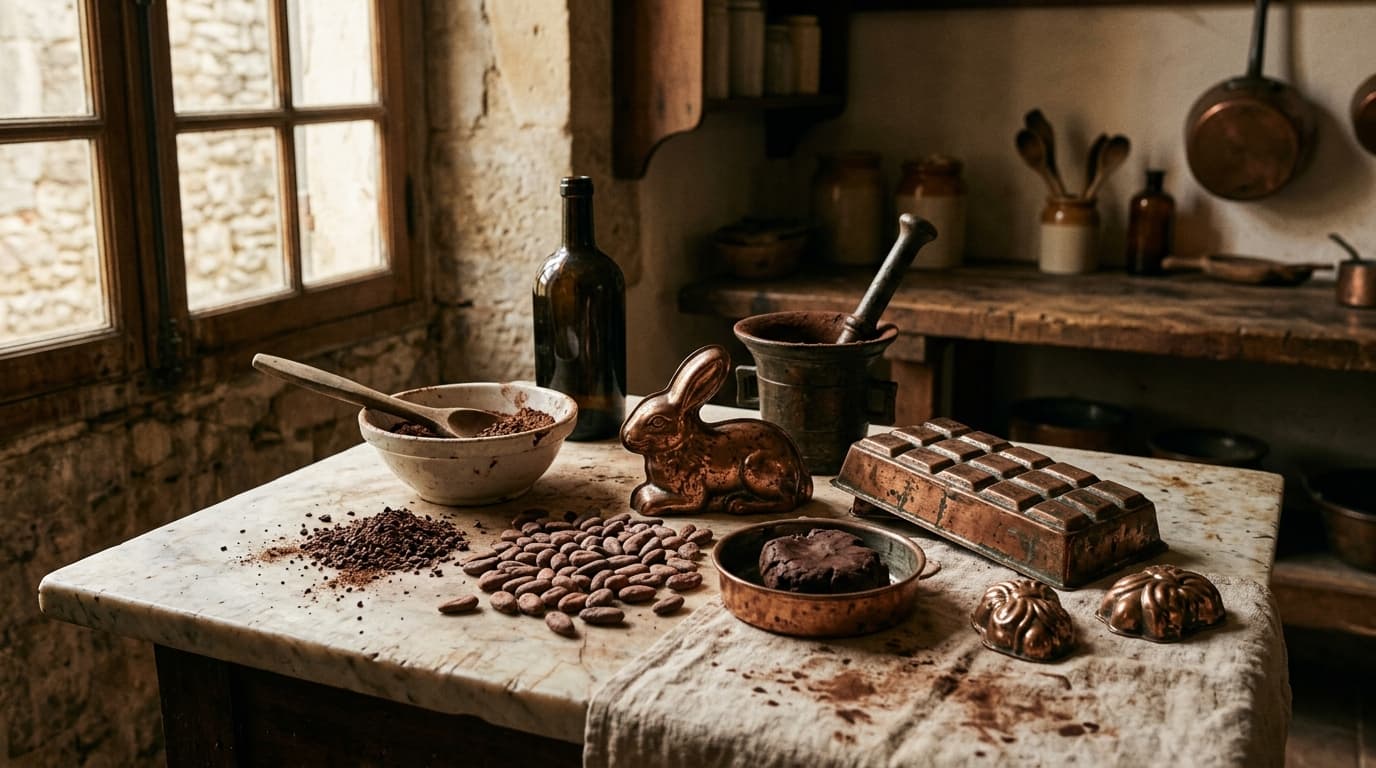
One player dominates behind the scenes: Barry Callebaut. Born in 1996 from the merger of France's Cacao Barry and Belgium's Callebaut, the group supplies about 80% of Belgian chocolate and buys nearly one cocoa bean in five worldwide.
In other words, many chocolatiers — even prestigious ones — start from a high-quality industrial "couverture" that they melt, blend and fill their own way. There is nothing shameful in it: it is the same principle as a great restaurant that does not grow its own wheat. What sets the houses apart is then the gesture, the filling recipes and the freshness.
Belgium also remains an export powerhouse: the country ranks among the world's top chocolate exporters, with a market worth billions of euros each year. The know-how is therefore as industrial as it is artisanal — and it is precisely this dual scale that feeds the reputation.
Great houses or artisans: who carries the reputation today?
Both, and that is the whole point. The great houses secure worldwide fame; the artisans keep up the standards. On the houses side, Neuhaus (the historic praline), Côte d'Or (the milk bar, born in 1883) and Leonidas (the accessible praline) spread the name "Belgian chocolate" across every continent.
On the artisan side, this is where contemporary finesse is decided. Pierre Marcolini has established himself as the high-end reference: the Sablon house works bean-to-bar, meaning it selects and roasts its own beans, which very few Belgian chocolatiers do at this scale. The result, at tasting, is a marked flavour profile — fruity, sometimes tangy — that pulls the whole category upward.
Other names round out the picture depending on the mood: Galler (Royal Warrant holder, its filled sticks), Wittamer on the Sablon square, or artisans like Laurent Gerbaud who pair cocoa with dried fruit. The Belgian reputation is not a single brand: it is an ecosystem.
| Profile | Reference house | What sets it apart | What for |
|---|---|---|---|
| High-end artisan | Pierre Marcolini | Bean-to-bar, in-house roasting | Finesse, exceptional gift |
| Historic great house | Neuhaus | Inventor of the praline (1912) | Ballotin to give |
| Accessible praline | Leonidas | Dense network, gentle prices | Everyday treat |
| Everyday bar | Côte d'Or | Smooth milk, since 1883 | Home, baking |
Is Belgian chocolate really better than Swiss or French?
Say rather that it plays in its own category. Comparing Belgium, Switzerland and France means comparing three traditions that do not aim for the same thing, rather than naming an absolute champion.
Switzerland built its fame on smooth milk chocolate and long conching, which gives that characteristic velvet. France shines on dark tasting chocolate and pastry. Belgium reigns over the fresh filled praline and the craft of its great houses. Each is right on its own ground.
How can you spot a truly good Belgian chocolate?
Trust the window, not the flag on the box. The best reflex comes down to four simple signs, valid whether you are in Brussels, in Bruges or facing a supermarket aisle.
First sign: pralines sold bare and by weight, with a date or a freshness note — a real praline keeps a few weeks, not six months. Second: a chocolatier's name on display, not a generic wrapper. Third: on a bar's label, 100% cocoa butter and no added vegetable oil. Fourth: a visible rotation of the trays in store.
Want to know what kind of chocolate lover you are before pushing open a shop door? Test yourself with our chocolate quiz — and if you are torn between the great houses, our comparison which Belgian chocolatier to choose puts each in its place.
Histoire du chocolat comparator
Compare all histoire du chocolat side by side.
Compare now →
Frequently asked questions
Bruxelloise pur sucre, Margaux arpente les chocolateries belges depuis plus de dix ans. Ancienne pâtissière reconvertie dans le journalisme gourmand, elle goûte, compare et raconte le chocolat belge sans complaisance — des grandes maisons aux ateliers de quartier.