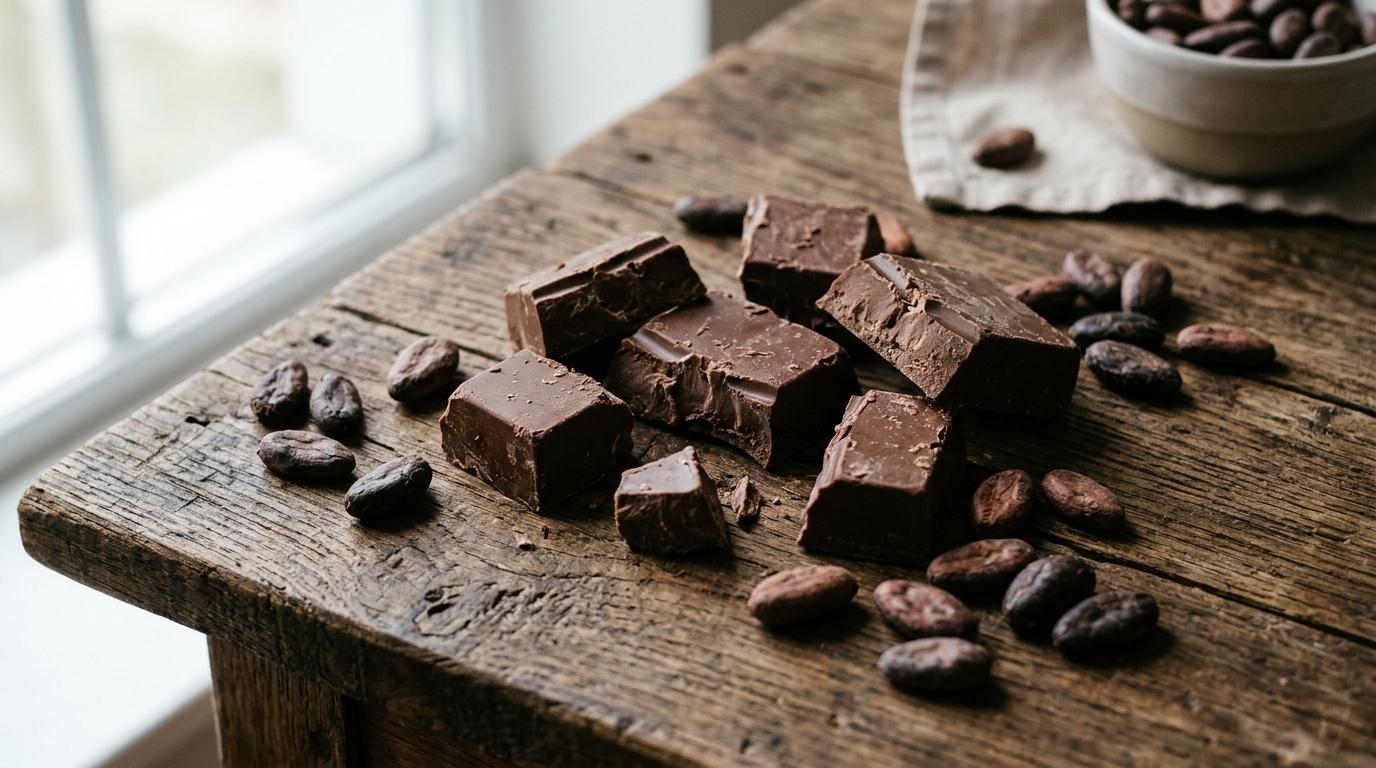
A 180 g Tony's Chocolonely milk bar cost €3.99 on 11 November 2026 at Albert Heijn Belgium, twice the per-kilo price of a Côte d'Or milk bar. I went looking for where those two extra euros go. The answer is a little awkward for everyone, the brand included.
The 11 November check: €3.99 for the milk bar
I noted the prices on 11 November 2026 on the Albert Heijn Belgium website, because the retailer shows the price per kilo, the cocoa content and the labels on the same page. Five bars, none on promotion that day.
| Bar | Weight | Price | Price per kilo | Cocoa | Label shown |
|---|---|---|---|---|---|
| Tony's Chocolonely milk | 180 g | €3.99 | €22.17 | at least 32% | Fairtrade |
| Tony's Chocolonely dark | 180 g | €4.99 | €27.72 | at least 70% | Fairtrade |
| Côte d'Or milk | 2 × 200 g | €4.35 | €10.88 | at least 34% | Cocoa Life |
| Côte d'Or Noir de Noir | 2 × 200 g | €5.15 | €12.88 | at least 54% | Cocoa Life |
| AH Biologisch milk | 100 g | €2.49 | €24.90 | 35% | Organic, Fairtrade |
Scaled to 180 g, a Côte d'Or milk bar would cost €1.96. The gap with Tony's is therefore €2.03 per bar. On the dark side the comparison is lopsided, since Noir de Noir tops out at 54% while Tony's states 70%, but the gap climbs to €2.67.
The last row is the most interesting. The retailer's own organic Fairtrade bar costs more per kilo than Tony's. The image of an ethical luxury chocolate that follows the brand around does not survive this figure: among labelled bars, it is not the most expensive on the shelf.
The price has moved. In March 2023 the brand announced in the Netherlands a recommended retail price of €3.69 for the 180 g bar, citing sugar up 115% and packaging up 77% since October 2021. Three and a half years later, the Belgian label shows thirty cents more.
Read in one go, the timeline further down tells the story of a brand that began as an indictment of the industry and ended up settling in with the biggest industrial player in the sector. That is not necessarily a betrayal. Teun van de Keuken wanted the big players to change their methods, and Tony's has always chosen to play inside the system rather than beside it. The price follows the same slope: a campaigning bar sold at supermarket prices, which gained thirty cents in three years while cocoa prices tripled and then fell back. For a brand that pays above market for its beans, that is a moderate rise, and it owes as much to sugar and packaging as to cocoa itself.
How much does the farmer get from a bar?
About eight cents of premium, on the milk bar. That is my calculation, not a figure from the brand, and here is how I get there.
Tony's pays for its beans at least the living income reference price that Fairtrade calculates for Ivory Coast and Ghana. Since 1 October 2025, that price has been set at €2.65 per kilo of beans in Ivory Coast, according to Fairtrade's explanatory note. On top of the price paid locally, the brand adds a premium. The latest figure I found dates from 20 October 2022: 1,096 dollars per tonne in Ivory Coast, up from 792, plus a 50-dollar fee paid to the co-op.
The remaining question is how many beans go into a bar. The label states at least 32% cocoa in the milk bar, so 57.6 g out of 180 g. Counting 1.25 kg of beans per kilo of cocoa products, to cover the shell and the water lost in roasting (my own rounded assumption), that comes to 72 g of beans.
| Item, 180 g bar | Milk (32%) | Dark (70%) |
|---|---|---|
| Cocoa products in the bar | 57.6 g | 126 g |
| Beans needed (1.25 assumption) | 72 g | 158 g |
| Value of beans at the reference price (€2.65/kg) | €0.19 | €0.42 |
| Tony's 2022 premium ($1,096/t) | about $0.08 | about $0.17 |
| Shelf price gap with Côte d'Or | €2.03 | €2.67 |
Eight cents out of two euros: under 4% of the gap.
The rest comes from everything that is not the bean. The physical separation of beans at the manufacturer, which Tony's says it pays extra for. Certifications, marketing, the retailer's margin, and the name. I do not know how those items break down, the brand does not publish the cost structure of a bar, and I would rather say so than invent percentages.
An honest point, in the other direction. Eight cents is no small thing for an Ivorian farmer: per tonne, the 2022 premium amounted to almost half of the reference price of the time, which was 2,390 dollars. The calculation shows that ethics costs the consumer little, not that it pays the producer little.
And the amount is not fixed. In April 2024, when prices soared, Tony's wrote that the Ivorian farmgate price had just reached the reference price, around €2,287 per tonne: the gap to fill had vanished. In June 2026, the reverse: prices fell back below 4,000 dollars per tonne, the farmgate price dropped by about 57% in Ivory Coast according to Food Manufacture, and the brand repeats that it will pay at least the reference price over the long term. Our article on the price of cocoa details the lag between those prices and your bar.
An Amsterdam brand made in Belgium
Tony's Chocolonely was born in Amsterdam on 29 November 2005, out of the anger of a television journalist, Teun van de Keuken, who had spent three years trying to get buyers of cocoa produced by children prosecuted. Prosecutors refused. He made his own bar, and sold 20,000 in two days, according to the brand's Wikipedia page.
The chocolate itself comes out of a Belgian factory. Barry Callebaut, the giant whose largest plant runs in Wieze, has made Tony's bars since 2005, and DutchNews placed the dedicated line in Antwerp in 2021. It is precisely this link that got the brand removed, in February 2021, from the list kept by the American association Slave Free Chocolate. Its founder, Ayn Riggs, considered that working with Barry Callebaut "ties them to child slavery", FoodNavigator reported on 16 February 2021.
Tony's answer rests on two arguments. Its traceable beans are said to go through a fully separate processing chain, never meeting those of other customers. And making chocolate at the world's largest processor would be the way to prove the method works at scale, where a small independent factory would let manufacturers reply that the model does not apply to them.
The argument holds. It does not remove the objection, which is about money: every Tony's bar also keeps a group running whose general sourcing is still under fire. Both positions can be defended, and I will not decide for the reader.
Why does Tony's keep finding more children at work?
Because it looks harder, first of all.
In February 2021, the brand reported 387 cases of illegal child labour identified the previous year, 221 of them resolved, across seven co-ops. A year later, the British press headlined on around 1,700 cases. The 2024-2025 annual report, presented on 3 February 2026, lists 3,448, of which 813 were closed, barely one in four. It also puts the coverage of its monitoring and remediation system at 93.7% of the households the brand works with, for 32,133 farmers paid at least the reference price. On deforestation, 42,538 farms were checked and two showed confirmed deforestation.
These figures read both ways, and that is what makes them useful. The rise follows the expansion of monitoring: more households checked, more cases found. But 2,635 cases were still open at the time of the report, and the brand itself writes that in its longest-standing partner co-ops, 59.4% of farmers do not yet earn a living income.
Tony's does not sell a child-free bar.
It sells a bar whose supply chain looks for children, counts them and publishes the count, which remains rare: most supermarket brands publish no comparable figure. To place the labels against each other, our article on fair trade chocolate compares Fairtrade, Rainforest Alliance and in-house programmes.
Twenty years of prices and promises
| Date | Fact | Source |
|---|---|---|
| 29 Nov. 2005 | Launch in Amsterdam, 20,000 bars sold in two days | Wikipedia |
| 2007 | An Amsterdam court finds sufficient evidence of slavery-free production | Wikipedia |
| 2013 and 2016 | Cocoa mass, then cocoa butter fully traceable | Wikipedia |
| 2019 | Launch of Tony's Open Chain, open to other brands | Wikipedia |
| Feb. 2021 | Removed from the Slave Free Chocolate list over the Barry Callebaut link | FoodNavigator |
| 20 Oct. 2022 | Premium raised from $792 to $1,096 per tonne in Ivory Coast | Tony's |
| Apr. 2023 | Recommended price of €3.69 for 180 g in the Netherlands | Tony's |
| Apr. 2024 | Ivorian farmgate price reaches the reference price | Tony's |
| 1 Oct. 2025 | Reference price set at €2.65 per kilo in Ivory Coast | Fairtrade |
| June 2026 | Prices fall back below $4,000 per tonne | Food Manufacture |
| 11 Nov. 2026 | €3.99 for the milk bar in Belgium | Albert Heijn check |
Two details in this timeline do not show on the wrapper. Since 2023 the brand has been majority-owned by the Belgian fund Verlinvest, with 55.9% of the capital according to Wikipedia: a Dutch bar, made in Belgium, held by Belgian capital. And the opening of its model to other brands, through Open Chain, now counts more than twenty partners, including Ben & Jerry's and the Aldi chain.
Four verifiable commitments, two blind spots
I re-read the product page, the annual report and the brand's statements, asking myself what a shopper can actually check.
- Traceability: beans are tracked from the co-op to the bar, a claim the brand says is validated by PwC in its annual reports.
- The price floor: 32,133 farmers paid at least the Fairtrade reference price, a figure published for 2024-2025.
- Long-term commitment: the brand buys from co-ops on five-year contracts, one of the five principles it was already setting out in 2021.
- Transparency: child labour cases are counted and published, including when the number rises.
- First blind spot: the current premium amount is not published in the 2024-2025 report, and the latest figure I could read dates from 2022.
- Second blind spot: the Fairtrade label shown on the product page is only part of the story, and the separation of beans at Barry Callebaut rests on the word of the brand and its auditor.
Cocoa is not the only ingredient. The milk bar starts with sugar, then whole milk powder, according to the Albert Heijn product page, and Tony's had already changed hazelnut supplier in 2010 after a report on the Turkish harvest. The commitment covers the bean: for the rest of the list, read the label as you would for any bar.
Should you pay two euros more?
It depends on what you are buying with those two euros.
If you want to pay the farmer, the share that reaches them directly as a premium is small, around eight cents, and Albert Heijn's organic Fairtrade bar, dearer per kilo, carries the same label without Tony's own premium. If you want a documented supply chain, with figures and published failures, Tony's remains one of the few supermarket brands that provides one. If you want the best milk chocolate for four euros, that is another question, covered in our comparison of the best Belgian supermarket chocolate.
To compare with other approaches, our article on organic chocolate explains what a label covers, and our ranking lists the Belgian houses that work bars and pralines.
Prices noted on 11 November 2026 on ah.be. Sources read the same day: Tony's Chocolonely 2024-2025 annual report, Fairtrade note on the 2025 reference prices, FoodNavigator (16 February 2021), DutchNews (15 February 2021), Food Manufacture (17 June 2026), Wikipedia.
Histoire du chocolat comparator
Compare all histoire du chocolat side by side.
Compare now →
Frequently asked questions
Bruxelloise pur sucre, Margaux arpente les chocolateries belges depuis plus de dix ans. Ancienne pâtissière reconvertie dans le journalisme gourmand, elle goûte, compare et raconte le chocolat belge sans complaisance — des grandes maisons aux ateliers de quartier.