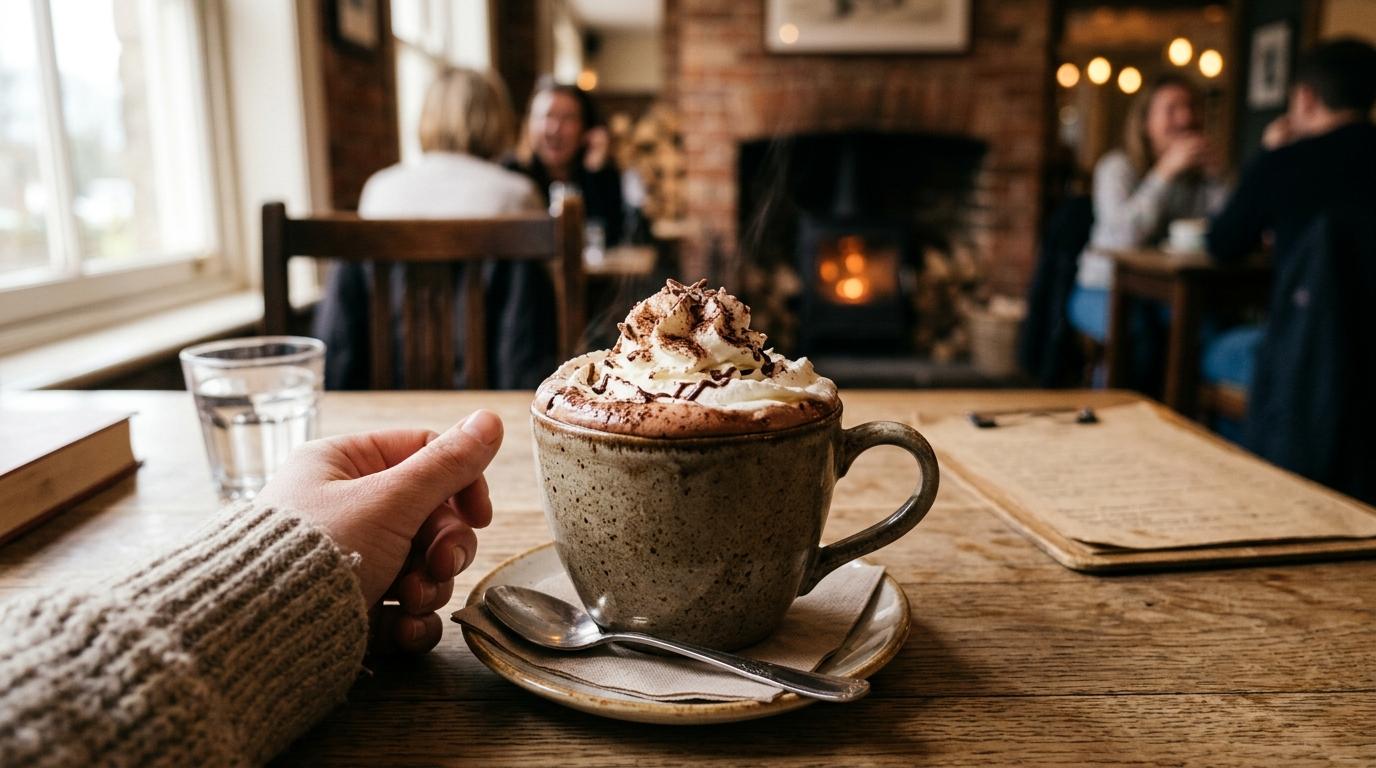
A chocolat viennois, or Viennese hot chocolate, is hot chocolate topped with whipped cream. The Italian version is thickened with starch, the Spanish one is drunk from the cup, often with churros, and the Belgian one arrives as a kit: hot milk on one side, chocolate on the other. Five cups, five stories, and a stop in Liège.
What is the difference between Viennese, Italian and Belgian hot chocolate?
It all comes down to three variables: the liquid, what thickens it, and what goes on top. The rest is local habit.
| Style | Liquid | Thickener | Typical topping | Landmark |
|---|---|---|---|---|
| Viennese | milk | none, or just the richness of the chocolate | whipped cream | Vienna's café culture |
| Italian (cioccolata calda) | milk, sometimes water | cornstarch | often none | texture likened to a milkshake |
| Spanish (chocolate a la taza) | water traditionally, milk today | the bar itself, sometimes starched | churros for dipping | Trapa bar made since 1891 |
| Parisian | milk | a heavy dose of chocolate | whipped cream on the side | Angelina, rue de Rivoli, 1903 |
| Belgian | milk served on its own | none: you melt it yourself | chocolate drops on the side | Callebaut's 72 °C milk ritual |
The table says it all. The Viennese and the Belgian start from a classic hot chocolate and differ in how they are served. The Italian and the Spanish change the very texture of the drink, to the point where you almost eat them with a spoon.
The Viennese is hot chocolate under whipped cream
Nothing more. No official recipe, no protected name, no ratio set by any text.
The adjective comes from Viennese cafés, where whipped cream, Schlagobers, readily accompanies hot drinks. In France as in Belgium, a brasserie menu means by chocolat viennois a hot milk chocolate, more or less thick, under a dome of sweetened whipped cream.
Quality therefore depends entirely on the cup underneath. Defatted powder under a squirt of aerosol cream is still a hot cocoa in disguise; real chocolate melted into milk, under hand-whipped cream, is another thing altogether. I rarely order one on a terrace for that reason: the cream hides the level of the chocolate too well.
Why did the café viennois become liégeois in 1914?
Because of the war, and because of Liège.
In August 1914 the city held out for twelve days against the German army, slowing the invasion and later earning Liège the Légion d'honneur, as the Wikipedia page on café liégeois recalls. In Paris, Austria-Hungary was the enemy's ally, and bistros no longer wanted to serve a dessert bearing its name. The café viennois became the café liégeois, as La Libre told it (4 August 2014).
The chocolate variant followed: the chocolat liégeois, chocolate ice cream under whipped cream. The hot Viennese kept its name.
Is Italian hot chocolate thicker because of starch?
Yes. Cioccolata calda owes its consistency to an ingredient you will not find in a Viennese hot chocolate: cornstarch, sometimes potato starch.
Food Republic gives the arithmetic behind that choice: without starch, you would need about three times as much chocolate to reach the same thickness. Starch is as much a saving as a texture. The drink is so dense that it is likened to a milkshake, and it needs no topping.
The thick old-fashioned hot chocolate found under that name in many French recipes often borrows this Italian trick without saying so.
Spanish and Parisian: water, the cup and an Austrian confectioner
In Spain, chocolate a la taza was originally made with water, which gives a thick, almost creamy drink; milk, now common, makes it thinner and softer, according to the Foods & Wines from Spain portal (13 December 2023). The Trapa bar, made since 1891, actually lists cornstarch among its ingredients. Churros, fried for about two minutes at 180 °C, are dipped into it, especially in autumn.
Paris has its monument: Angelina, at 226 rue de Rivoli, founded in 1903 under the name Rumpelmayer by Antoine Rumpelmayer, an Austrian confectioner, according to Wikipedia. Its "L'Africain" chocolate is described as almost pudding-like, and served with its whipped cream on the side. The most famous Parisian hot chocolate was therefore born in an Austrian's shop, which makes the border with the Viennese rather porous.
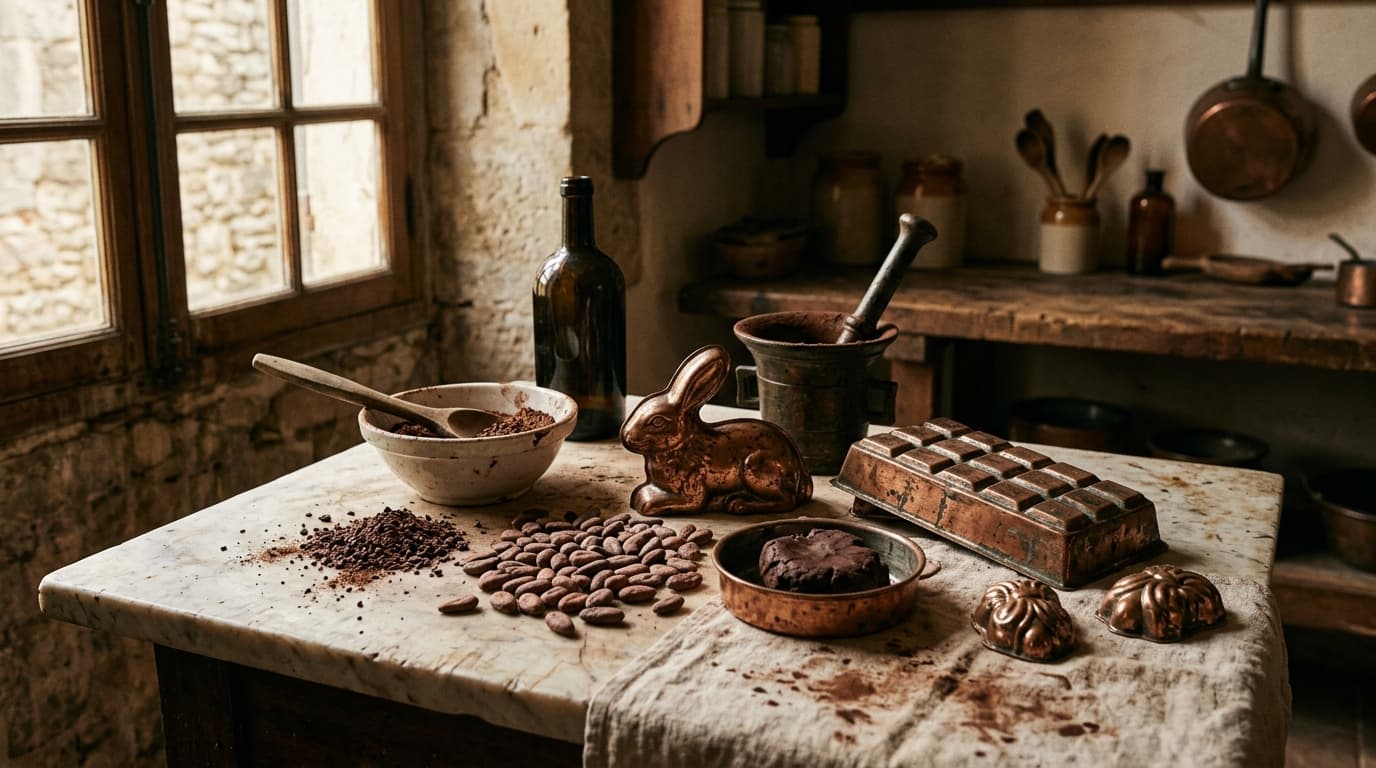
The Belgian way: milk and chocolate arrive separately
Belgian hot chocolate is recognised not by its recipe but by how it is served. You are brought a glass of hot milk and, next to it, a small bowl of chocolate drops or shavings, sometimes a little whisk. You pour, you stir, you decide the strength.
Callebaut, the couverture maker from Wieze, describes the same method to cafés under the name of the Callets ritual: the customer picks a chocolate, the milk is steamed to 72 °C and served in a tall glass, then the customer pours the chocolate in and melts it. The dose stated on the Callebaut Hot Chocolate 811 product page is 35 g for 200 ml of milk. In Bruges, The Old Chocolate House, Mariastraat 1c, was already serving it this way in 2020, and still in 2025 according to visitors' accounts: hot milk and pieces of chocolate in a cup itself made of chocolate, which you eat.
The idea is not new, and this is where Brussels enters the European history of the drink. According to Caobisco, the European manufacturers' association, chocolate reached Switzerland in 1697, after a visit to Brussels by the mayor of Zurich, Heinrich Escher, who had discovered the drink there. Swiss chocolate went through Brussels before it existed.
In Brussels today, the Bruxelles Secrète site (updated on 6 November 2026) lists Laurent Gerbaud, rue Ravenstein, for a hot chocolate made with organic dark cocoa and no added sugar, Frédéric Blondeel in Koekelberg, who roasts his own beans, and The Unusual, rue Montagne aux Herbes Potagères, where you choose between six chocolates melted directly into the milk. Brussels came tenth in a European hot chocolate ranking drawn up by the ferry company DFDS from online reviews, reported by Paris Match Belgique on 11 December 2025, far behind Budapest.
On any menu, in any country, five clues separate a real hot chocolate from a powder drink:
- the word "chocolate" followed by a percentage or an origin, rather than "chocolate drink";
- a choice between dark, milk or white, which implies that a chocolate is being melted rather than a ready-made mix;
- milk and chocolate served separately, the Belgian signature;
- a price to match, since 35 g of chocolate costs more than a spoonful of powder;
- a texture that coats the spoon without starch, a sign that cocoa butter is doing the work.
How much does a homemade Belgian-style cup cost?
Less than a euro of chocolate, with a manufacturer's couverture. I noted two prices on 17 November 2026 and scaled each to Callebaut's 35 g dose.
| Chocolate | Pack | Price noted on 17/11/2026 | Price per kilo | Cost of 35 g |
|---|---|---|---|---|
| Callebaut Hot Chocolate 811, dark, manufacturer's shop | 25 doses of 35 g (875 g) | €21.94 | €25.07 | €0.88 |
| Milk drinking chocolate, The Belgian Chocolate Makers (Brussels, bean-to-bar, Haitian cocoa) | 200 g | €7.50 | €37.50 | €1.31 |
Milk is not counted, its price varies too much from one shop to the next. Two caveats: the Callebaut price is the one shown on the German version of its shop, discounted that day from a recommended price of €31.35, and the Dutch retailer Baktotaal listed the same box at €27.39, out of stock until 23 November. The Brussels chocolate gives no dosage: I apply Callebaut's, which is a calculation convention, not an instruction from the maker.
At home I keep it simpler, with the same chocolate pistoles I use for baking. The ritual of the glass and the little bowl owes less to the recipe than to the pleasure of watching the drops melt.
Viennese for indulgence, Italian for the spoon, Belgian for the chocolate
No style wins on every count, and none really competes with the others. The Viennese suits anyone who wants a dessert to drink, provided you check what lies under the cream. The Italian and the Spanish are for lovers of thick textures, but starch dilutes the taste of the cocoa a little. Angelina's Parisian plays density through the sheer amount of chocolate, and is priced accordingly. Nothing stops you from adding whipped cream to a Belgian-style cup, either.
The Belgian is the most honest of the five. Nothing thickens, nothing hides, and the quality of the chocolate shows directly in the glass. It is also the most demanding: with supermarket powder the method saves nothing, and a cup of cocoa powder remains a different drink.
To understand where this chocolate's reputation comes from, why Belgian chocolate is so famous traces the story back. Our chocolate itinerary in Bruges leads to the tasting rooms, and the ranking of Belgian chocolatiers lists the houses whose chocolate deserves to be melted in a glass. On the difference between hot cocoa and hot chocolate, the French Wikipedia page on hot chocolate sums up the history of the drink in Europe.
Sources read on 17 November 2026: Caobisco, Wikipedia (café liégeois, Angelina, Heinrich Escher, hot chocolate), La Libre (4 August 2014), Food Republic, Foods & Wines from Spain (13 December 2023), Callebaut, Bruxelles Secrète (6 November 2026), Destination Eat Drink (8 May 2025), Paris Match Belgique (11 December 2025).
Histoire du chocolat comparator
Compare all histoire du chocolat side by side.
Compare now →
Frequently asked questions
Bruxelloise pur sucre, Margaux arpente les chocolateries belges depuis plus de dix ans. Ancienne pâtissière reconvertie dans le journalisme gourmand, elle goûte, compare et raconte le chocolat belge sans complaisance — des grandes maisons aux ateliers de quartier.