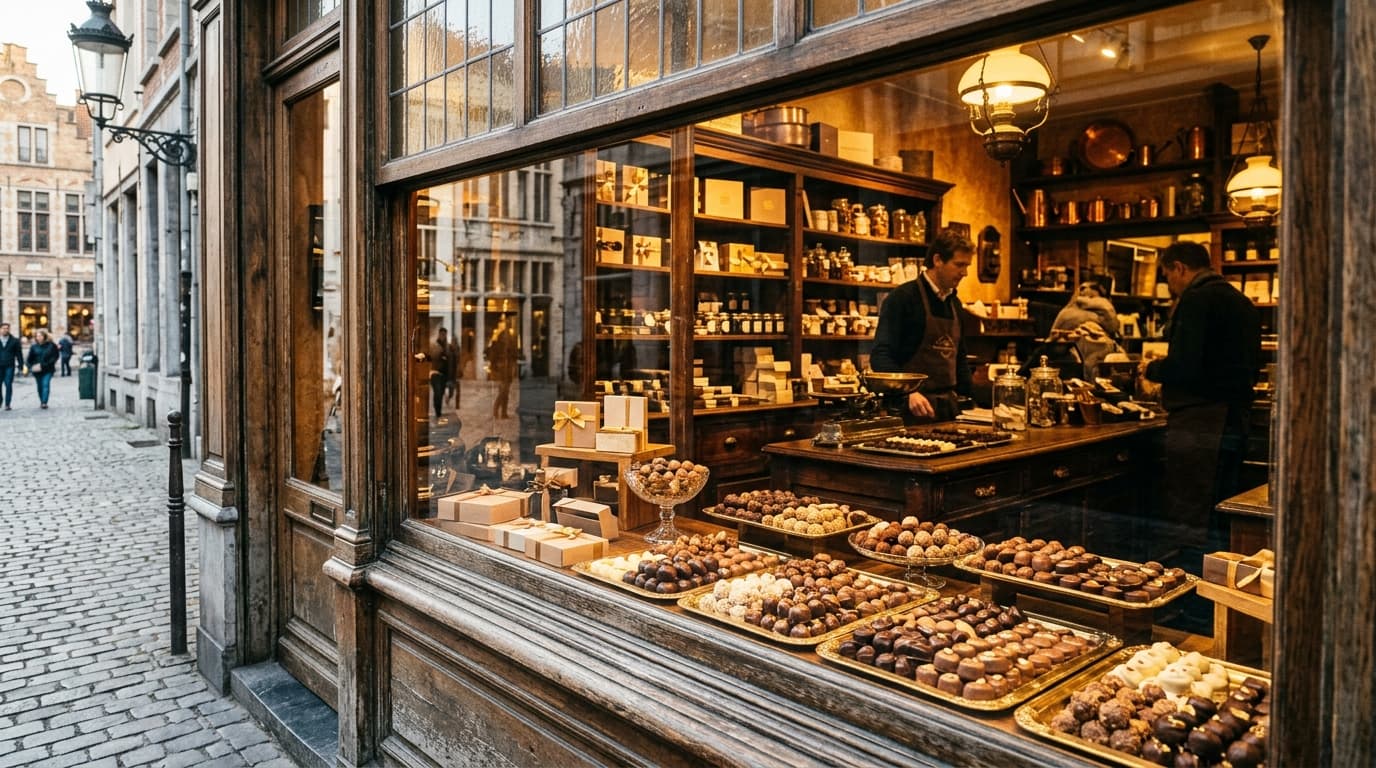
In Brussels, plenty of shopfronts proudly display a founding date. Some really are more than a century and a half old; others simply bought an antique-looking decor. Here are the genuinely historic Belgian chocolate houses — who founded them, what they invented, and what they're still worth when you push the door open today.
Which is the oldest Belgian chocolate house?
Neuhaus, no contest, with 1857 written into its history. The house opened that year in the Galeries Royales Saint-Hubert… as a pharmacy. Jean Neuhaus, an apothecary of Swiss origin, coated his remedies in a layer of chocolate to make them swallowable.
The turning point came two generations later. In 1912, Jean Neuhaus Junior emptied the shell of its remedy and filled it with something delicious: the filled praline was born, and with it the whole Belgian chocolate industry as we know it. In 1915 his wife Louise Agostini devised the ballotin, the light box that protects these fragile bites. Without it, no gift.
We pushed open the door of the historic Galeries shop: the address is very touristy, but stock turns over well and the coffee manon remains a lesson in freshness. At tasting, the shell still snaps cleanly.
Is Côte d'Or really the elder of Belgian bars?
Yes — and the family link is a surprise. Côte d'Or was founded in 1883 by Charles Neuhaus, the same surname as the house in the Galleries, in a Belgium where chocolate was still an apothecary's and fine grocer's product.
The elephant, the palm trees, the name itself: everything points to the Gold Coast, today's Ghana, where the cocoa came from. More than a hundred and forty years on, the milk bar still sits in nearly every Belgian cupboard, and it's probably the most-eaten chocolate in the country.
On taste, let's stay clear-eyed: Côte d'Or plays the reassuring, melting-milk register, not the great tasting-cocoa one. It's an everyday bar, excellent for baking, that never claimed to rival a fresh praline.
Wittamer, Leonidas, Mary: what are the early-20th-century houses worth?
They are the three pillars of the next generation, and they have nothing in common.
Wittamer (1910) started as a patisserie on the Grand Sablon square before becoming the house of Brussels' big occasions. It's the only one on this list where you hesitate between a praline and a slice of cake — and usually take both.
Leonidas (1913) owes its name to Leonidas Kestekides, a Greek-American confectioner who came over for a world's fair and stayed for love of the country (and of a Belgian woman). His achievement: making the fresh praline affordable for everyone, with a dense shop network and a per-kilo price that remains the gentlest on the market to this day.
Mary (1919) was founded on rue Royale by Mary Delluc, a woman alone in a man's trade, a stone's throw from the Palace. The house earned the Royal Warrant and still holds it: it's the most discreet of the great names, and one of the finest on ganaches.
Three houses, three ambitions: Wittamer aims at the festive table, Leonidas at the street, Mary at the Palace. They never tried to make the same chocolate.
What are the key dates of Belgian chocolate houses?
The table runs to six lines — and it tells on its own how the country went from the pharmacy to affordable luxury.
| House | Founded | Founder | What it contributed | Where to see it |
|---|---|---|---|---|
| Neuhaus | 1857 | Jean Neuhaus | The filled praline (1912), the ballotin (1915) | Galeries Royales Saint-Hubert |
| Côte d'Or | 1883 | Charles Neuhaus | The everyday milk bar | Supermarkets |
| Wittamer | 1910 | Wittamer family | Patisserie and festive chocolate | Grand Sablon square |
| Leonidas | 1913 | Leonidas Kestekides | The affordable fresh praline | All over Belgium |
| Mary | 1919 | Mary Delluc | Fine ganaches, Royal Warrant | Rue Royale, Brussels |
| Corné Port-Royal | 1932 | Maurice Corné | Praliné and the cream manon | Royal Galleries |
What stands out is the concentration: between 1857 and 1932, everything happened within a few streets — the Galleries, the Sablon, rue Royale. A twenty-minute walk covers three quarters of the story.
Does an old chocolate house make better chocolate?
No, and that's the trap of this article. Age proves one thing: a recipe survived crises, wars and fashions. It proves nothing about the praline in your hand today.
We tasted, in the same month, a praline from a century-old house heavily exposed to tourists and the same family of praline at an artisan with no pedigree: the second was fresher, the shell crisper, the filling less sugary. How fast the trays turn over matters more than the date on the shopfront.
Which historic house should you choose, and for what?
Start from the occasion, never from the founding date.
To give a safe classic, Neuhaus: the ballotin lands well, the house is consistent, and the history comes free. To share a big box without blowing the budget, Leonidas is unbeatable per kilo. For a festive table, Wittamer, where patisserie and chocolate answer each other. For a discreet, refined gift, Mary and its ganaches.
And if the criterion is sheer finesse or an exceptional gift, the answer stops being historic: it's Pierre Marcolini, founded in 1995, working bean-to-bar on the Sablon — selecting and roasting his own beans, which none of the century-old houses above do. In the window on rue des Minimes, the difference in aromatic profile hits you before the first bite.
How can you visit these historic houses in a day?
That's the easy part: they sit within a tiny perimeter. Start at the Galeries Royales Saint-Hubert (Neuhaus, Corné Port-Royal), walk up to rue Royale for Mary, then head down to the Grand Sablon, where Wittamer and Marcolini face each other. Allow an hour and a half of walking, tastings included.
One method tip: buy no more than two or three pralines per house, and eat them the same day. A fresh praline keeps a few weeks at best — and the comparison only means something on the same day, with the same palate.
Want to stretch the walk further? Follow our chocolate itinerary in Brussels, and if you're still torn between the great houses, our comparison of which Belgian chocolatier to choose settles it.
Histoire du chocolat comparator
Compare all histoire du chocolat side by side.
Compare now →
Frequently asked questions
Bruxelloise pur sucre, Margaux arpente les chocolateries belges depuis plus de dix ans. Ancienne pâtissière reconvertie dans le journalisme gourmand, elle goûte, compare et raconte le chocolat belge sans complaisance — des grandes maisons aux ateliers de quartier.