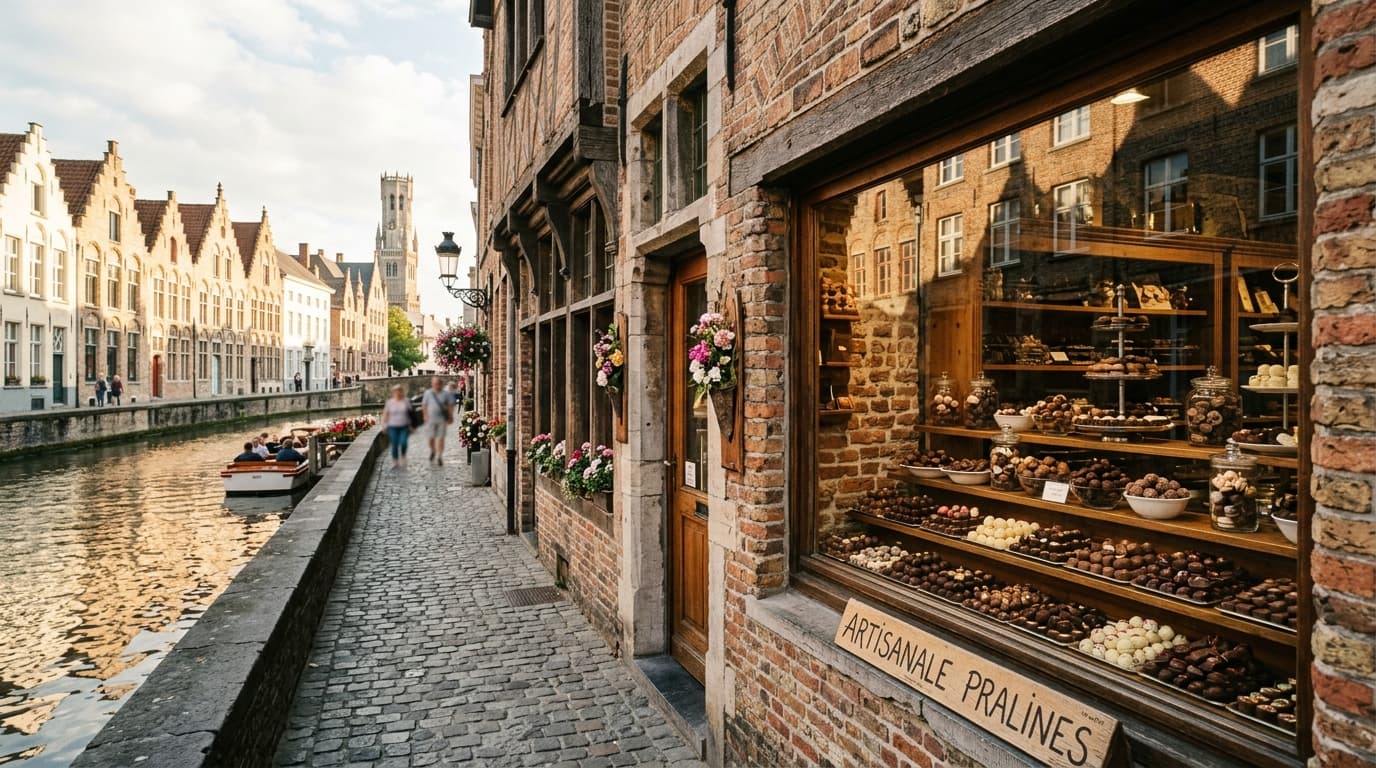
Bruges is best enjoyed on foot, a cone of pralines in hand. In a single morning you can link The Chocolate Line, Dumon and the little shops of Katelijnestraat without ever walking more than five minutes. Here is the route I send visiting friends on, address by address, with what to taste at each stop.
Where should you start a chocolate walk in Bruges?
Start at the Markt, at the foot of the Belfry, and head down towards Katelijnestraat and the Church of Our Lady. The direction matters little here — the city is flat — but starting from the centre spares you the back-and-forth.
The medieval heart packs some fifty chocolatiers into a tiny area. Simon Stevinplein holds the two flagships, Katelijnestraat and Mariastraat hide the neighbourhood workshops, and the Choco-Story museum sits steps from the Markt. Follow that order and you move straight through.
In Bruges, you won't be hunting for a Pierre Marcolini: the Sablon's bean-to-bar house has no shop here, and the city plays a different card, that of small workshops. If the Sablon is what draws you, our chocolate itinerary in Brussels puts the great houses in perspective. We walked the Bruges route again on a Thursday in May, leaving the Markt at 10am, last truffle gone by 1pm — with time for a bowl of mussels in between.
Is The Chocolate Line worth the detour?
Yes, for the daring. It's the most talked-about address in Bruges, that of Dominique Persoone and his son Julius, on Simon Stevinplein. People come as much to be surprised as to taste.
Persoone made his name by taking chocolate out of its comfort zone: wasabi praline, bacon, tomato, and the famous "shooter" that fires cocoa powder up your nose. Behind the provocation lies real bean work and precise ganaches. In the window, you spot the wildest creations at once, lined up like in an apothecary.
Expect a high budget, around €8 per 100 g — the priciest on the walk. When tasting, take two or three contrasting pieces rather than a big box: this is an address to experience, not to stock up on. To see where Bruges sits in the Belgian landscape, our comparison of which Belgian chocolatier to choose puts the great houses in perspective.
At Persoone's, a wasabi praline is no gimmick: it's a reminder that Belgian chocolate can still surprise.
Where can you find the best classic pralines in Bruges?
At Dumon, a few metres from The Chocolate Line, on that same Simon Stevinplein. If Persoone plays on surprise, Dumon defends the other camp: the creamy, melting praline, with no showing off.
The family house has been working since 1992 and now runs several outlets around town (Simon Stevinplein, Eiermarkt, Walstraat). Its pralines are prized for their soft texture and unbeatable value: a box of twelve costs under €10, enough to fill a ballotin without breaking the bank. When tasting, we tried the house praliné and a coffee ganache for you, both reassuringly consistent.
It's the address I recommend for takeaway, at the end of the walk, when you want to bring chocolate home without blowing the budget. Keep Persoone for the experience, Dumon for the bag.
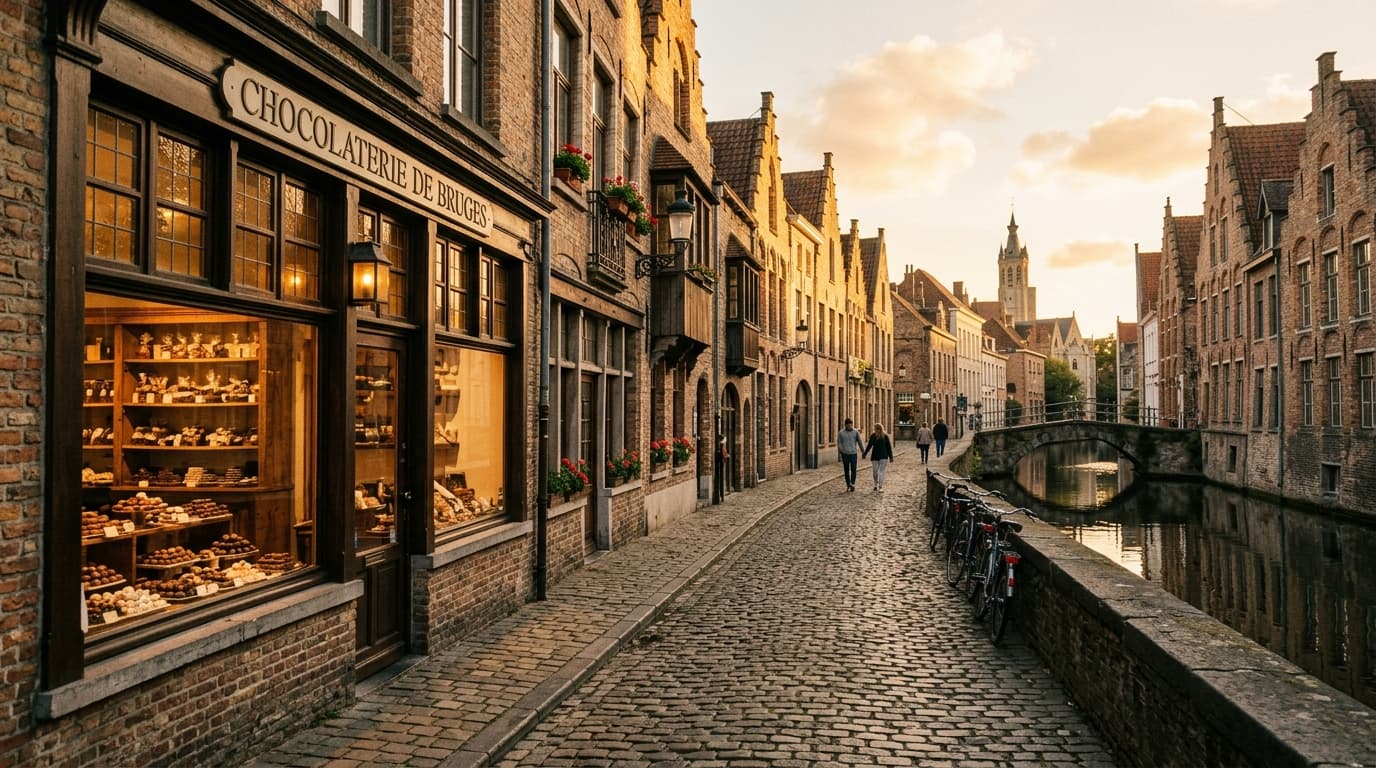
Sukerbuyc, Depla, Pralinette: which neighbourhood shops?
These are the gems you miss if you stay on the main square. Three houses, three streets, minutes apart, where the people of Bruges actually buy their chocolate.
Sukerbuyc, on Katelijnestraat, hides a workshop behind the shop where chef Kristoff reinvents the classic pralines. A few steps away, Depla, on Mariastraat, is the city's oldest chocolatier (since 1958): a safe bet, loved by locals who value tradition. A little further, Pralinette, on Wollestraat, has made a speciality of hand-rolled truffles coated in Belgian chocolate. For the curious, Spegelaere remains Bruges' best-kept secret, away from the tourist flow.
Is the Choco-Story museum worth it?
If you have two extra hours or children with you, yes. Choco-Story, near the Markt, traces the history of cocoa, from the Mayan bean to the Belgian praline, with moulding demonstrations by a master chocolatier.
It isn't essential for a rushed sweet tooth, but the visit sheds light on what you've tasted around town: a ganache makes more sense once you've seen a raw bean and smelled a mass of cocoa being conched. The visit lasts about an hour, tasting included. To dig into where that reputation comes from, our piece on why Belgian chocolate is so renowned rounds out the stop.
How much time and budget should you plan?
Allow a morning and €20 to €50 for tasting. That's ample to sample four or five houses buying by the piece rather than whole boxes.
| Stop | Street | To taste | Budget |
|---|---|---|---|
| The Chocolate Line | Simon Stevinplein | Wasabi praline or the shooter | €€€€ |
| Dumon | Simon Stevinplein | Box of creamy pralines | €€ |
| Sukerbuyc | Katelijnestraat | Chef Kristoff's house praline | €€€ |
| Depla | Mariastraat | House praliné (since 1958) | €€ |
| The Old Chocolate House | Mariastraat | Hot chocolate on a stick | €€ |
| Pralinette | Wollestraat | Hand-rolled truffle | €€ |
The rule I follow: two pieces per house, never a full box at the first shop. You keep room — and budget — to compare, and save the takeaway purchase for the end so the pralines don't melt in your bag all morning.
Which tourist traps should you avoid in Bruges?
The number-one trap sits on Katelijnestraat and Wollestraat, the two busiest streets: windows stacking coloured moulds under cellophane, at prices inflated for visitors. Locals rarely buy their chocolate on these routes.
The right reflex comes down to three signs: pralines sold loose and by weight, a chocolatier's name on display, and visible turnover in the window. A real fresh praline keeps for only a few weeks — if a box promises six months, you're no longer with an artisan. Trust too the label of the Bruges Chocolatiers' Guild, which several quality houses display.
Before you push open the first door, want to know what kind of chocolate lover you are? Test yourself with our chocolate quiz — it points you to the house that suits your profile.
Itinéraires gourmands comparator
Compare all itinéraires gourmands side by side.
Compare now →
Frequently asked questions
Bruxelloise pur sucre, Margaux arpente les chocolateries belges depuis plus de dix ans. Ancienne pâtissière reconvertie dans le journalisme gourmand, elle goûte, compare et raconte le chocolat belge sans complaisance — des grandes maisons aux ateliers de quartier.