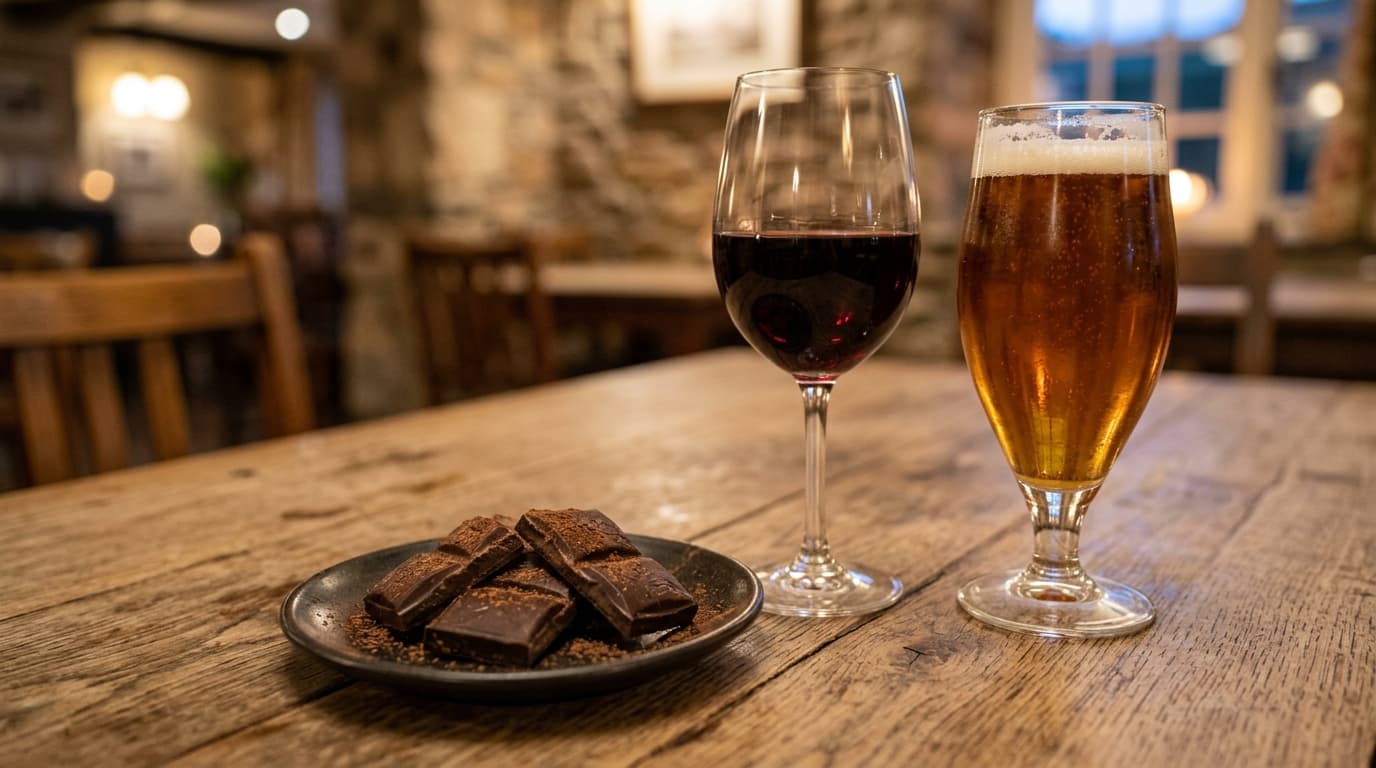
With dark chocolate, a port or a banyuls. With milk, a light sweet wine. With white, a fruity sparkling. The rule fits on one line: the glass must be at least as sweet as the square, or it reads as sour. And the dry red, that great end-of-meal classic, is almost always a mistake.
Which wine goes with dark chocolate?
A fortified wine. Red port, banyuls, maury, rivesaltes, pineau des Charentes: they all share the same construction, a fermentation stopped by adding alcohol, so residual sugar and a high degree.
Dark chocolate brings bitterness, cocoa tannins and a touch of acidity. A dry wine stacks its own tannins on top, and the sum dries out the mouth in three seconds. A fortified wine does the opposite: its sugar neutralises the bitterness, its alcohol carries the roasted aromas.
Tawny port is the easiest to get right, because its oxidative ageing gives it walnut and caramel notes that meet those of the roast. On a 70 per cent, it works every time. Above 80 per cent, you have to go sweeter: a young maury or a banyuls rimage hold up better.
Does dry red wine work with chocolate?
Rarely, and it is worth saying plainly.
Dry red and dark chocolate stack two bitternesses that do not answer each other. Grape tannins and cocoa tannins add up, saliva vanishes, the fruit of the wine goes out. A cellared bordeaux opened at dessert is the most common waste of a festive meal, and it is nearly always committed out of kindness.
One exception stands: a very ripe red, low in tannin and generous in alcohol, somewhere near a warm grenache or a Californian zinfandel, passes on milk chocolate. On dark, even that one backs off.
Which wine for milk and white chocolate?
Milk asks for less power. It is sweeter, less bitter, more dairy. A light sweet wine is enough: jurançon, young coteaux-du-layon, or a muscat vin doux naturel served well chilled. You want a glass that accompanies, not a glass that crushes.
White chocolate is not bitter at all: no cocoa mass, no tannins, only cocoa butter, milk and sugar. The difficulty flips. You need acidity and fruit to avoid cloying, without falling into dryness. A moscato d'Asti, a muscat de Rivesaltes, a demi-sec sparkling.
The pairing table, chocolate by chocolate
| Chocolate served | Serve this | Avoid this | Why |
|---|---|---|---|
| Dark 70 to 75 % | Tawny port, banyuls, maury | Dry tannic red | The fortified wine's sugar cancels cocoa bitterness |
| Dark 80 % and up | Young maury, banyuls rimage | Any dry wine, any brut | You need more sugar than the square has bitterness |
| Milk | Jurançon, coteaux-du-layon, chilled muscat | Cellared red | Too powerful a wine erases the dairy note |
| White | Moscato d'Asti, muscat de Rivesaltes, demi-sec | Brut champagne | Acidity cuts the fat, brut hardens it |
| Praliné-filled praline | Pineau des Charentes, vin de paille | Sharp dry white | Roasted hazelnut calls for an oxidative wine |
| Red-fruit ganache | Young banyuls rimage | Tawny port | The wine's fresh fruit has to answer the ganache |
Should chocolate come out of the fridge before serving?
Yes, about twenty minutes ahead. Cocoa butter melts between 34 and 36 °C, just below mouth temperature, and that melt is what releases the aromas. At 6 °C, straight from the crisper drawer, a praline gives almost nothing. It is hard. It stays hard, and you taste sugar before anything else.
On 5 September I probed two identical ganaches sitting side by side on the worktop, one out of the fridge, the other left in the cupboard. The first took twenty-two minutes to reach the 19 °C of the second. Twenty-two minutes during which the wine had already been poured and had already gone warm.
Does Belgian beer beat wine on chocolate?
On dark chocolate, yes, more often than we admit here.
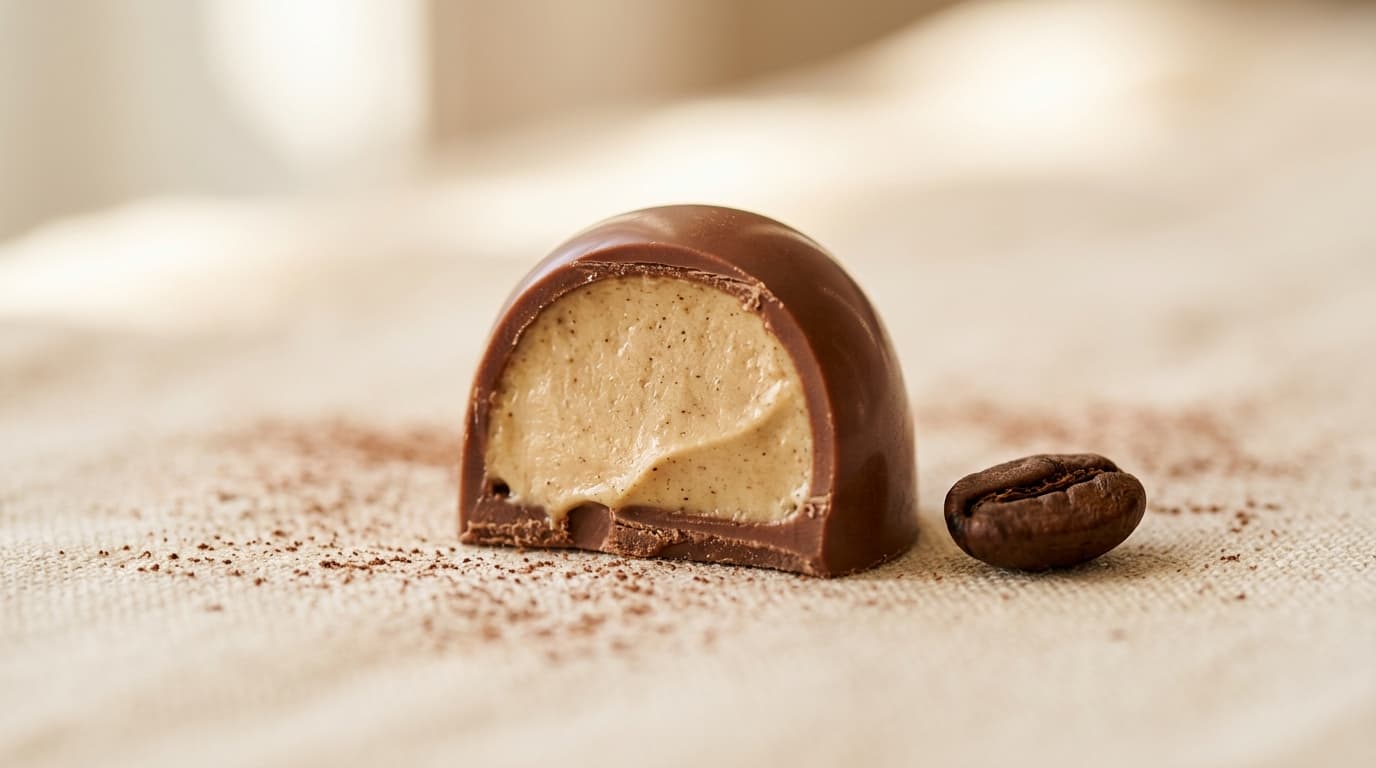
Abbey browns are brewed with dark candi sugar, which gives them notes of plum, raisin and caramel without contributing a single grape tannin, and that difference in construction alone explains why they succeed where a bordeaux fails. Add the carbonation, which scrubs cocoa butter away between two bites, and the structure is complete.
Three Trappists do the job. Rochefort 10, a quadrupel at 11.3 per cent, flattens nearly everything and demands a very intense dark. Chimay Blue, 9 per cent, launched in 1954 as a Christmas beer at Scourmont Abbey, keeps a peppery edge that lifts a ganache. Westmalle Dubbel, 7 per cent, is the most versatile of the three, and by far the easiest to put on a table.
Six pairings tasted blind on 5 September 2026, in this order:
| Beer | Chocolate | Tasting verdict |
|---|---|---|
| Westmalle Dubbel 7 % | Dark 70 % | Best of the six. Caramel and cocoa answer each other, nothing dominates |
| Westmalle Dubbel 7 % | Milk praline | Fine, but the beer takes over after two sips |
| Chimay Blue 9 % | Dark ganache | Works. The pepper relaunches the ganache on the finish |
| Chimay Blue 9 % | White manon | Failed. Two sugars piling up, nothing cuts through |
| Rochefort 10 at 11.3 % | Dark 85 % | Holds, but tiring by the third square |
| Rochefort 10 at 11.3 % | Hazelnut praliné | The only pairing that made me reopen the bottle |
Beer culture in Belgium has been on the UNESCO list of intangible cultural heritage since 2016. Chocolate has not. Both come out of the same country, and they rarely meet on the same table.
Can you serve champagne with chocolate?
A brut, no. A demi-sec, yes.
The acidity of a brut champagne collides with the bitterness of dark chocolate and turns it metallic. A demi-sec, between 32 and 50 grams of sugar per litre, straightens the pairing out. On white chocolate it becomes one of the best options available.
Five mistakes that ruin a chocolate pairing
- Serving chocolate straight from the fridge, without the twenty minutes back up to room temperature.
- Opening a big tannic red at dessert, out of end-of-meal reflex.
- Starting with the most intense square, which flattens everything that follows.
- Serving a brut or a dry white, whose acidity hardens the cocoa instead of opening it.
- Going past three squares without a glass of water: the palate saturates and stops telling anything apart.
To pick the square that goes in the glass, our guide to Belgian dark chocolate covers origins and percentages. On storage before tasting, everything is in how to keep Belgian chocolate. And to find out where to buy the squares for the tasting, the ranking of Belgian chocolatiers is the place to start.
Pralines & spécialités comparator
Compare all pralines & spécialités side by side.
Compare now →
Frequently asked questions
Bruxelloise pur sucre, Margaux arpente les chocolateries belges depuis plus de dix ans. Ancienne pâtissière reconvertie dans le journalisme gourmand, elle goûte, compare et raconte le chocolat belge sans complaisance — des grandes maisons aux ateliers de quartier.