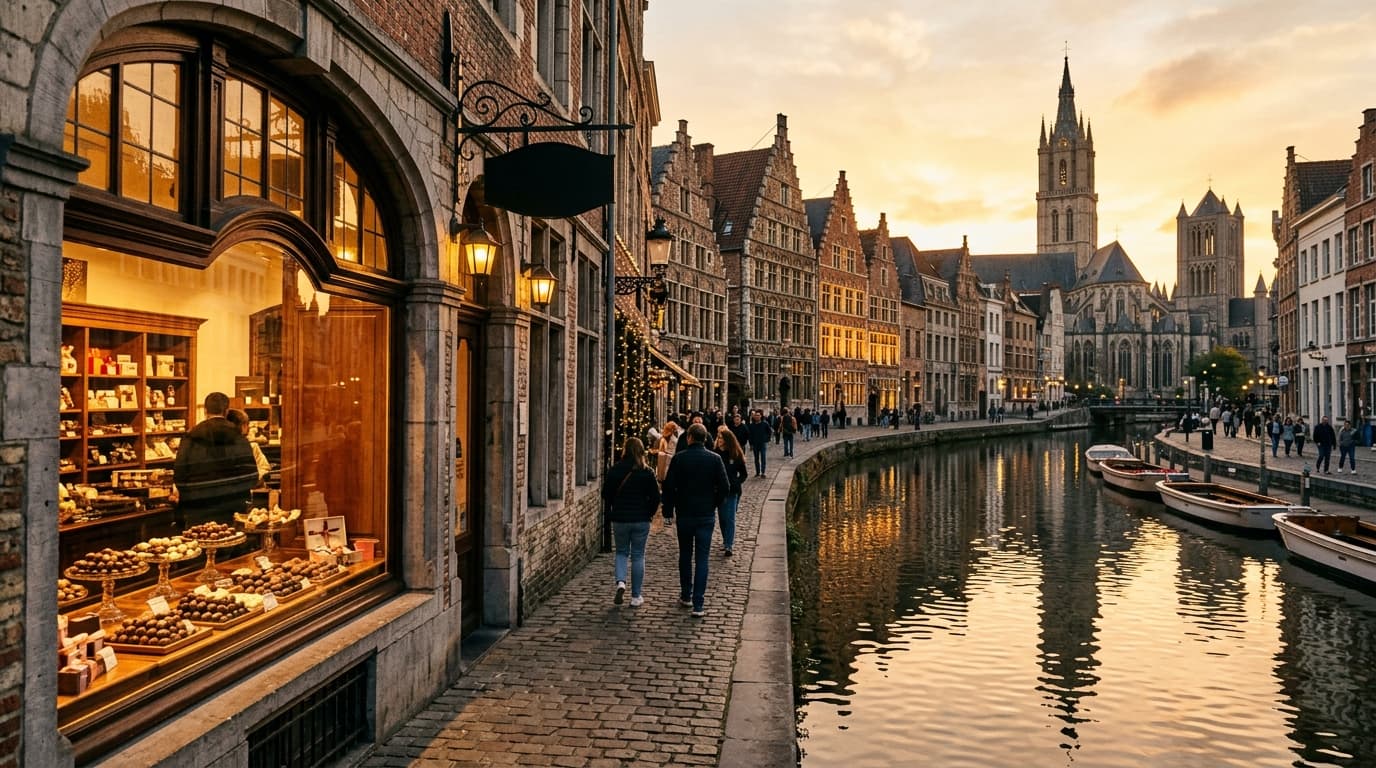
Ghent is the chocolate city food lovers forget. Everyone heads to Brussels for the Sablon and Bruges for the canals, leaving aside some fifty shops where chocolate is sold first to people from Ghent, not to coach parties. Here is the route I send visiting friends on: three stops that matter, two hours of walking, and what to taste at each window.
Where should a chocolate walk in Ghent start?
Start at Sint-Baafsplein, at the foot of Saint Bavo's Cathedral, head down to the Groentenmarkt, then go straight south to Walpoortstraat. The order matters here, because the best address closes earliest.
The medieval centre packs the essentials into a kilometre and a half. Sint-Baafsplein holds the historic family house, the Groentenmarkt keeps the oldest confectioner, and Walpoortstraat, slightly off the tourist flow, hides the country's most singular workshop. Following this direction, you walk along the Graslei on the way — no bad thing.
We did the route again on a Tuesday in March, leaving Sint-Baafsplein at 10.30, last bar eaten around 12.45. The difference with Bruges hits you at the first window: in Ghent, the people queuing at a chocolatier live on the next street.
Is Van Hoorebeke worth the stop?
Yes, and it's the best starting point. The shop sits at Sint-Baafsplein 15, thirty seconds from the Ghent Altarpiece — you may as well do both.
Luc Van Hoorebeke started his workshop in 1982, and his son Cédric now works beside him: two generations at the same bench. The detail that makes the shop is a glass panel in the floor, letting you watch the workshop below while you choose. You see the pralines being made under your feet, which settles the freshness question in advance.
On taste, the house owns the classic: clean Belgian praline, frank ganaches, and a few well-judged detours towards lemongrass. This is not bean-to-bar — Van Hoorebeke starts from a quality Belgian couverture, like the vast majority of the country's chocolatiers. At tasting, the shell snaps cleanly and the praliné stays low on sugar, which is rarer than you'd think. Expect a mid-range budget, around €6 per 100 g.
Is Yuzu the most original chocolatier in Belgium?
The most singular, certainly, and the stop I argue for hardest. Yuzu hides at Walpoortstraat 11a, ten minutes south of the centre, in a minimalist shop that looks like no other Belgian window.
Nicolas Vanaise studied archaeology at the University of Ghent and dug in the Middle East before opening his shop in September 2003. Chance had little to do with it: his same-named ancestor already ran a pastry-and-chocolate shop in Ghent in 1854. From his trips to Japan he brought back the yuzu — whose colour he took for his packaging, against the sober browns of the rest of the trade — and a taste for pairings that unsettle.
He works single-origin chocolate, beans from Central and South America, and has signed over 200 creations, of which only about thirty are in the window at any given moment. We tasted a woody ganache with tobacco notes for you: this is not a comfort praline, it's a chocolate that asks you to sit down. If you only have time for one address in Ghent, make it this one.
At Yuzu, a tobacco praline isn't provocation: it's an archaeologist digging into cocoa the way he once dug in the Middle East.
Where can you taste the real Ghent cuberdons?
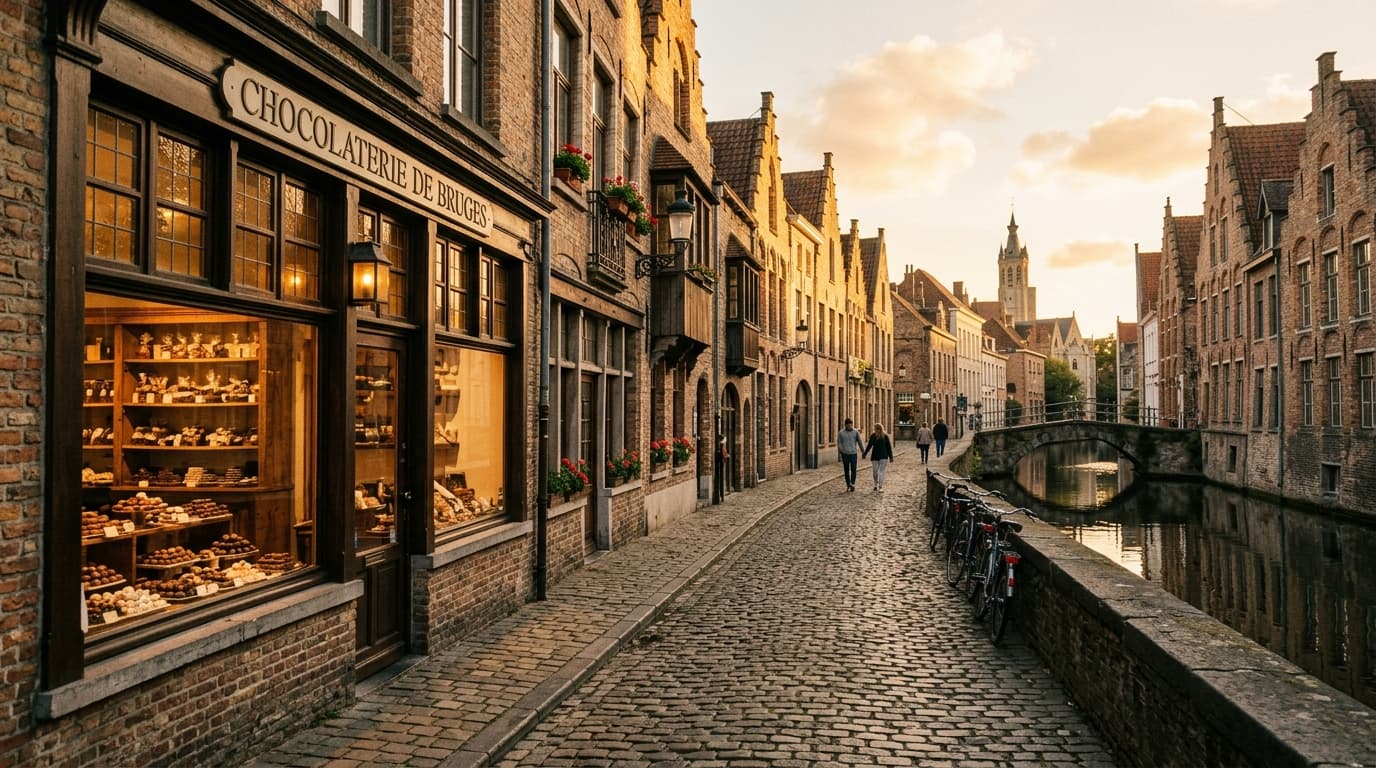
At Confiserie Temmerman, on the Groentenmarkt, and nowhere else if you want the original. The house was founded in 1904 by Bertha Moffaert and her husband; the fifth generation now runs the counter, making it the oldest confectioner in Ghent still in the same family's hands.
The shop occupies a 17th-century building whose façade carries bas-reliefs of the seven works of mercy. Inside, you edge between jars, gingerbread and loose tea. Its cuberdons are made without gelatine, with a runny raspberry heart, and keep the original face profile rather than the cone you see everywhere else.
A word on this sweet, because the confusion is permanent: the cuberdon is not chocolate. It was born in 1873 at the hands of De Vynck, a Ghent pharmacist trying to preserve his medicinal syrups — the same apothecary story that gave Belgian chocolate its reputation. It's eaten within days, never later.
Vandenbouhede, Deduytschaever: which other addresses?
These are the two extras if you stay the day. Chocolaterie Vandenbouhede, in the centre, is run by Stijn and Janique in an open workshop: you'll find the classic praline, but also frankly local pairings, Ganda ham or beetroot. It's fun, sometimes uneven, always honest.
Jannes Deduytschaever, meanwhile, has been crowned best chocolatier in Flanders and works in a register of finesse and complexity close to the sharpest work in the country. If you have a fourth stop in reserve, spend it here.
To place these houses in the Belgian landscape, our comparison of which Belgian chocolatier to choose puts the big names in perspective.
Is there a Pierre Marcolini shop in Ghent?
No, and it's worth saying up front to save you the disappointment. Pierre Marcolini — the Belgian high-end reference, the only great house working bean-to-bar at this scale, meaning it selects and roasts its own beans — has no shop in Ghent. You'll find him at the Sablon and the Galeries de la Reine in Brussels, and in Knokke.
This isn't a gap for Ghent, it's a position. The city never played the luxury-window card; it produced family houses and signature chocolatiers instead. If bean-to-bar finesse is what draws you, the Sablon is a thirty-minute train ride away, and our comparison of which Belgian chocolatier to choose explains what you'd be going for.
How much time and budget should you plan?
Allow two hours and €20 to €45 for tasting. That's comfortable for four houses if you buy by the piece rather than by the full ballotin.
| Stop | Street | What to taste | Budget |
|---|---|---|---|
| Van Hoorebeke | Sint-Baafsplein 15 | House praliné, hot chocolate | €€€ |
| Temmerman | Groentenmarkt | Cuberdon with a raspberry heart | € |
| Vandenbouhede | Centre | Ganda ham praline | €€ |
| Yuzu | Walpoortstraat 11a | Woody ganache, single-origin bar | €€€€ |
| Deduytschaever | Centre | The chef's signature praline | €€€ |
The rule I apply: two pieces per house, never a full ballotin at the first shop. You keep room — and budget — to compare, and you save the take-home purchase for Van Hoorebeke at the end, on the way back to the station.
Which tourist traps should you avoid in Ghent?
Ghent has markedly fewer than Bruges, and that's its strength. The risk sits around the Korenlei and the approaches to the cathedral: a few windows stack coloured moulds under cellophane, with no house name and no freshness date.
The right reflex comes down to three signs: pralines sold bare and by weight, a chocolatier's name on display, and visible turnover in the window. A fresh praline keeps a few weeks at best — if a box promises six months, you're no longer at an artisan's. The second trap is sneakier: industrial cuberdons, hardened, sold in bags near the tourist sites. They've given the Ghent sweet a reputation as a sugary pebble that it thoroughly doesn't deserve.
Still torn between Ghent and Bruges for your food weekend? Our chocolate itinerary in Bruges lays out the other route — and if you want to know what kind of chocolate lover you are before pushing open the first door, test yourself with our chocolate quiz.
Itinéraires gourmands comparator
Compare all itinéraires gourmands side by side.
Compare now →
Frequently asked questions
Bruxelloise pur sucre, Margaux arpente les chocolateries belges depuis plus de dix ans. Ancienne pâtissière reconvertie dans le journalisme gourmand, elle goûte, compare et raconte le chocolat belge sans complaisance — des grandes maisons aux ateliers de quartier.