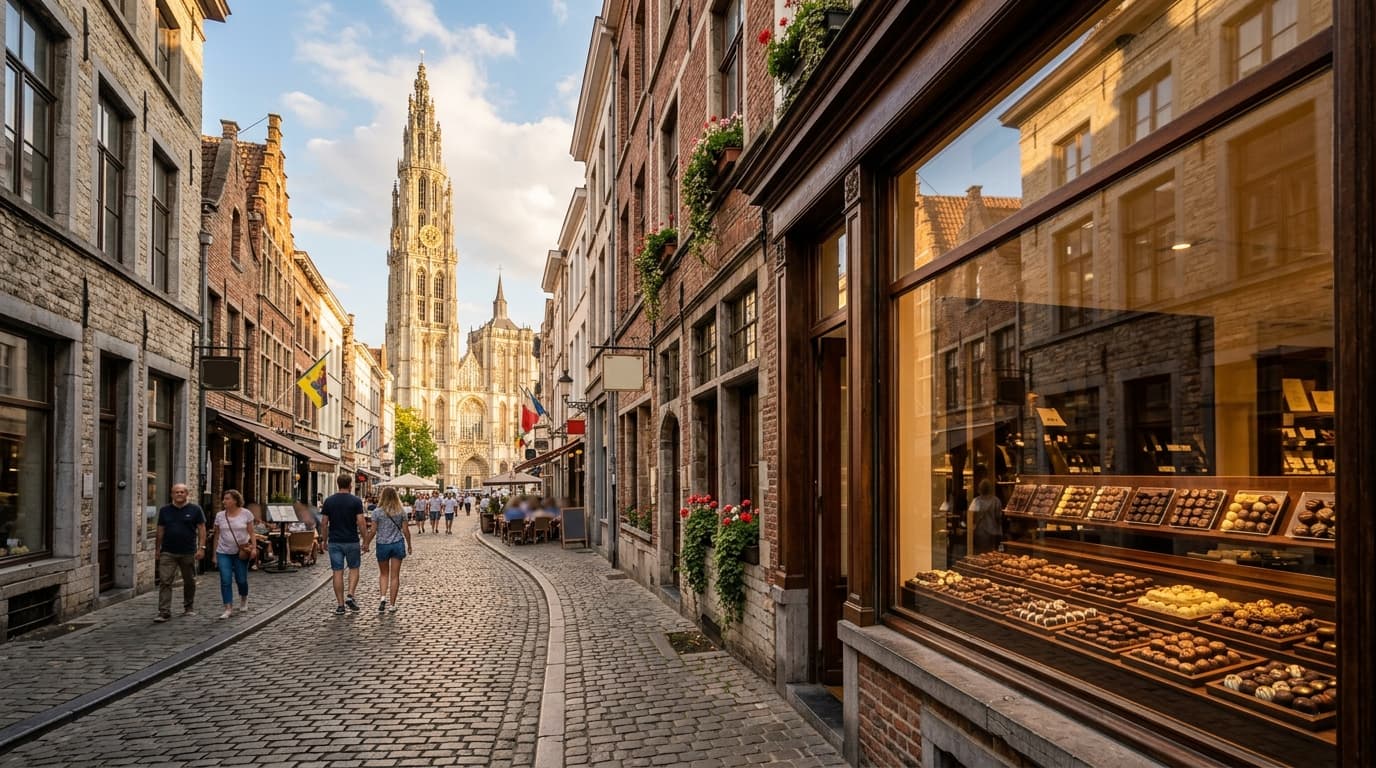
Antwerp is best explored on foot, from the Meir to Central Station, with a praline break at every corner. In half a day you can link The Chocolate Line, Del Rey and Burie without ever rushing. Here is the route I send visiting food lovers along, address by address, with what to taste at each stop.
Where to start a chocolate walk in Antwerp?
Start on the Meir, the main shopping street, and head down towards Central Station through the diamond district. The direction hardly matters, but starting from the Meir means you finish near the station, handy if you leave by train.
The centre packs the essentials into a small area: the Meir for the flagships, Korte Gasthuisstraat and Steenhouwersvest for the neighbourhood workshops, and Astridplein, opposite the station, for the Chocolate Nation museum. Follow that order and you flow through without detours or backtracking. Unlike Bruges, where it all plays out around a single square, Antwerp stretches its chocolate along a one-kilometre axis — which is exactly why a proper route beats aimless wandering.
We did the loop again on a Tuesday in June, setting off at 11 am on the Meir, last praline eaten around 3 pm, with a tearoom break in the middle. If Bruges tempts you too, our chocolate itinerary in Bruges follows the same address-by-address logic.
Is Antwerp's Chocolate Line worth the detour?
Yes, and for a unique setting. Dominique Persoone's house occupies the Paleis op de Meir, a 1745 palace where Napoleon and King William I of the Netherlands once stayed. Tasting a praline under the mouldings of a royal room is an experience in itself.
Persoone made his name pushing chocolate out of its comfort zone: pairings with wasabi, oyster, asparagus or cauliflower, and the famous "shooter" that fires cocoa powder up your nose. Behind the provocation there is real bean work and precise ganaches. In the window, the wildest creations line up like an apothecary's shelf, and you quickly spot the safe bets next to the gambles.
Expect a high budget, around €8 per 100 g — the priciest on the walk. At tasting, better to take two or three contrasting pieces than a big box: it's an address to experiment with, not to stock up on. To place Antwerp within the Belgian landscape, our comparison of which Belgian chocolatier to choose puts the great houses in perspective.
At Persoone's, an oyster praline isn't a gimmick: it's a way of reminding you that Belgian chocolate can still surprise.
Why stop at Del Rey near the station?
Because it's Antwerp's other face: refinement rather than daring. Del Rey, on Appelmansstraat, in the heart of the diamond district, runs a cosy tearoom paired with a chocolate shop and a patisserie. You come as much for the praline as to sit down.
The house plays the well-executed classic: clean ganaches, melting pralinés, and pastry worth the detour if you're hungry between windows. It's the comfort stop of the route, a stone's throw from Central Station — ideal for a rest before heading back to the Meir, or to finish on if you're leaving by train.
At tasting, we tried a house ganache and a hazelnut praliné, both reassuringly consistent. It's the address I recommend to anyone after the smart, no-surprises version, the exact opposite of The Chocolate Line.
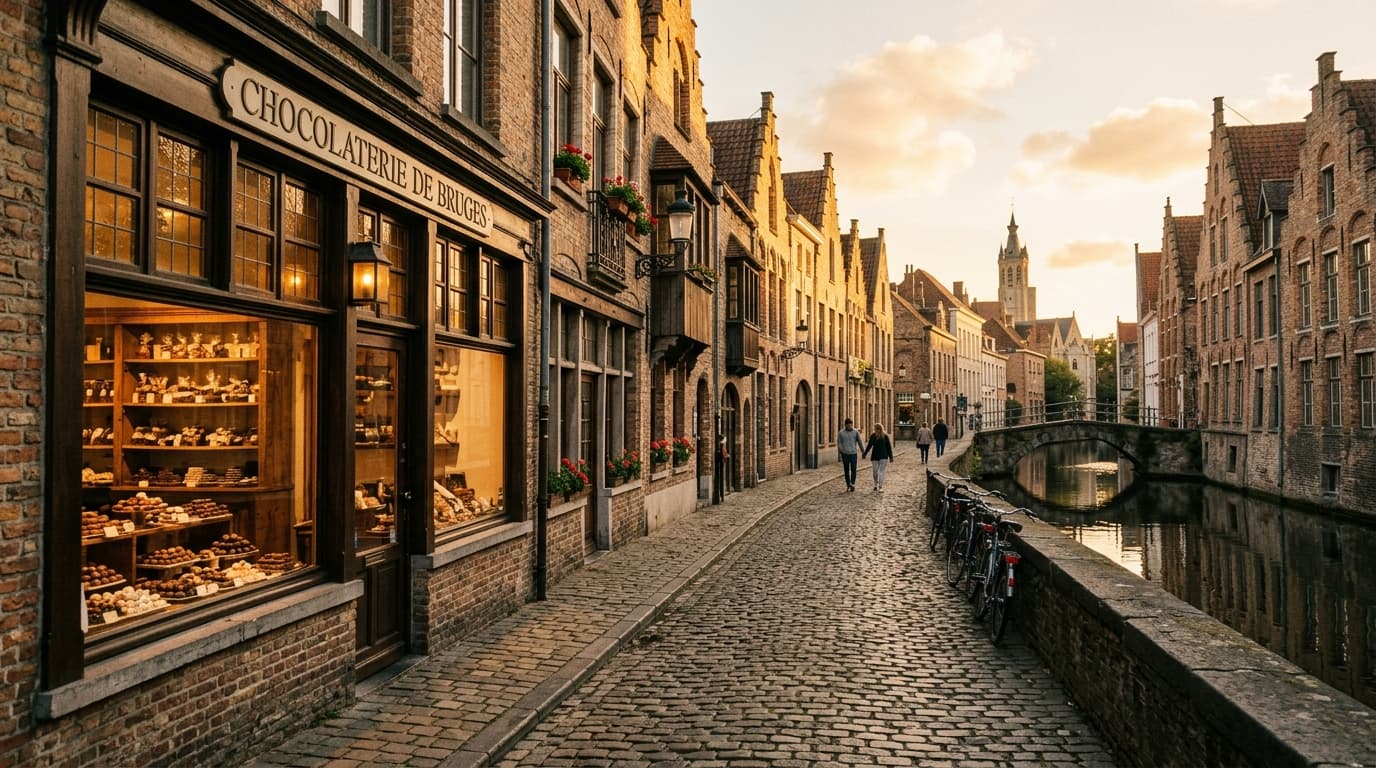
Burie, Günther Watté: which neighbourhood addresses?
These are the gems you miss if you stay on the Meir. Two houses, two streets, a few minutes apart, where the locals actually buy their chocolate.
Burie, on Korte Gasthuisstraat, is famous for its moulded figures and sculpted pieces — bicycles, boats, animals in chocolate — a spectacular craft that delights children and admirers of fine work alike. A little further on, Günther Watté, on Steenhouwersvest, marries house-roasted coffee and chocolate: it's the address to aim for a praline-and-espresso duo, on the edge of the fashion district and the historic centre. For the high-end style and marked origins, Pierre Marcolini also runs a shop in Antwerp, near the Meir, in the spirit of his bean-to-bar house at the Sablon.
Is the Chocolate Nation museum worth visiting?
If you have an hour and a half and some curiosity, yes. Chocolate Nation, opened in 2019 on Astridplein, right opposite Central Station, is the largest Belgian museum devoted to chocolate: fourteen themed rooms, a 60-to-90-minute journey from the cocoa plantation to Antwerp's cocoa port.
It's not essential for a hurried food lover, but the visit sheds light on what you tasted in town: you understand a ganache better once you've seen a raw bean and smelled a cocoa mass being conched. The tasting is included in the ticket. To go further into the origins of this reputation, our article on why Belgian chocolate is so renowned rounds off the stop nicely.
How much time and budget to plan for?
Allow half a day and €20 to €50 of tasting. That's generous for sampling at four or five houses, buying by the piece rather than by the full box.
| Stop | Street | To taste | Budget |
|---|---|---|---|
| The Chocolate Line | Paleis op de Meir 50 | Wasabi praline or the shooter | €€€€ |
| Del Rey | Appelmansstraat | House ganache in the tearoom | €€€ |
| Burie | Korte Gasthuisstraat | A moulded chocolate figure | €€ |
| Günther Watté | Steenhouwersvest | Espresso-and-praline duo | €€ |
| Pierre Marcolini | Meir | A bean-to-bar origin square | €€€€ |
| Chocolate Nation | Astridplein | Museum + tasting included | €€ |
The rule I apply: two pieces per house, never a full box at the first shop. You keep room — and budget — to compare, and you save the takeaway purchase for the end, so the pralines don't melt in the bag all day. To plan another route, our chocolate blog maps out more Belgian tastings city by city.
Which tourist traps to avoid in Antwerp?
The number-one trap is on the Meir and around it, the busiest axis: windows stacking colourful moulds under cellophane, at prices inflated for visitors. The locals rarely buy their chocolate on that street.
The right reflex comes down to three signs: pralines sold loose and by weight, a chocolatier's name on show, and visible turnover in the window. A real fresh praline keeps only a few weeks — if a box promises six months' shelf life, you're no longer with an artisan. The fact that Antwerp is the world's leading cocoa port guarantees nothing about a shop's quality: what counts is the chocolatier's work, not the proximity of the beans.
Before you push open the first door, want to know what kind of chocolate lover you are? Test yourself with our chocolate quiz — it points you to the house profile made for you.
Itinéraires gourmands comparator
Compare all itinéraires gourmands side by side.
Compare now →
Frequently asked questions
Bruxelloise pur sucre, Margaux arpente les chocolateries belges depuis plus de dix ans. Ancienne pâtissière reconvertie dans le journalisme gourmand, elle goûte, compare et raconte le chocolat belge sans complaisance — des grandes maisons aux ateliers de quartier.