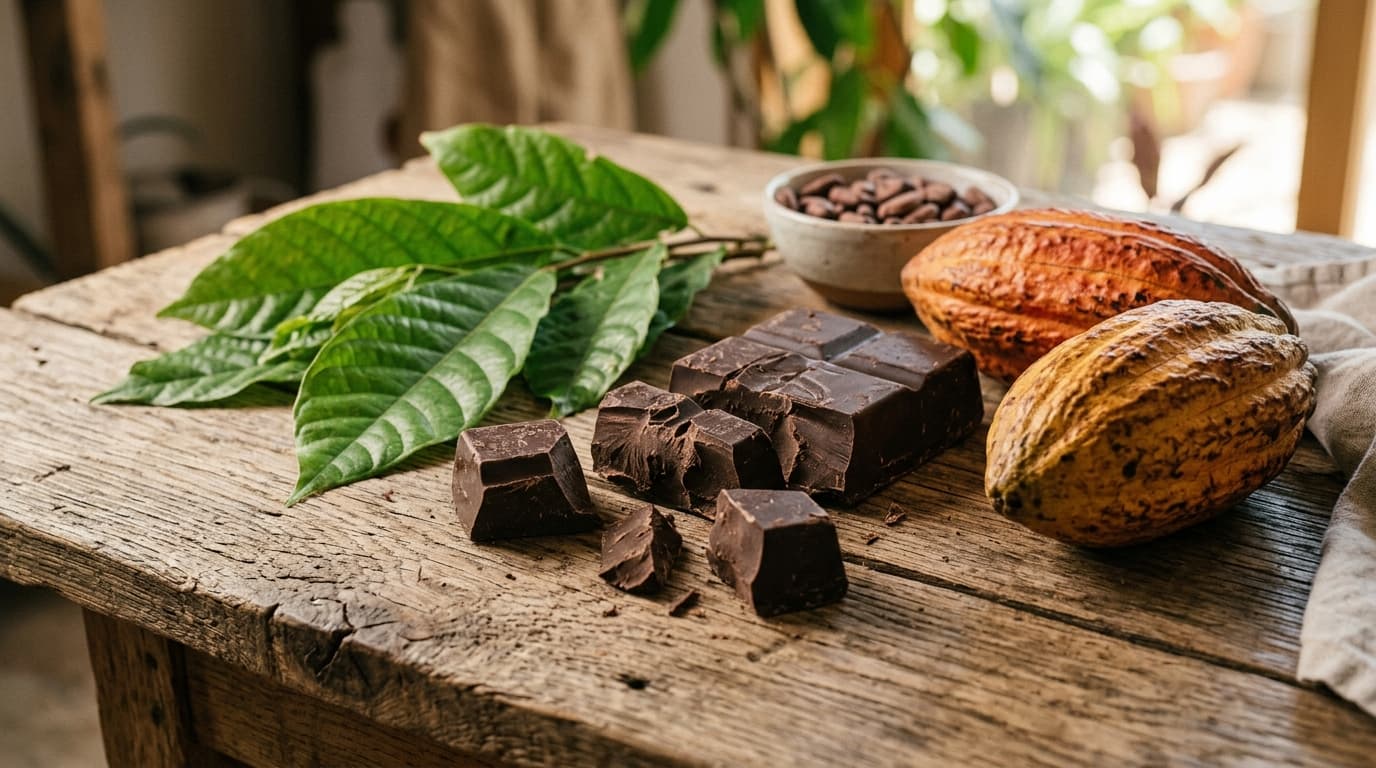
The EU organic label guarantees one thing: the cocoa and the sugar in the bar grew without synthetic pesticides or fertilisers, and at least 95 percent of the agricultural ingredients are certified. It says nothing about the price paid to the grower, nothing about child labour, nothing about taste.
Organic certifies a plot of land, not a value chain
The governing text is Regulation (EU) 2018/848, in force since 1 January 2022. It sets the production, inspection and labelling rules for everything sold as organic in the Union.
For a chocolate bar, the mechanics come down to three points. The beans come from a plot farmed without synthetic pesticides or chemical fertilisers. At least 95 percent of agricultural ingredients by weight are certified organic, and that threshold applies to the sugar, the milk, the hazelnuts and the vanilla just as much as to the cocoa itself. The remaining 5 percent are tolerated only if they appear on an official list annexed to the regulation.
Everything else falls outside the scope. The price paid to the grower is not in there. Nor are working conditions on the plantation. Fermentation and drying, which decide most of what a bean will taste like, are not covered either.
The legislator forgot nothing. Organic rules are an agricultural and environmental text, written to govern a way of farming, and they do exactly what they were written to do. The misunderstanding comes from elsewhere: the green leaf ended up being read as a general certificate of good conduct, on subjects it never claimed to address.
Who issues organic certification in Belgium?
Three bodies, and three only. Certisys carries the code BE-BIO-01, TÜV NORD Integra BE-BIO-02, FoodChain ID Certification BE-BIO-03, formerly Quality Partner. All three are approved for Wallonia, Flanders and the Brussels-Capital Region, as the Walloon agriculture portal confirms.
On a Belgian subject, that is rare enough to be worth noting: taxation, subsidies, waste rules, everything splits by Region, and organic certification does not.
The code is printed on the wrapper, right under the green leaf, in tiny characters. It is the only element on the pack a buyer can genuinely cross-check, since it names an identified company, reachable, and answerable for its accreditation. It took me a good ten minutes on 12 September to find it on three bars from my own stock: on the back, in six-point type, under the net weight, in exactly the place nobody ever looks.
Retailers must be certified too. The Belgian shop where I recorded the prices below displays its own code, BE-BIO-03, at the very bottom of its home page.
Organic and fair trade do not cover the same promises
The most common confusion throws both logos into the same basket, when they answer different questions and neither one covers the other's ground.
| Buyer's question | EU organic | Fairtrade | Deforestation regulation |
|---|---|---|---|
| Synthetic pesticides banned | Yes | No | No |
| Floor price guaranteed to the grower | No | Yes | No |
| Premium paid to the cooperative | No | Yes | No |
| Child labour audited | No | Yes | No |
| Plot geolocated, no clearing after 2020 | No | No | Yes, mandatory |
| Fermentation and drying governed | No | No | No |
| Inspection body named on the wrapper | Yes | No | No |
Rainforest Alliance, the third logo you meet on a bar, covers both environmental and social ground. I am leaving it out of this table, and the reason deserves saying: its standard is private, it is revised by the house that issues it, and the version applied to the bar in your hand is printed nowhere on the wrapper. Filing it under a fixed column would suggest a stability it does not have.
How much does organic earn the cocoa grower?
Roughly four cents on a 100 gram bar. The calculation is public, and it takes two lines.
Fairtrade pays a specific top-up on certified organic cocoa, called the organic differential, which comes on top of the minimum price and the premium. In its price announcement of 11 December 2025, the organisation raised that differential and set the timetable for it.
| Cocoa beans | Minimum price | Premium | Organic differential | Applicable |
|---|---|---|---|---|
| World excluding Côte d'Ivoire and Ghana | USD 3,500/t | USD 275/t | USD 450/t | since 11 June 2026 |
| Ghana | USD 3,500/t | USD 275/t | USD 450/t | from 1 October 2026 |
| Côte d'Ivoire | EUR 3,200/t | EUR 250/t | EUR 410/t | from 1 October 2026 |
| Côte d'Ivoire, current regime | EUR 2,206/t | EUR 221/t | EUR 276/t | until 1 October 2026 |
Take the world differential, 450 dollars per tonne of beans, so 0.45 dollar per kilo. A 100 gram dark bar at 70 percent draws on roughly 80 grams of beans once shell and processing losses are accounted for. The organic top-up reaching the producer therefore weighs around four cents per bar. For Côte d'Ivoire, the world's largest supplier, the figure in force today falls below three cents, and it only moves up to its new level in eleven days.
That number is an order of magnitude, not an accounting statement: processing yields vary from recipe to recipe, and the vast majority of organic cocoa is not Fairtrade certified at all, so earns no differential whatsoever.
The gap is still hard to miss. The organic top-up is counted in cents at the farm, and the extra cost of an organic bar is counted in euros in the shop.
The organic differential is counted in cents at the farm. The extra cost of the bar is counted in euros in the shop.
Where the reasoning goes next is less comfortable. The premium on organic is nothing like an abusive margin: it comes from lower yields per hectare, from the annual cost of certification, from the obligation to keep organic batches physically separate from the rest at every stage of transport, storage and roasting, and from volumes too small to spread anything over. Those costs are real. A good share of them lands on the cooperative itself, which pays for its audit before selling a single sack. They simply never take the form of an extra cheque to the grower, which is precisely what most buyers believe they are funding when they pay more.
Does organic chocolate taste better?
No.
The taste of a bean is decided during fermentation and drying, in the days after harvest, and neither of those steps is governed by organic rules. I paid for that on 12 September, with an organic bar from Peru bought in a shop in Ixelles: green attack, dry bitterness, nothing holding up after ten seconds. The label could do nothing for it.
Origin, harvest year and the name of the maker tell you far more than the logo, as our article on Belgian dark chocolate sets out.
What does a Belgian organic bar cost per kilo?
On 20 September 2026 I recorded the eight Belvas references sold by a Belgian organic retailer, public price without membership, each price divided by its stated weight.
The kilo runs from €53.10 for the dark-chocolate-coated marshmallows to €76.25 for the 80 gram 100 percent cocoa bar, sold at €6.10. Between the bottom and the top of the range the spread fits inside a factor of 1.44, which is tight for eight products that different.
Those figures place the house precisely. In the survey of 7 September published in our article on the Belgian ballotin, Leonidas charged €41.80 per kilo and Neuhaus €105.00. Belgian organic therefore settles between the two, closer to the middle than to luxury.
Belvas deserves naming here, and on dated facts rather than on a pitch. The chocolate works was founded in 2005 at Ghislenghien, in Hainaut, by Thierry Noesen. It applied for the Max Havelaar licence in its very first year of trading, before it even went organic, which it did in 2007 with Certisys certification. The order matters: the house started from fair trade and added organic, whereas the market almost always does the reverse.
Three reservations, because they count as much as the rest. The prices above sit well above a supermarket organic bar, and it is the buyer who pays for the double certification. Distribution stays confidential: organic shops, specialist networks and online sales, but you will not find it in a Brussels chocolatier's window. And organic plus fair trade still guarantees nothing about taste, which is settled at the tasting table and nowhere else.
On 30 December 2026, deforestation leaves the world of labels
Regulation (EU) 2023/1115 bans placing on the EU market any product grown on land cleared after 31 December 2020. Cocoa is one of the seven commodities covered, alongside coffee, soy, palm oil, timber, rubber and cattle.
Every operator will have to file a due diligence statement carrying the geolocation of the production plots. The obligation applies to large and medium-sized companies from 30 December 2026, and to micro and small operators a year later.
The shift matters more than it appears. Until now, the guarantee against deforestation was sold in logo form, to those willing to pay for it, and a house that refused to join a private standard was left with nothing to show on its wrapper, even when it had been buying its beans from a cooperative it had known for fifteen years. In three months it becomes a condition of entry to the European market, for every bar sold here, organic and non-organic alike. A label will no longer be able to claim it as an advantage, since the bar next to it on the shelf will face the same requirement.
Our article on the price of cocoa sets out what that traceability is already costing the industry.
Five checks on the wrapper before you pay
The organic aisle reads fast once you know where to put your eyes.
- The inspection body code under the green leaf, BE-BIO-01, 02 or 03 for a product inspected in Belgium.
- The stated cocoa origin, country or cooperative, missing from most entry-level organic bars.
- The presence or absence of a second, social logo, the only thing that says anything about the price paid to the grower.
- The ingredient list, where cocoa butter should be the only added fat.
- The price per kilo, displayed on the shelf, the only figure that compares across brands.
To understand what social labels really hold up, read our breakdown of fair trade chocolate. And if the goal is simply to buy well, our ranking gives the order of preference among Belgian houses.
Histoire du chocolat comparator
Compare all histoire du chocolat side by side.
Compare now →
Frequently asked questions
Bruxelloise pur sucre, Margaux arpente les chocolateries belges depuis plus de dix ans. Ancienne pâtissière reconvertie dans le journalisme gourmand, elle goûte, compare et raconte le chocolat belge sans complaisance — des grandes maisons aux ateliers de quartier.