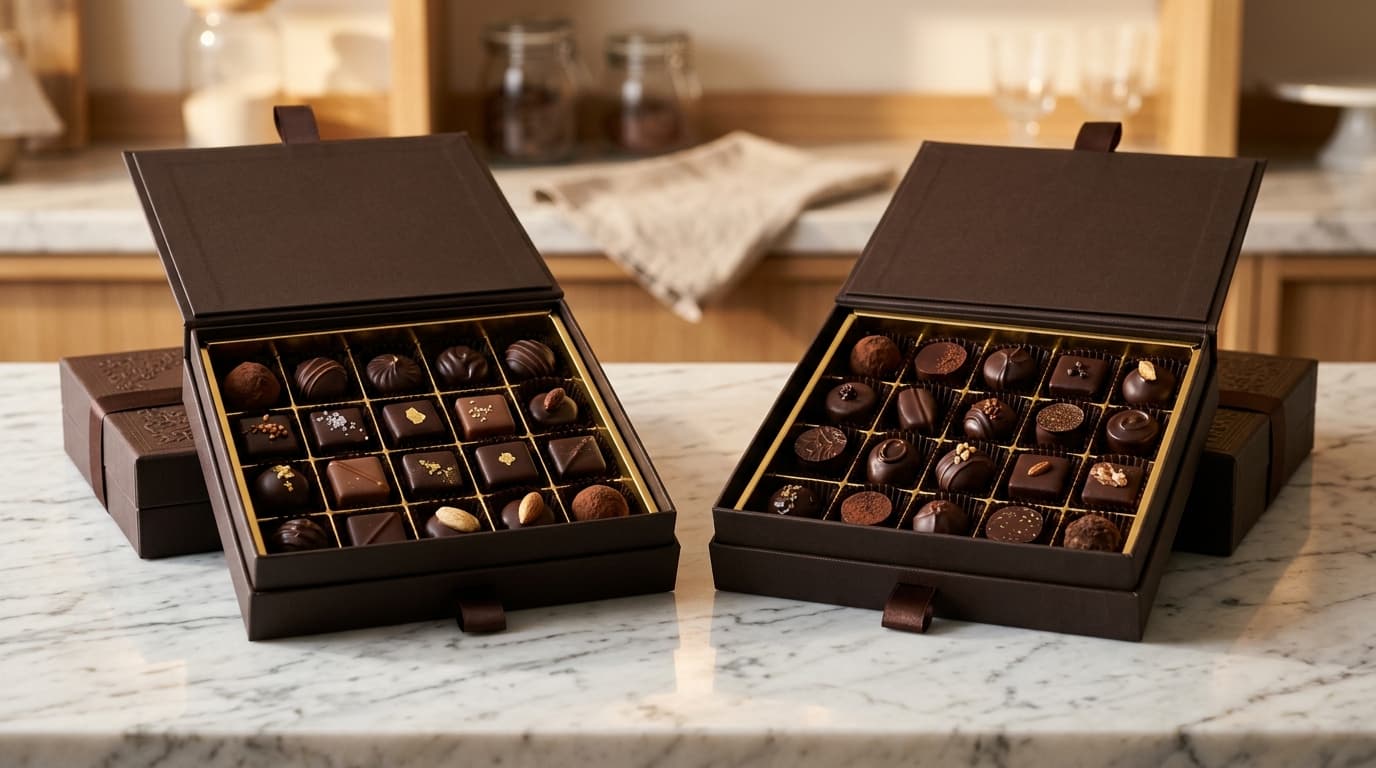
Two names, two worlds. Godiva is the Belgian chocolate the whole planet recognises; Pierre Marcolini is the Sablon artisan enthusiasts trade tips about in hushed tones. In front of the window, we hesitate. Here's how to decide based on what you're after: a gift that impresses, a serious tasting, or a name that travels.
Godiva or Marcolini: which makes the better chocolate?
At tasting, Pierre Marcolini takes the lead. Its cocoa is cleaner, more defined, with origin notes that hold in the mouth where Godiva stays in a softer, more consensual register.
The reason lies in the way each works. Marcolini selects and roasts its own beans; Godiva mostly blends cocoas from Africa and South America for a stable recipe built to please the many. That's no fault in itself: a consistent chocolate, available everywhere, has its value. But on finesse, the artisan keeps the edge.
We tasted both side by side, a plain square of each. The Marcolini attacks sharp, slightly tannic, then opens onto fruit; the Godiva is round, sweet, pleasant, without the same signature. If you're after emotion, Marcolini. If you want easy pleasure, Godiva does the job.
What does Marcolini's bean-to-bar change in the taste?
Bean-to-bar means controlling the whole chain, from bean to bar. Marcolini picks its growers (Sao Tomé, Venezuela, Peru, Cuba…), roasts, conches and moulds itself. The result: a cocoa profile you won't find at a classic blender.
In practice that shows in single-origin bars where you sense the terroir, as with wine. A Peruvian cocoa doesn't have the same nose as a Sao Tomé, and that's the whole point. The house, founded in 1995, made this approach its signature long before bean-to-bar became fashionable.
Godiva, by contrast, bets on industrial consistency: the same truffle, the same taste, in Brussels as in Tokyo. Reassuring for a gift, less exciting for a tasting. To judge the gap, take a plain ganache at Marcolini before the more elaborate creations: that's where the cocoa speaks loudest.
Is Godiva still a Belgian chocolate?
On paper, yes; in practice, it's more nuanced. Godiva was indeed born in Brussels in 1926 and keeps its European headquarters and R&D centre there. But the brand has for years belonged to Turkey's Yıldız Holding.
The telling detail: in 2019, Yıldız sold Godiva's Belgian factory (along with its Japan, Korea and Australia operations) to the fund MBK Partners, then in March 2021 the brand closed its 128 North American shops, pandemic obliging. The historic DNA stays Belgian, but the geography of production and ownership has largely shifted.
Marcolini, meanwhile, has remained an independent Belgian artisan, rooted on Place du Grand Sablon. For anyone buying Belgian chocolate out of attachment to the "made here", the nuance matters. It changes nothing in the box, but it explains why Brussels purists cite Marcolini more readily than Godiva.
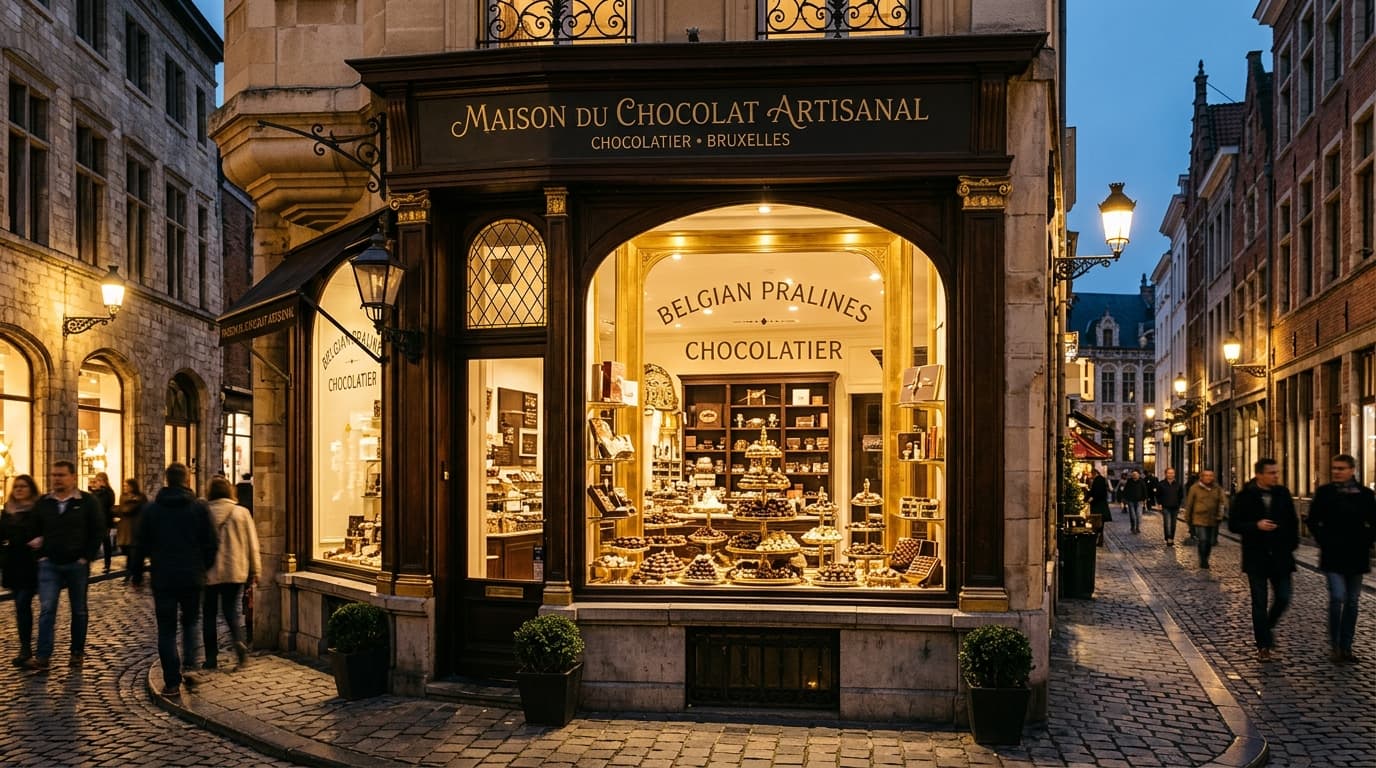
Does Pierre Marcolini justify its price?
Yes, if you're after the best of Belgian cocoa and a gift that lands. Marcolini is the pricier of the two, often called the "Louis Vuitton of chocolate", and that positioning comes at a cost.
That price covers real craft: direct bean sourcing, small batches, renewed collections, careful packaging. For a serious tasting or a gift to someone who knows, the price gap is fully defensible. In the window on Place du Grand Sablon, you quickly grasp that you're paying for a house, not just a box.
Godiva stays premium, but more accessible, especially in retail and at the airport. For a "safe bet" gift on a contained budget, or to offer a name everyone recognises, it does the job very well. The question isn't "which is best" in absolute terms, but "for what, and for whom".
Which one to choose by occasion?
Start from the occasion, not the logo. An exceptional gift, an international corporate gift and a tasting craving don't call for the same house.
To make a statement — an exceptional gift, an important birthday, a demanding enthusiast — Pierre Marcolini is the first pick: the most defensible finesse and the most Belgian aura of the two. For a corporate gift to a foreign contact, Godiva has the edge of a globally known name. And to treat yourself square by square, Marcolini on its pure origins, no hesitation.
| Criterion | Pierre Marcolini | Godiva |
|---|---|---|
| Style | Bean-to-bar artisan | Global premium brand |
| Cocoa | Pure origins, defined | Round blend, consistent |
| Price | €€€€ | €€€ |
| Exceptional gift | Ideal | Good |
| Name known abroad | Good | Excellent |
| Belgian roots | Strong (Sablon) | Historic, foreign ownership |
To widen the comparison beyond these two names, our guide which Belgian chocolatier to choose puts Neuhaus, Leonidas and Marcolini head to head by budget and occasion.
Where to buy Godiva and Marcolini in Brussels?
Both are easy to find in the centre, but not at the same addresses. Pierre Marcolini has its emblematic workshop-boutique on Place du Grand Sablon, open every day: the stop not to miss to see the house in full.
Godiva, more widely distributed, is found in the Galeries Royales Saint-Hubert, at several city-centre points and at Zaventem airport, often at the counter alongside other great Belgian houses. Handy for a last-minute buy, less so for the experience.
If you want to compare Marcolini with another great Sablon house, our head-to-head Wittamer or Pierre Marcolini helps you settle the two neighbours. And before pushing open a door, test your chocolate profile with our chocolate quiz.
Chocolatiers & maisons comparator
Compare all chocolatiers & maisons side by side.
Compare now →
Frequently asked questions
Bruxelloise pur sucre, Margaux arpente les chocolateries belges depuis plus de dix ans. Ancienne pâtissière reconvertie dans le journalisme gourmand, elle goûte, compare et raconte le chocolat belge sans complaisance — des grandes maisons aux ateliers de quartier.