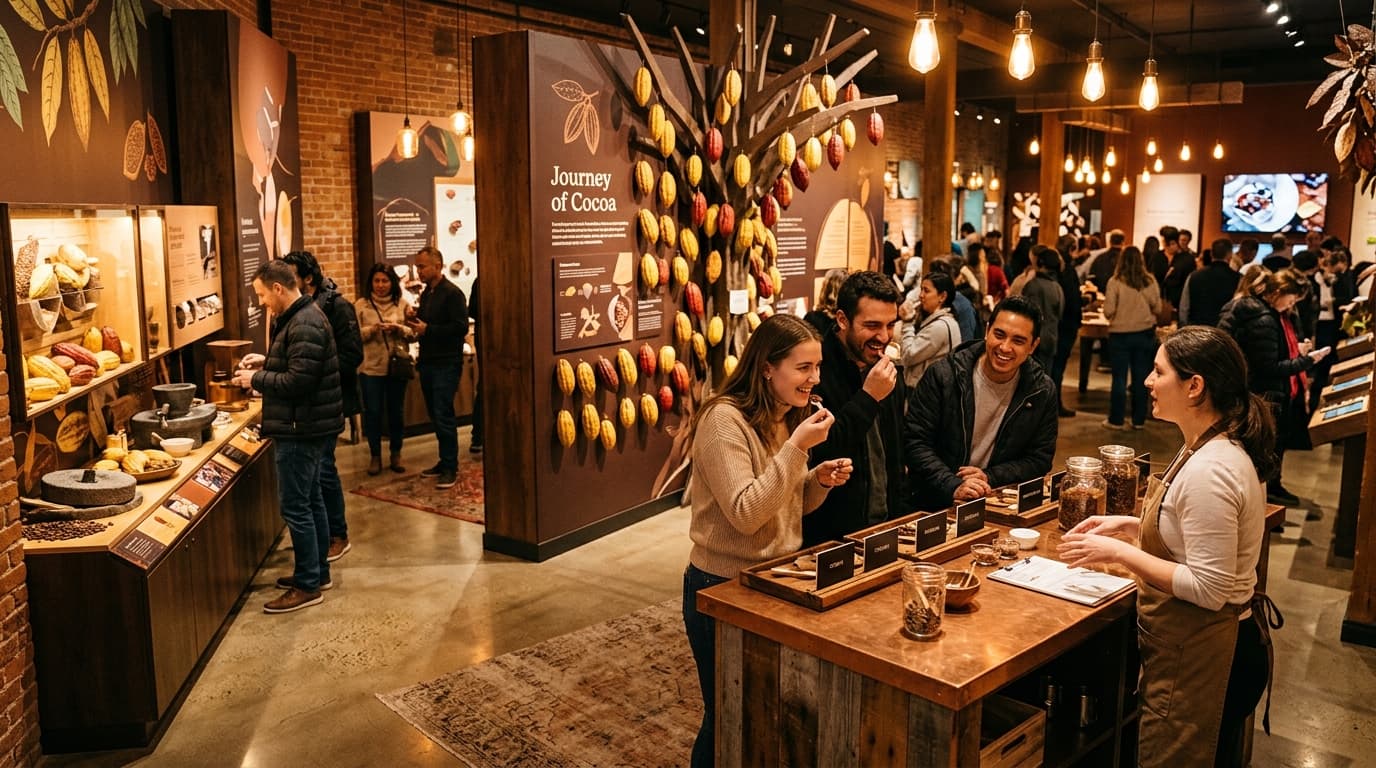
Belgium has four chocolate museums worth the trip, and they don't tell the same story. Antwerp goes for the show, Brussels and Bruges for the history of cocoa, Koekelberg for the greenhouse and the atelier, the Ardennes for the artisan behind his glass wall. Here's which to pick, at what price and for how long.
Which chocolate museums are worth visiting in Belgium?
Four addresses stand out: Chocolate Nation in Antwerp, Choco-Story in Brussels and Bruges, Belgian Chocolate Village in Koekelberg and Chocolaterie Defroidmont in Erezée. The rest are shops with an explanatory panel on the wall.
The difference lies in what each place is trying to do. Chocolate Nation, opposite Antwerp's central station, is an immersive route through 14 themed rooms. Choco-Story traces cocoa back to pre-Columbian civilisations, with more than 600 objects in Brussels. Belgian Chocolate Village occupies the former Victoria chocolate and biscuit factory and goes as far as a tropical greenhouse planted with cocoa trees. Defroidmont stages nothing at all: you simply watch the workshop run.
We did all four over ten days, notebook in hand. The surprise: the most expensive is not the one you leave having learned the most.
Chocolate Nation or Choco-Story: which one to choose?
Chocolate Nation for the show, Choco-Story for the history. The two museums aren't chasing the same visitor, even if they show up in the same searches.
Chocolate Nation sits on Astridplein, facing Antwerp's central station. The route runs 60 to 90 minutes and hands out 10 tastings along the way — that's where most of the pleasure lives. The staging is sonic and tactile, and genuinely good in the rooms on roasting and conching. Adult entry is €19.90, €18.50 for ages 12 to 17 and €14.50 for ages 4 to 11, seven days a week from 10.15 am to 6.30 pm. The museum sells its own chocolate under the Octave label, a nod to Octaaf Callebaut.
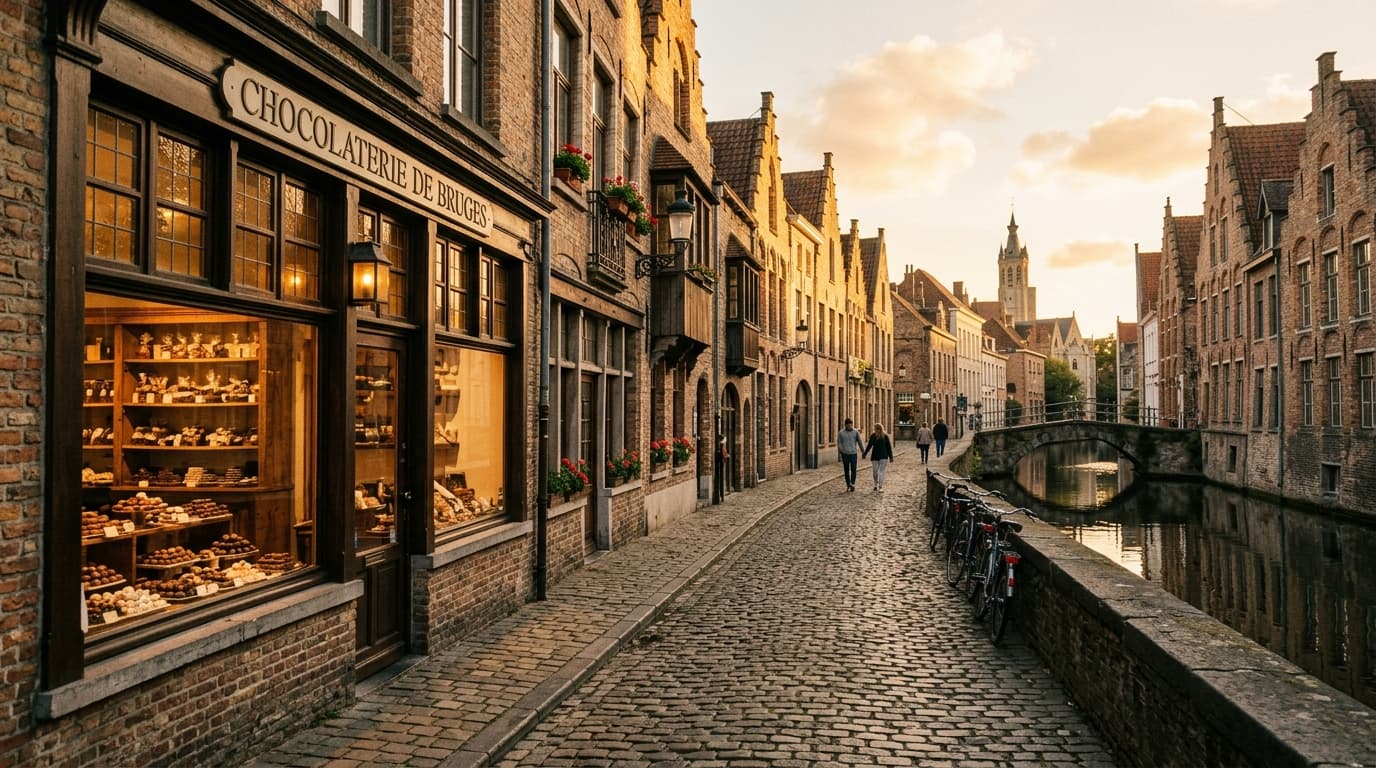
Choco-Story Brussels, at Rue de l'Étuve 41, is the exact opposite: small, central, three minutes from Manneken-Pis. The route was reworked in 2019 and ends with a praline demonstration in front of you, followed by a tasting. Expect about €11 booking direct — ticketing platforms easily climb to €16 or €18 for the same entry. Choco-Story Bruges plays in another league: four floors, audio guide, €14 for adults, open daily from 10 am to 6 pm with last tickets at 5 pm, plus combi-tickets with the Belgian fries museum and the diamond museum.
What does a visit cost and how long should you allow?
Between €8 and €19.90 per adult, and never more than 90 minutes. None of these museums eats a day: they are stops, not destinations.
| Museum | City | Adult | Duration | Tasting |
|---|---|---|---|---|
| Chocolate Nation | Antwerp | €19.90 | 60-90 min | 10 tastings |
| Choco-Story | Bruges | €14 | ~60 min | Yes, atelier on site |
| Choco-Story | Brussels | ~€11 direct | ~45 min | Yes, demonstration |
| Belgian Chocolate Village | Koekelberg | €8 | ~45 min | Yes |
| Defroidmont | Erezée | Modest entry | ~40 min | Adjoining shop |
Value per minute tips clearly towards Koekelberg. At €8 for three quarters of an hour, cocoa greenhouse included, Belgian Chocolate Village more than holds its own against a €19.90 ticket. That said, the Antwerp staging impresses an eight-year-old far more — and that is often the real criterion.
€19.90
Most expensive entry (Antwerp)
€8
Cheapest entry (Koekelberg)
10
Tastings at Chocolate Nation
Which chocolate museum works best with children?
Chocolate Nation if the budget allows, Belgian Chocolate Village otherwise. Both work, for different reasons.
In Antwerp, the route is built as a run of sensations: smells, sounds, machines, and a tasting every few rooms. A child never drifts off, because there's something to eat before boredom sets in. The family bill stings a little — €14.50 per child aged 4 to 11, on top of the adults.
In Koekelberg, entry drops to €5 for ages 6 to 18 and is free under 6, which changes the arithmetic of a family outing entirely. The tropical greenhouse with its living cocoa trees leaves a stronger mark on children than a cabinet of antique moulds. The museum closes on Mondays, opens at 9 am on weekdays and 10 am at weekends and during school holidays, with last entry at 5 pm.
Is Belgian Chocolate Village worth the detour?
Yes, and it's the most underrated of the lot. You just have to accept leaving the centre: Rue De Neck 20, in Koekelberg, next to the Basilica.
The building is half the charm. It's the former Victoria chocolate and biscuit factory, a name that still means something to older Brussels residents, converted into museum space. You follow the full journey, from the cocoa tree in a tropical greenhouse to the artisan atelier, tastings included. At €8 for adults, €7 for seniors and €6 per person for groups of twenty or more, it's the best content-to-price ratio in this selection. Entry is free with the Brussels Card.
The fair criticism: the museography has aged in places, and midweek attendance is sometimes so low that you visit alone. Some people hate that. Personally I love it — you actually get time to read the labels, which is impossible in Antwerp on a Saturday.
In Koekelberg you visit a former chocolate workshop. In Antwerp you visit a staging of chocolate. Both stand up, but they are not the same promise.
Is Defroidmont in the Ardennes worth the drive?
If you're passing through the province of Luxembourg, yes. As a destination in itself, no — unless you want precisely what the others don't give: to watch chocolate being made.
Chocolaterie Defroidmont has stood since 2000 at the edge of the Bois du Pays, in Erezée. Philippe Defroidmont comes from a family of bakers and pastry chefs active since 1926 and founded his Chocolatier des Ardennes in 1984. The museum covers, in about forty minutes with an audio guide in four languages, the route from bean to filled chocolate, with the family history as a through line.
The real reason to go is elsewhere: a glass-walled atelier lets you watch the chocolatier and his team at work, in real conditions. None of the other three offers that. At tasting, it's a frank Walloon artisan chocolate, less sweet than the tourist-window praline. A nature trail about birds and bees adjoins the chocolate shop, which settles the question of what to do with children afterwards.
What a museum cannot replace
None of these four will have you tasting the best Belgian chocolate. That's the blind spot of the format: a museum sells its own chocolate, always decent, never exceptional.
For finesse, you need to push open a chocolatier's door. Pierre Marcolini, on the Sablon, remains the Belgian bean-to-bar reference, the only great house selecting and roasting its own beans at that scale — a plain ganache square there says more about cocoa than any museum room. Neuhaus keeps the classic ballotin, inventor of the filled praline in 1912. The smart move is to chain them: Choco-Story in the morning, the Sablon in the afternoon. Our guide to the best chocolatiers in Brussels lists the addresses, and our comparison of which Belgian chocolatier to choose places each house.
Same logic in Antwerp: a Chocolate Nation visit runs naturally into our Antwerp chocolate itinerary, which gets you out of the station perimeter.
Which museum fits your profile?
The rule fits on one line: start from who's with you, not from the city you're in.
Family on a tight budget, Koekelberg. Family without budget constraints, Antwerp. Couple on a Bruges weekend, Choco-Story Bruges and its four-floor audio guide. Half-day stopover in Brussels, Choco-Story on Rue de l'Étuve, because centrality wins. Holidaying in the Ardennes, Defroidmont, for the glass-walled atelier. And if what you really want is to understand why this country became what it is in chocolate, our piece on why Belgian chocolate is famous does the job few museums do properly.
Not sure yet what kind of chocolate lover you are before booking? Test yourself with our chocolate quiz.
Itinéraires gourmands comparator
Compare all itinéraires gourmands side by side.
Compare now →
Frequently asked questions
Bruxelloise pur sucre, Margaux arpente les chocolateries belges depuis plus de dix ans. Ancienne pâtissière reconvertie dans le journalisme gourmand, elle goûte, compare et raconte le chocolat belge sans complaisance — des grandes maisons aux ateliers de quartier.