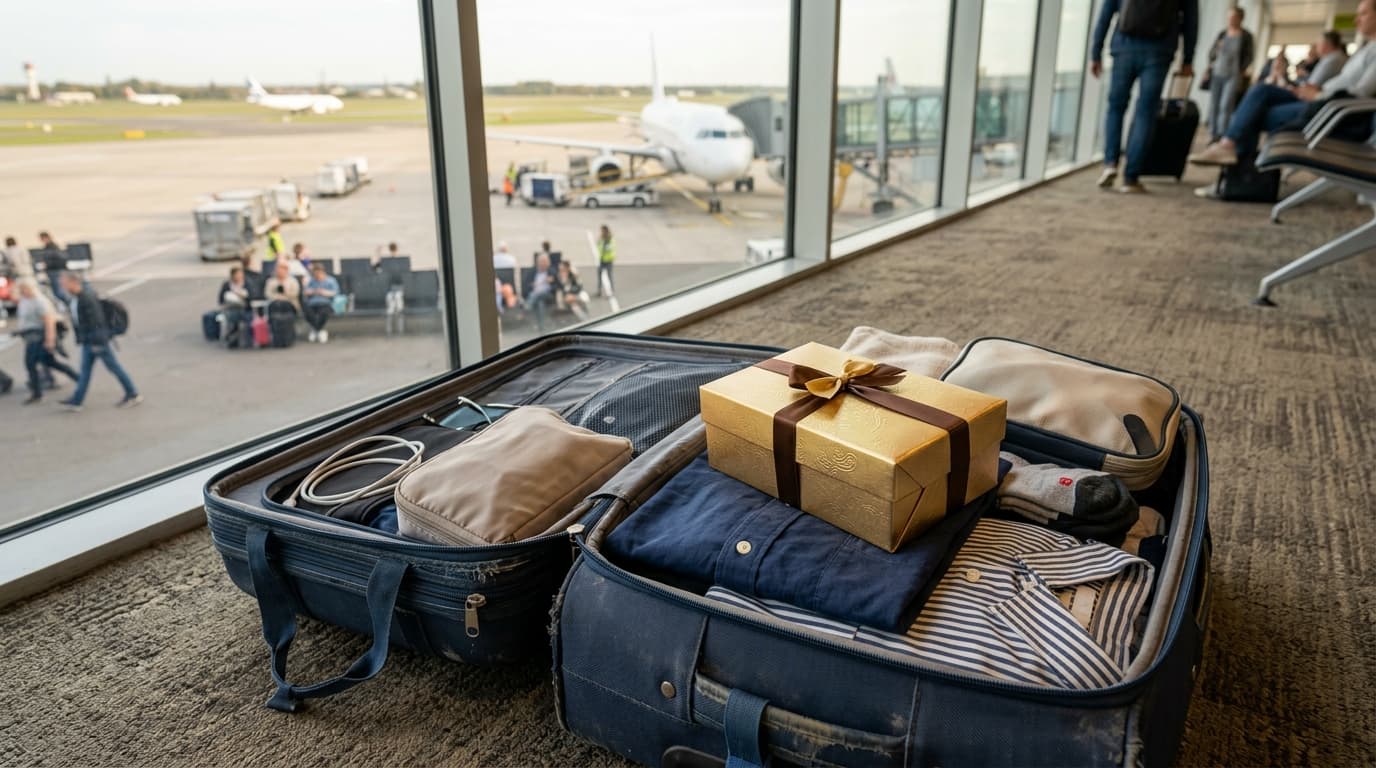
Solid chocolate travels in carry-on baggage, with no quantity limit, anywhere in Europe. The real questions are only three: what runs, what melts and what clears customs. Here is how to get a ballotin from Brussels to your kitchen without finding it welded to the paper.
Does chocolate pass in carry-on baggage?
Yes. Bars, pralines, mendiants, moulded figures, eggs: anything solid flies in the cabin with no maximum quantity.
The 100 ml rule only covers liquids, aerosols and gels, as the official Brussels Airport page on liquids and gels sets out. A 500 g ballotin, two bars and a tray of mendiants raise no issue at the checkpoint — the only real ceiling is the hand-baggage weight your airline allows.
Which Belgian chocolates count as liquids?
The ones you can spread or pour. That is the test security staff apply, and it catches a lot of travellers out as they empty their bag.
| Product | In the cabin | Why |
|---|---|---|
| Bar, praline, mendiant, moulded figure | No limit | Solid |
| Box of fresh pralines | No limit | Solid, even when filled |
| Chocolate spread, syrup, sauce | 100 ml max, in the transparent bag | Treated as a liquid |
| Mousse, cream, runny ganache in a pot | 100 ml max, in the transparent bag | Paste-like |
| Bottled chocolate liqueur | 100 ml max before the checkpoint | Liquid |
| Cool pack | Refused if soft or thawed | Gel |
That last case is the most common trap, and the most infuriating: you carefully wrap your ballotin in a cool bag with a gel pack, and it is the pack that ends up in the bin at security. A properly frozen, rock-hard block usually passes; the same block, softened after two hours of travel, is treated as a liquid.
Cabin or hold: the real trade-off
Cabin, almost always. But not for the reason people think.
You often read that the hold is freezing, or on the contrary that it climbs to 40 °C. Both are wrong in flight: the baggage compartments of airliners are pressurised and regulated, within a range that suits chocolate perfectly well. The danger is elsewhere. It is on the ground — on the tarmac of a Mediterranean airport in July, on a motionless cart, on an open-air belt, in a parked hold with the door open. Those twenty to forty minutes do the damage, and you have no say in them.
In the cabin, you keep control: bag under the seat, never in an overhead bin above a sunlit window, and air conditioning running from take-off to landing.
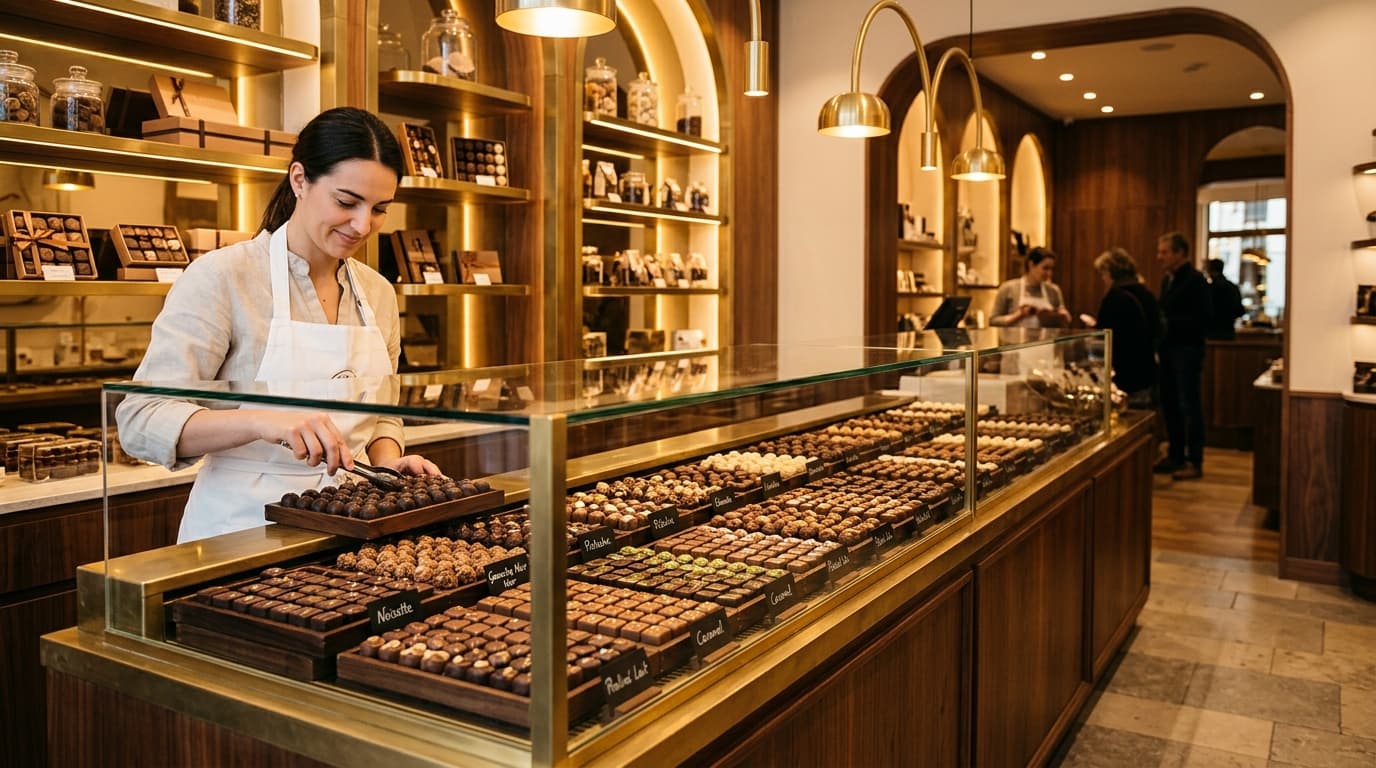
One honest caveat, though. If you are travelling with five kilos of chocolate for the whole family, the cabin will not do, and some of it will have to go in the hold. In that case, put the fresh pralines in the cabin and the bars in the hold: a bar that blooms is still good, a ganache that melted and set again is beyond saving.
How do you pack a ballotin for a summer flight?
Five steps, fifteen minutes, and nothing you don't already have at home.
- Buy as late as possible. The best insulation is the time you don't spend outdoors. A ballotin bought on rue au Beurre at 11 a.m. for a 3 p.m. flight has already won.
- Keep the original box and pack it tight. The Belgian ballotin is built to hold pralines snugly; it is the empty space around them that breaks them. A rolled-up sock in each corner does the job.
- Wrap the box in newspaper, then in bubble wrap. Newspaper insulates, bubble wrap absorbs shocks. Two layers are enough.
- Slide the whole thing into a soft cool bag, in the middle of your carry-on, surrounded by clothes. The centre of the bag is always the coolest point.
- On arrival, leave the box shut for two hours before opening it. Chocolate that warms up slowly does not bloom; chocolate taken from the cool straight into a 26 °C room gets covered in condensation, and that is when the sugar rises to the surface.
| Kit | What it does | What you get |
|---|---|---|
| Newspaper (3-4 sheets) | Thermal insulation | 2 to 3 h of delay on the temperature rise |
| Bubble wrap | Shock protection | Intact box, uncrushed pralines |
| Soft cool bag | Thermal barrier | 3 to 5 useful hours with no cold source |
| Hard-frozen gel pack | Cold source | Roughly double, but refused at security once soft |
| Rigid box | Anti-crush | Essential if the bag goes in the hold |
The mistakes that ruin a ballotin
The ones I see most often, and they all come down to the same thing: people protect against knocks, not against heat.
- Leaving the bag in a parked car while you have one last coffee — it is the cabin of the car, not the aircraft hold, that hits 50 °C.
- Buying the day before and leaving the box on the hotel windowsill.
- Putting the ballotin in the outside pocket of the bag, the one pressed against the taxi's bodywork.
- Choosing fresh ganaches for a long-haul flight with a stopover, when a praliné or a gianduja copes far better.
- Packing with an already soft gel pack, which cools nothing and will be confiscated at security anyway.
Can you take Belgian chocolate outside the EU?
Yes in almost every case, but two destinations need a word of explanation.
Within the Union, there is nothing to report: chocolate moves like any other product, with no formalities, as the Your Europe page on animal products carried by travellers summarises.
The United Kingdom changed the rules on 12 April 2025: it is now illegal to bring meat and dairy products from an EU country into Great Britain for personal use, a measure taken after foot-and-mouth outbreaks in central Europe. Belgian chocolate contains milk, so the question is a fair one — and the answer is reassuring. Chocolate and confectionery fall under composite products: they remain allowed as long as the milk they contain is processed and makes up less than half the product, as the UK government's Bringing food into Great Britain page specifies. A box of pralines passes. A box of fresh-cream truffles, much less so.
The United States admits chocolate without difficulty but requires a declaration: every food product must be listed on CBP form 6059B, duty-free included. Tick the box. A declared ballotin has never caused anyone trouble; a forgotten one during a random check certainly has.
Is it better to post your chocolate instead?
Sometimes, yes — and in summer, often. A parcel spends days in vans and unrefrigerated sorting centres, where a flight lasts three hours. But the Belgian houses know how to ship.
Checked on 22 August 2026 on their official pages: Neuhaus documents a cooled shipping method with insulated packaging and cold blocks during hot spells, and Leonidas warns in its FAQ that during heat alerts delivery dates may change, or that only express shipping stays available. In other words, the professional manages the cold chain better than your suitcase does, and commits to it contractually.
The rule I apply to myself: whatever has to arrive intact and on a set date goes through the house's online shop; whatever I want to hand over in person travels with me. A 250 g ballotin holds around twenty pralines — I weighed one from Leonidas in March 2026, twenty-one pralines averaging 11.9 g. That is exactly what fits in a cabin backpack without ever having to open the box in front of an officer.
Then there is calendar common sense: don't ship chocolate on a Thursday before a heatwave weekend, and avoid pick-up points, where a parcel can sit in a shop for days.
To decide what to bring back before you even think about transport, our guide to which Belgian chocolate to bring home sorts it by budget and recipient — and if you're buying at the last minute, everything happens at Brussels Airport. To work out which house deserves the space in your bag, start with our ranking of Belgian chocolatiers.
Où acheter comparator
Compare all où acheter side by side.
Compare now →
Frequently asked questions
Bruxelloise pur sucre, Margaux arpente les chocolateries belges depuis plus de dix ans. Ancienne pâtissière reconvertie dans le journalisme gourmand, elle goûte, compare et raconte le chocolat belge sans complaisance — des grandes maisons aux ateliers de quartier.